First Seen
2023-05-10T21:03:35+00:00
simple-description (llama3.2-vision_11b)
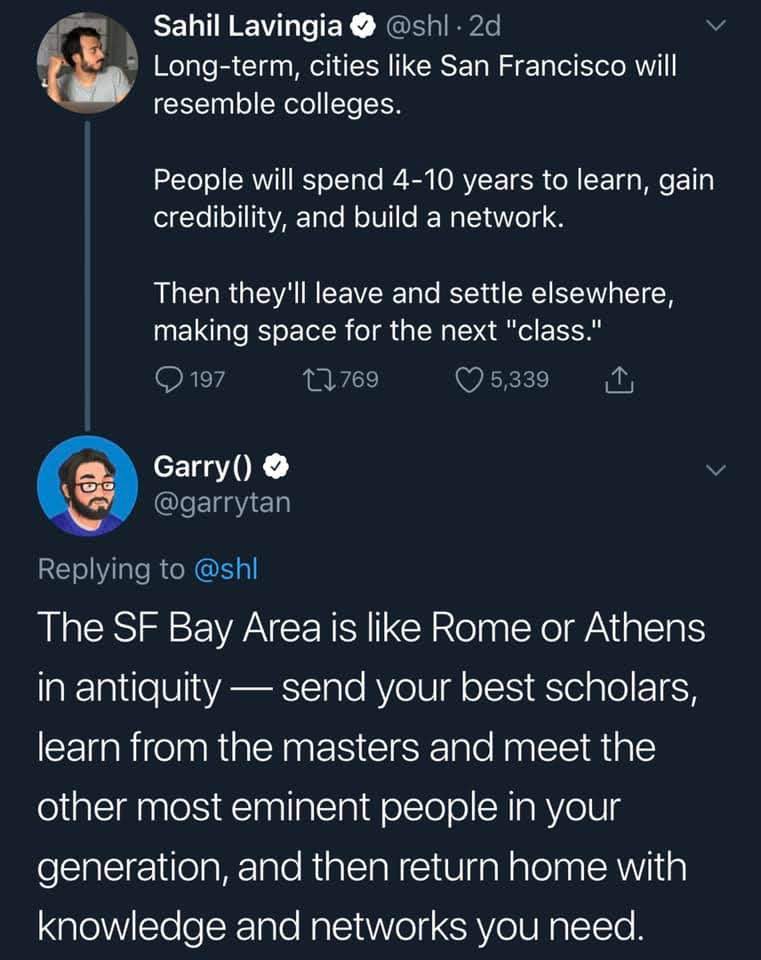
The meme is a humorous comparison between San Francisco and the ancient city of Rome or Athens in the context of leftism. It implies that San Francisco is like a city that has been around for thousands of years, with a long history of cultural and cultural heritage, and that it is now being compared to a city that has been around for thousands of years, with a long history of cultural and cultural heritage, and that it is now being compared to a city that has been around for thousands of years, with a long history of cultural and cultural heritage, and that it is now being compared to a city that has been around for thousands of years, with a long history of cultural and cultural.
detailed-analysis (gemma3-27b-vision)
Okay, let's break down this Twitter exchange through several theoretical lenses, keeping in mind that some lenses won't be as directly applicable as others. I will provide sections for each requested topic only if a substantial analysis is possible.
Visual Description
The image captures a Twitter conversation. Two user profiles are displayed, with accompanying usernames and profile pictures. The first user, Sahil Lavignia (@shl), posted the initial statement. The second user, Garry (@garrytan), replied directly to Sahil's post. The tweet includes engagement metrics – likes, retweets, and comments. The interface is typical of Twitter/X. The profiles appear to be of young men.
Foucauldian Genealogical Discourse Analysis
This exchange is strongly amenable to a Foucauldian reading. The core of the argument centers on knowledge, power, and the discursive production of subjects. Here's how:
- Discursive Formation: The claim that cities like San Francisco function as "colleges" isn’t literal; it's a discursive formation that constructs a specific way of thinking about urban spaces and their purpose. It’s not simply about education in a formal sense; it’s about the production of a particular type of subject – the networked, credentialed, globally-minded professional.
- Power/Knowledge: The “knowledge” gained in San Francisco isn't neutral. It's inherently tied to power. The credentialing and networking emphasized are mechanisms for accumulating social, cultural, and economic capital. This capital functions as a form of power, enabling individuals to navigate and succeed within specific social structures.
- Genealogy of the “Professional”: Tracing the genealogy of this "college" analogy might reveal how the idea of the urban center as a place of intellectual and professional accumulation has evolved. The comparison to Rome/Athens (see Garry's reply) is key. It suggests a continuity between ancient centers of learning and contemporary cities, positioning San Francisco as a modern-day inheritor of that legacy. This builds a narrative of certain cities as intrinsically valuable for creating the "best" individuals.
- Subjectivation: The exchange prescribes a path to subjectivation. Individuals go to San Francisco, learn, network, and then leave, becoming a particular kind of subject – a globalized, credentialed professional who carries that knowledge elsewhere. The system encourages a transient “talent pipeline.”
Critical Theory
This exchange lends itself to a reading through the lens of Critical Theory, specifically concerning the dynamics of modern capitalism and the reproduction of social hierarchies.
- Commodification of Knowledge: The “knowledge” gained isn’t presented as an end in itself, but as a means to an end - increased professional capital. This aligns with the Critical Theory concern with the commodification of all aspects of life under late capitalism. Knowledge, even “higher” learning, becomes a product to be acquired, utilized, and exchanged.
- Reification & Alienation: The entire process can be read as alienating. Individuals go to San Francisco not to live a fulfilling life, but to become a certain type of product. The place itself becomes instrumentalized – a means to an end, rather than a place for genuine connection or community.
- The "Creative Class" and Uneven Development: The argument implicitly supports the idea of a “creative class” that moves between cities, extracting value and leaving behind a hollowed-out local economy. This contributes to uneven development, where some cities become hubs for capital accumulation, while others are left behind.
- Cultural Capital & Social Reproduction: The emphasis on networking and building credentials speaks directly to the concept of cultural capital. Those with access to these networks (often those already privileged) are better positioned to succeed, perpetuating social hierarchies.
Marxist Conflict Theory
A Marxist analysis would view this exchange as highlighting the inherent contradictions of capitalism and the class dynamics at play.
- Exploitation of “Talent”: The "college" model suggests a form of exploitation. Individuals are investing significant time and resources (years of their life, financial capital) in a city that provides them with knowledge and connections. But this knowledge and these connections are not necessarily accessible to everyone, reinforcing class-based disparities.
- Mobility of Capital vs. Mobility of Labor: The exchange highlights the mobility of labor – individuals moving to access opportunities – while implicitly downplaying the mobility of capital. The underlying assumption is that capital will flow to where the “talent” is, rather than addressing systemic inequalities.
- The Reproduction of Class: By emphasizing networking and credentialing, the exchange reinforces existing class structures. Those with pre-existing social and economic capital are better positioned to benefit from the “college” model, while those from marginalized backgrounds are often excluded.
Postmodernism
A postmodern reading would focus on the deconstruction of traditional concepts of learning, place, and identity.
- Simulacra and Simulation: San Francisco is presented not as itself, but as a simulation of a university. It's a city acting as a place of learning, borrowing the characteristics of a college without necessarily embodying its core values. This aligns with Baudrillard's concept of simulacra, where signs and symbols have become detached from reality.
- De-centered Knowledge: The emphasis on leaving San Francisco suggests that knowledge is no longer tied to a specific place. It becomes a fluid, portable commodity that can be transferred anywhere. This challenges traditional notions of place-based knowledge and community.
- Fluid Identity: The transient nature of the “students” (those who come and go) suggests a fluid, fragmented identity. They are defined not by their connection to a place, but by their portable skills and networks.
Please note: These analyses are interpretations, and other readings are certainly possible. The richness of the exchange lies in its ability to be viewed through multiple theoretical lenses.
simple-description (llama3.2-vision)
This meme is a Twitter conversation between two users, Sahil Lavingia and Garry Tan. The conversation starts with Lavingia's comment on how cities like San Francisco will have colleges that resemble colleges in the past. Garry Tan responds with a sarcastic comment about the SF Bay Area being like Rome or Athens in antiquity, with a comment that has been liked by 5,339 people and has 769 replies.
tesseract-ocr
e . Sahil Lavingia @ @shl- 2d M4 ‘s Long-term, cities like San Francisco will ™ resemble colleges. People will spend 4-10 years to learn, gain credibility, and build a network. Then they'll leave and settle elsewhere, making space for the next "class." 0197 ~1769 0 5,339 “a Garry() @ iv @garrytan Replying to @shl The SF Bay Area is like Rome or Athens in antiquity — send your best scholars, learn from the masters and meet the other most eminent people in your generation, and then return home with knowledge and networks you need.