First Seen
2023-05-10T21:03:35+00:00
simple-description (llama3.2-vision_11b)
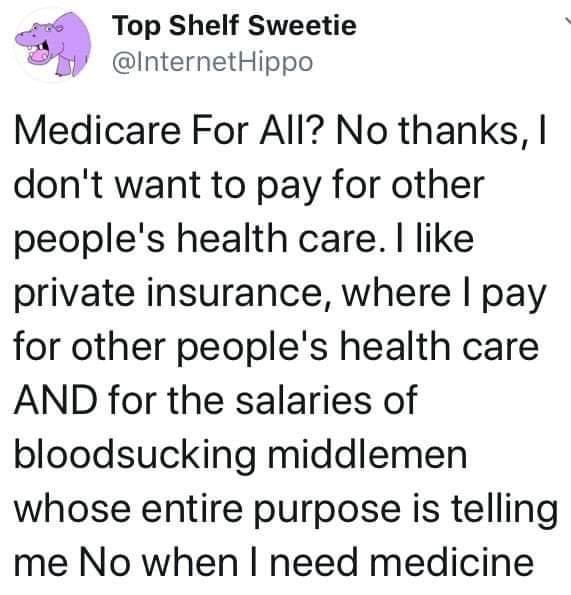
The meme is a satirical commentary on the topic of healthcare, specifically the popular "Medicare for All" policy. It pokes fun at the idea of a "Medicare for All" policy by saying that it's not just about healthcare, but also about the people who are not only getting the healthcare, but also the ones who are getting the money for it. The meme is trying to make a point that the people who are getting the money for the healthcare are not just the ones who are getting the healthcare, but also the ones who are getting the money for it, and it's not just the ones who are getting the money for it.
detailed-analysis (gemma3-27b-vision)
Okay, here's an analysis of the provided Twitter post, broken down into sections according to the headings you've requested, focusing on where those frameworks are relevant and skipping where they aren't. (Some of these, like Queer Feminist Intersectional Analysis, are not readily applicable to the surface content here and will be noted as such).
Visual Description
The image is a screenshot of a Twitter post. The profile picture for the account "@InternetHippo" shows a purple cartoon hippo. The username is "Top Shelf Sweetie". The text of the tweet is a direct expression of opposition to "Medicare for All," framed with sardonic commentary on private insurance. The font is standard Twitter text and appears against a white background. The visual elements are minimal, focused on text and the cartoon avatar, which likely contributes to the ironic tone of the message.
Foucauldian Genealogical Discourse Analysis
This post reveals interesting power dynamics as framed by Foucault. The writer’s opposition to Medicare for All isn’t simply a preference, but reflects an internalization of discourse surrounding individual responsibility and market-based solutions.
- Discourse of Individualization: The statement “I don’t want to pay for other people’s health care” is a perfect illustration of how the idea of personal financial responsibility has become deeply ingrained in the culture. This isn't a natural stance; it’s a product of decades of neoliberal rhetoric.
- The “Middleman” as Biopower: The characterization of insurance company employees as “bloodsucking middlemen” highlights the mechanisms of biopower. These individuals aren't simply processing claims; they are gatekeepers controlling access to life-sustaining resources. Their power stems from their ability to say "no," to dictate who receives care and when. This demonstrates how power is increasingly exercised through control over life itself.
- Genealogy of Neoliberalism: A genealogical examination would trace how the concepts of market-based healthcare, individual responsibility, and profit-driven insurance policies developed historically, ultimately becoming normalized as common sense. This tweet isn’t an isolated opinion; it's a symptom of a broader historical shift.
Critical Theory
The tweet is ripe for a critical analysis based on the Frankfurt School's ideas.
- Critique of Instrumental Reason: The focus on financial cost ("I don't want to pay...") over the fundamental human need for healthcare exemplifies a core tenet of critical theory: the dominance of instrumental reason. The writer prioritizes economic efficiency over ethical considerations and the common good.
- Commodification of Healthcare: The framing implicitly accepts healthcare as a commodity to be bought and sold, rather than a right. This is a key issue for critical theorists who critique the extension of market logic into all spheres of life.
- False Consciousness: The post can be read as an example of "false consciousness"—where individuals unknowingly support systems that are detrimental to their own well-being. The writer believes they are making a rational financial choice, but fails to recognize how the current system actively harms everyone, including themselves, through high costs, administrative waste, and denial of care.
Marxist Conflict Theory
This tweet is profoundly relevant to Marxist thought, specifically concerning class conflict and the role of ideology.
- Class Interest: The opposition to Medicare for All directly serves the interests of the capitalist class (insurance companies, pharmaceutical companies, healthcare providers who benefit from the current system). The tweet reinforces the ideology that protects their profits.
- Ideology & Hegemony: The statement "I don't want to pay for other people's health care" is an ideological construct. It's a way of justifying a system that produces enormous profits for a few while leaving many vulnerable. The acceptance of this statement as common sense contributes to the maintenance of capitalist hegemony.
- Exploitation & Surplus Value: The "bloodsucking middlemen" are directly involved in extracting surplus value from the healthcare system. Their salaries and profits represent a cost that could be used to provide care, but are instead diverted to private gain.
- Alienation: The post also hints at alienation. The writer views healthcare as a financial burden, rather than a shared responsibility. This detachment from collective well-being is a characteristic of alienated labor under capitalism.
Postmodernism
Postmodern analysis is less directly applicable here, but can offer some insights.
- Deconstruction of “Common Sense”: The post presents a seemingly straightforward opinion, but a postmodern reading would question the very foundations of that opinion. What does “paying for other people’s healthcare” even mean? How has that phrase been constructed to evoke specific emotions and associations?
- Hyperreality and Simulation: The tweet operates within a mediated reality—Twitter—where opinions are often performative and divorced from genuine lived experience. The statement is a simulation of a concern for personal finances, masking deeper structural issues.
Queer Feminist Intersectional Analysis
This framework is the least directly applicable. While healthcare access is a significant issue for LGBTQ+ individuals and women, and intersects with issues of class and power, the surface content of the tweet does not explicitly address gender, sexuality, or intersectionality. A deeper analysis could explore how the current healthcare system disproportionately harms marginalized groups, but this would require going beyond the text of the tweet itself.
Hopefully, this detailed breakdown provides the analysis you were looking for, organized by the requested theoretical frameworks. Let me know if you’d like me to elaborate on any specific point!
simple-description (llama3.2-vision)
The meme is a humorous response to the topic of healthcare and insurance. The text reads: "Medicare for all? No thanks, I don't want to pay for other people's health care. I like private insurance, where I pay for my own health care and the salaries of bloodsucking middlemen whose entire purpose is telling me I need to take a pill for something I don't need."
tesseract-ocr
Top Shelf Sweetie . S)) @lnternetHippo Medicare For All? No thanks, | don't want to pay for other people's health care. | like private insurance, where | pay for other people's health care AND for the salaries of bloodsucking middlemen whose entire purpose is telling me No when | need medicine