First Seen
2023-05-10T21:03:35+00:00
simple-description (llama3.2-vision_11b)
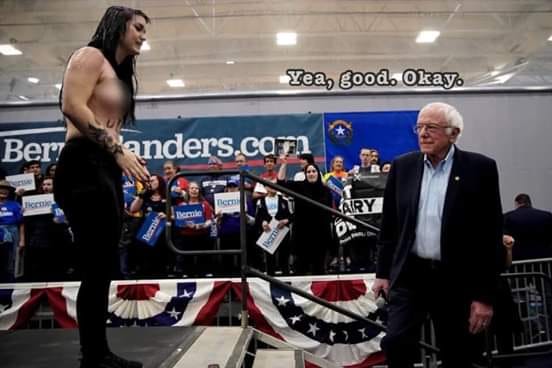
This meme is a play on the 2016 presidential campaign of Bernie Sanders, a left-wing candidate. The image shows a shirtless, tattooed man (Nathan … ) meeting with Bernie Sanders. The text "Yea, good. Okay." is superimposed above the meeting. The meme is meant to be humorous, poking fun at the idea that a left-wing candidate would be meeting with a tattooed, shirtless man. The image is meant to be humorous and satirical, rather than serious or accurate.
detailed-analysis (gemma3-27b-vision)
Here's an analysis of the image, broken down into the requested sections. Please note that the depth of analysis within each section will vary depending on the applicability of the framework. The situation depicted is sensitive and potentially exploitative, so I'll aim for analytical distance.
Visual Description
The image captures a moment at a Bernie Sanders campaign rally. Bernie Sanders is positioned on a raised platform, standing in a suit and appearing to address the crowd. In the foreground, and prominently positioned between the camera and Sanders, is a performer, a woman, doing a pole dance. She appears to be wearing minimal clothing. Behind them are signs and banners reading "Bernie" and the campaign website "Bernie.sanders.com". The crowd is visible, mostly blurred in the background. The lighting appears bright, typical of a rally environment. There is a banner above with the words "Yea, good. Okay."
Foucauldian Genealogical Discourse Analysis
The image powerfully demonstrates the construction of power relations through discourse. Foucault's genealogical approach asks us to examine how knowledge and power are linked, and how practices become "normalised" over time.
- Discipline & Control: The rally itself operates as a site of disciplined crowds and performances of political identity. The performer’s role as entertainment within this space is a curious imposition. It begs questions of control: who decided this was appropriate entertainment? Is she embodying a form of spectacle that simultaneously attracts and controls the audience, reinforcing pre-existing power dynamics?
- Visibility & Surveillance: The performer is positioned as spectacle—entirely visible and subject to the gaze of the crowd and now, through this image, a broader public. This is a form of surveillance, even if not overtly malicious. The image itself becomes part of the discourse, circulating and generating further interpretations.
- The Production of Norms: The inclusion of this form of entertainment at a progressive political rally challenges the "normal" expectations of what political events look like. It asks: what is appropriate behavior at a political gathering? This challenges, or potentially reinforces, norms around sexuality and its relation to political engagement.
Critical Theory
Applying a broadly Critical Theoretical lens (rooted in the Frankfurt School) allows us to question the underlying assumptions and structures shaping this event.
- Commodification of the Body: The performer's body is on display, functioning as a commodity within a political space. This is a key critique of late capitalism: the reduction of individuals to objects of consumption, even within seemingly progressive movements. The performer’s agency and well-being are secondary to the entertainment value.
- Culture Industry & Spectacle: The performer can be seen as an element of the "culture industry", producing a spectacle intended to entertain and distract. This distracts from the substantive political issues. Is the performance meant to attract a particular demographic? What messages are being communicated through the pairing of a political candidate with this type of entertainment?
- Alienation: The performer’s separation from her own agency and her reduction to an object for consumption can be seen as a form of alienation, a core concept in Marxist and critical thought.
Marxist Conflict Theory
From a Marxist perspective, the image reveals inherent conflicts within society and within the Sanders campaign itself.
- Class & Spectacle: The performer’s role highlights the class divisions embedded in entertainment and spectacle. Her labor is being exchanged for attention and potential political engagement, creating a dynamic where value is placed on her appearance and performance rather than her inherent worth.
- Ideology & Hegemony: The inclusion of this type of entertainment could be interpreted as an attempt to appeal to a certain demographic or to create a specific "brand" for the Sanders campaign. This raises questions about the manipulation of ideology to maintain or challenge existing power structures. Is this entertainment reinforcing certain societal norms or challenging them?
- Exploitation: The performer’s labor, even if consensual, operates within a broader system of exploitation where her body is commodified for profit or political gain.
Queer Feminist Intersectional Analysis
This framework, focused on the overlapping systems of oppression, provides a particularly critical lens for understanding the image.
- Sexualization & Objectification: The performer, presented in a sexually revealing manner, is subjected to the male gaze and is objectified. This reinforces harmful power dynamics and contributes to the normalization of sexual exploitation.
- Intersectionality & Power: The image raises questions about the intersections of gender, sexuality, and class. The performer’s labor and body are being exploited within a political space, and her experiences are likely shaped by these intersecting forces.
- Feminist Critique of the Public Sphere: Traditionally, the public sphere (politics, rallies) has been dominated by men. The inclusion of a hypersexualized performer, even with possible consent, can be seen as a continuation of this pattern—the female body used for male pleasure and political gain.
- Agency & Consent: The crucial question is about the performer’s agency and consent. Was she fully informed about the context of her performance? Was she fairly compensated? Without this information, it is difficult to assess the ethics of the situation.
Postmodernism
From a postmodern perspective, the image disrupts traditional notions of meaning and authenticity.
- Hyperreality & Simulation: The event, captured in the image, can be seen as a simulation of a political rally, where spectacle and entertainment are prioritized over substantive engagement.
- Deconstruction of Meaning: The unexpected juxtaposition of a progressive political candidate with a pole dancer challenges our expectations and deconstructs traditional notions of political messaging.
- Loss of Grand Narratives: The image undermines any sense of a unified political vision, suggesting that meaning is fluid and contingent.
Important Note: This analysis is based solely on the visual information presented in the image. A more complete understanding would require additional context about the event, the performer, and the intentions of the organizers. It is also important to approach this topic with sensitivity and respect for the individuals involved.
simple-description (llama3.2-vision)
This meme is a still image of a 2020 US presidential campaign event. Bernie Sanders, a white-haired, elderly man with a long, white beard, is standing in front of a crowd of people. He is wearing a suit and looking at a young, topless woman with long, dark hair, who is standing on a table. The text "Yea, good. Okay." appears above the image, suggesting that the woman's presence is not causing any concern or reaction from Sanders.
tesseract-ocr
i ) TEE Gb OLE — i aS : Ber7 anders.cay | Sy eR arc cae s, 7 5 Se eS AA