First Seen
2023-05-10T21:03:35+00:00
simple-description (llama3.2-vision_11b)
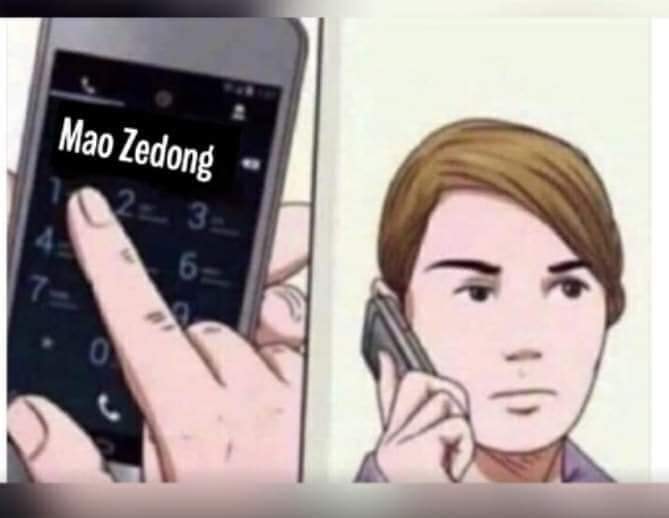
The meme is a screenshot of a phone screen with a phone number and a name "Mao Zedong" displayed on it. The image is likely used to humorously imply that someone is trying to call a famous historical figure, Mao Zedong, who is known for his role in Chinese politics, but the phone number is actually a typo and the name is actually "Mao Zedong" spelled as "Mao Zedong" is not a phone number and is actually a name.
detailed-analysis (gemma3-27b-vision)
Okay, let's break down this image with the requested analytical frameworks. It's a fairly complex image that lends itself to multiple readings.
Visual Description
The image appears to be a frame from an anime-style animation, presented against a very pale green background with a dark gray frame. The composition is split into two distinct areas.
On the left, a hand is shown interacting with a smartphone. The phone's screen displays a dialing pad, and the contact name "Mao Zedong" is prominently visible. The finger is in the act of pressing the number '1' on the phone.
On the right, a close-up portrait of a person with short brown hair and a neutral expression is depicted. They are holding a mobile phone to their ear, seemingly engaged in a call. The style is very flat, resembling a comic or manga. The image has a somewhat grainy and digitized quality. The presentation in a frame within a frame suggests it's part of a sequence.
Foucauldian Genealogical Discourse Analysis
This image is a fascinating subject for a Foucauldian reading. We can examine the discourses it evokes and how they relate to power structures.
- Discourses: The image collides several discourses: technology, political history (specifically, Maoist China), and personal communication. The pairing of the 20th-century political figure with modern technology immediately suggests a disruption of historical boundaries.
- Power/Knowledge: Foucault argues power and knowledge are inseparable. Here, the "knowledge" of Mao Zedong and his historical context is being deployed within the "power" structure of modern communication (the phone). The image asks us to consider who has the power to contact Mao now, and what that contact represents. The fact that it's a dialled contact suggests a potential reification or commodification of history – Mao becomes accessible as a data point.
- Genealogy: A genealogical analysis would trace the historical emergence of these elements. How did the figure of Mao become a symbol? How did smartphones become ubiquitous? Examining their separate histories, and then the contingent historical moment where they collide in this image, illuminates the arbitrary nature of their association and the power dynamics it implies.
Critical Theory
From a critical theory perspective (drawing on the Frankfurt School, especially), this image can be seen as an example of the culture industry's absorption and neutralization of potentially radical figures.
- Commodification of History: Mao Zedong, a complex and controversial historical figure, is reduced to a name on a phone screen – a contact. This represents the commodification of history and the flattening of nuanced political thought.
- Distraction and Passivity: The image suggests a shift from active political engagement to passive consumption. The act of simply having Mao Zedong as a contact does not necessitate any engagement with his ideology or the historical consequences of his actions. It becomes a superficial gesture.
- Reproduction of Ideology: By presenting Mao Zedong in this context, the image potentially reproduces a specific ideological narrative. Is it a critique? Is it a form of ironic appropriation? Regardless, it contributes to the ongoing discourse surrounding his legacy.
Marxist Conflict Theory
From a Marxist perspective, this image can be interpreted as a manifestation of the contradictions inherent in late capitalism.
- Alienation: The image could represent the alienation of political thought from its material conditions. Mao Zedong's revolutionary ideology is divorced from the historical context of class struggle and presented as a commodity within a technological framework.
- Capitalist Appropriation: The image appropriates a figure associated with anti-capitalist revolution and integrates it into a capitalist system (the smartphone). This reflects the capitalist tendency to absorb and neutralize opposition.
- False Consciousness: The image might induce a form of false consciousness, presenting a superficial understanding of Mao and his ideology, obscuring the underlying class conflicts and power dynamics.
Postmodernism
This image is deeply rooted in postmodern tropes.
- Pastiche & Intertextuality: The image is a deliberate juxtaposition of incongruous elements—a historical figure and modern technology. This creates a sense of pastiche, borrowing from different contexts and blending them in a playful and ironic way. The combination of the historical figure of Mao Zedong with the modern smartphone evokes a deliberate disruption of time and context.
- Simulacra & Simulation: The contact name "Mao Zedong" becomes a simulacrum – a copy without an original. It’s a representation of a representation, devoid of the historical figure’s actual presence or agency. The connection between the individual on the right and Mao becomes mediated and simulated.
- Deconstruction of Grand Narratives: The image challenges traditional narratives about history and political ideology. It undermines the idea of a linear progression of events and emphasizes the fragmented and subjective nature of knowledge.
Important Note: Without further context about the source of this image (where it comes from, what it's trying to convey), these readings are speculative but informed by the analytical frameworks. The image is open to multiple interpretations, and its meaning is constructed through the lens of the viewer and their understanding of the relevant discourses.
Let me know if you’d like me to elaborate on any of these points or explore additional analytical lenses.
simple-description (llama3.2-vision)
This meme features a character from a web comic or cartoon, who is shown holding a phone with a number pad on the screen. The phone displays the name "Mao Zedong" as the caller ID, which is a historical figure known for his role in Chinese politics. The character's expression suggests they are not pleased to receive a call from someone with a name that is likely to be associated with a very different type of person.
tesseract-ocr
as - Mao Zedong a \ | a s x oon / : : y ere re