First Seen
2023-05-10T21:03:35+00:00
simple-description (llama3.2-vision_11b)
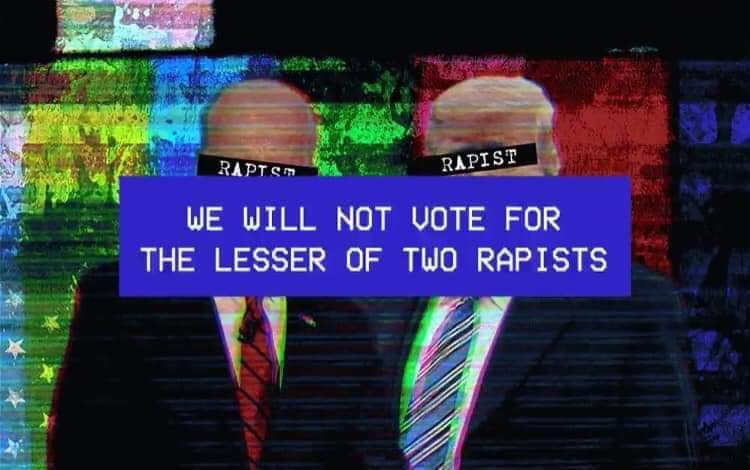
The meme is a satirical commentary on the political left's stance on sexual violence. It features a photo of two men in suits with their faces blurred out, with the words "rapist" written over their eyes. The text "We will not vote for the lesser of two rapists" is superimposed over the image, suggesting that both major political parties are equally responsible for perpetuating sexual violence. The meme implies that the left is not taking a strong enough stance against sexual violence, and that their support for one of the two major parties is complicit in this problem.
detailed-analysis (gemma3-27b-vision)
Okay, let's break down this image through the requested analytical lenses. Given the strongly political and emotionally charged content, several of the frameworks are very relevant.
Visual Description
The image is a digitally manipulated, striking visual statement. It depicts two figures visually resembling Donald Trump, mirrored and appearing as reflections, though the distorted and glitchy rendering suggests they aren't literal reflections. The rendering creates a strong visual effect of doubling and unreliability. Both figures are dressed in suits and ties, further hinting at a representation of political power.
The background is a chaotic wash of vibrant, saturated colors (red, blue, purple) with glitch effects akin to a degraded VHS tape. This contributes to an overall sense of unease and visual disruption.
Most prominently, superimposed over the figures and the background is bold white text: "WE WILL NOT VOTE FOR THE LESSER OF TWO RAPISTS.” Above each of the mirrored figures, the word "RAPIST" is prominently stamped.
Foucauldian Genealogical Discourse Analysis
This image can be powerfully analyzed through a Foucauldian lens, focusing on the creation and deployment of power/knowledge.
- Discourse & Power: The core message – "WE WILL NOT VOTE FOR THE LESSER OF TWO RAPISTS" – isn’t just an opinion; it constructs a discourse around political figures as inherently predatory. The very act of labeling candidates with a term like "rapist" isn't necessarily about proving specific acts (though the allusion to accusations against Trump is clearly present). It’s about establishing a truth regime wherein candidates are categorized by the potential for harm and abuse.
- Genealogy of "Rapist": A genealogical analysis would examine how the term “rapist” came to carry such weight, its historical connections to patriarchal power structures, and how it's been used to control and subjugate. In this context, it is applied to political figures.
- Disciplinary Power: The image suggests a rejection of the established political system, refusing to participate in what it deems a system that normalizes or protects abusive behaviors. It's a visual act of resistance.
- Subjectivation: By refusing to accept the “lesser of two evils” framework, the image promotes a different way of relating to political power – one where the boundaries of what is acceptable are radically redefined.
Critical Theory
The image aligns strongly with core tenets of Critical Theory, particularly the Frankfurt School’s focus on ideology and power dynamics.
- Critique of Instrumental Reason: The image rejects the rational calculations of political strategy (choosing the "lesser evil"). It suggests that such calculations legitimize harmful systems.
- Ideology & False Consciousness: It implicitly argues that the mainstream political discourse encourages a false consciousness, blinding people to the true nature of power and the prevalence of abuse within the system.
- Domination & Control: The image exposes how power operates not just through explicit acts of force, but through subtler forms of control, including the normalization of predatory behavior.
- Emancipatory Potential: By rejecting the existing political framework, the image gestures toward a vision of a more just and equitable society.
Marxist Conflict Theory
While not explicitly focused on economic class, Marxist principles can still be applied to analyze the image.
- Power Relations: The image highlights the power dynamics at play within the political sphere. The accusation of “rapist” suggests that political power is often built on exploitation and domination.
- Ideology as a Tool of Oppression: The "lesser of two evils" narrative can be seen as an ideological construct used to maintain the status quo and prevent meaningful change. It encourages acceptance of a system that perpetuates harm.
- Alienation: The image suggests a sense of alienation from the political process, as if it's beyond the reach of ordinary people and serves only the interests of the powerful.
- Revolutionary Impulse: The image's refusal to participate in the existing system can be seen as a revolutionary gesture, a rejection of the status quo and a call for radical change.
Postmodernism
Several aspects of the image align with postmodern thought:
- Deconstruction of Truth: The image challenges the notion of objective truth. By labeling candidates as “rapists,” it destabilizes the traditional categories of political discourse.
- Rejection of Metanarratives: The image rejects the idea that there is a single, overarching narrative that can explain or justify political power. It suggests that all narratives are contingent and constructed.
- Simulacra & Hyperreality: The digitally manipulated imagery and the glitch effects contribute to a sense of unreality. The image is not a direct representation of reality; it's a simulation of a simulation.
- Fragmentation & Disruption: The chaotic visual style and the deconstruction of language contribute to a sense of fragmentation and disruption. This reflects the postmodern condition of uncertainty and instability.
Queer Feminist Intersectional Analysis
This framework provides a particularly rich interpretation:
- Patriarchy & Sexual Violence: The core accusation of “rapist” directly addresses the systemic issue of patriarchal violence and the ways in which it is often normalized and excused.
- Intersectionality of Power: The image implicitly recognizes that power operates through multiple intersecting forms of oppression, including sexism, racism, and classism.
- Refusal of Complicity: The image represents a refusal to be complicit in a system that protects abusers and marginalizes survivors.
- Challenging the Binary: The rejection of the “lesser of two evils” framework can be seen as a challenge to the binary thinking that underpins patriarchal power structures. It suggests that there are alternatives to the existing system.
- Solidarity with Survivors: The image can be interpreted as an act of solidarity with survivors of sexual violence, creating a space for resistance and healing.
In conclusion, this image is a powerfully complex statement with layers of meaning. It can be analyzed through multiple theoretical lenses to reveal its critique of power, its challenge to established norms, and its call for radical social change.
simple-description (llama3.2-vision)
This meme features two images of Donald Trump with his face obscured by a "Rapist" sign, but with a modified text "We will not vote for the lesser of two rapists". The image is a satirical commentary on the 2016 US presidential election, where Trump and his opponent, Hillary Clinton, were both accused of sexual misconduct. The meme is a darkly humorous way to express the feeling of being forced to choose between two "rapists" in the election.
tesseract-ocr
eae 2 i Fie oh ca a = ai a Bi 3 a ee oes - * Av { a ( iin cy Char) a RAPIST ee a) Hen OU a ns ssl] a (=o ‘ IS