First Seen
2023-05-10T21:03:35+00:00
simple-description (llama3.2-vision_11b)
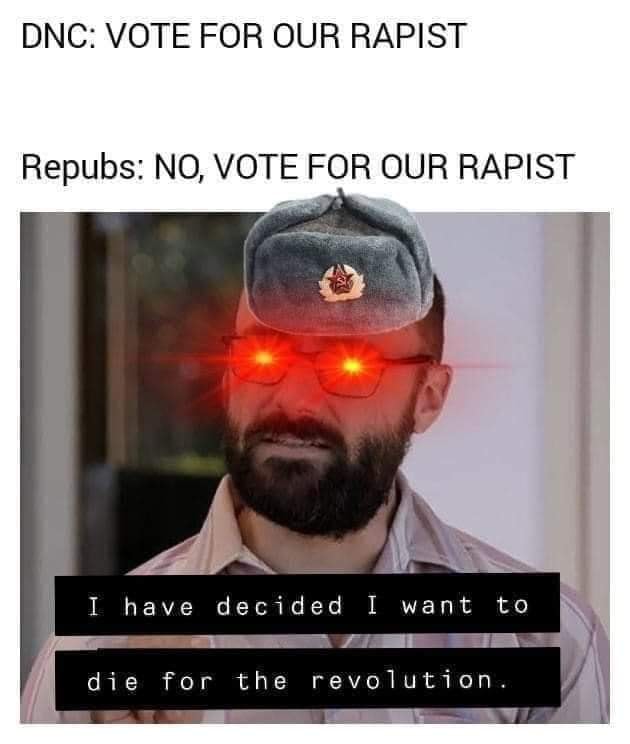
The meme is a satirical commentary on the political left's stance on the Democratic National Committee (DNC) and the Republican Party. It features a photo of a man with a red glow in his eyes, wearing a hat with a red star, and a quote that says, "I have decided I want to die for the revolution." The text above the image reads, "DNC: VOTE FOR OUR RAPIST" and "Repugs: NO, VOTE FOR OUR RAPIST," highlighting the perceived moral equivalence between the two parties. The meme suggests that both parties are equally corrupt and that the left is willing to overlook the actions of the DNC in order to maintain their power.
detailed-analysis (gemma3-27b-vision)
Okay, let's break down this image and its accompanying text through several theoretical lenses. Please be aware that interpreting memes is inherently complex and often relies on understanding subcultures and shared contexts. This analysis will be detailed, but not exhaustive.
Please note: The use of the term "rapist" in the text is deeply problematic and disturbing. This analysis will address it as a component of the message but does not condone or normalize the language. I will approach it as a signal of extreme political polarization and aggressive rhetoric.
1. Visual Description
The image depicts a man with a full beard wearing a baseball cap. His eyes are digitally altered to glow red. The image is framed within a meme format with text above and below. The text reads “DNC: VOTE FOR OUR RAPIST” and “REPUBS: NO, VOTE FOR OUR RAPIST.” Below the portrait, in a blacked-out rectangular box, are the words “I have decided I want to die for the revolution.”
The red eyes, combined with the text, create a highly charged and potentially violent visual. The meme aesthetic is used to present these messages in a way that's designed for rapid dissemination on social media. The use of blacked-out text gives it a clandestine and dramatic feel.
2. Foucauldian Genealogical Discourse Analysis
This meme is fascinating when viewed through a Foucaultian lens. Instead of asking "what is the truth?" Foucault asks "how did this 'truth' come to be?" and "what power relations are embedded within it?". Here's how it applies:
- Discourses of Power: The meme utilizes a discourse of extreme political polarization. The repeated accusation of "rapist" isn't necessarily about literal accusations (though that’s possible in the context) but functions as a signifier of ultimate moral corruption. It's a way of demonizing the "other side." This utilizes discourse to create an “us” vs “them” mentality.
- Genealogy of the Accusation: The meme's power lies in its tapping into a genealogy of accusations of corruption, predatory behavior, and power abuse leveled against politicians and political parties. The term "rapist" is a deliberate escalation of this rhetoric. It attempts to short-circuit rational debate and rely on visceral reaction.
- Normalization of Extreme Language: By framing the accusation as a "both sides do it" scenario (“DNC: VOTE FOR OUR RAPIST”/“REPUBS: NO, VOTE FOR OUR RAPIST”), the meme risks normalizing extreme and deeply harmful language. It presents political opposition not as a disagreement over ideology, but as a contest of monstrous evil.
- Subjectivity & Power: The phrase “I have decided I want to die for the revolution” reinforces the subject's willing submission to an ideology or cause. This highlights how power operates through the internalisation of beliefs and the construction of subjects who are willing to sacrifice themselves for a cause.
3. Critical Theory
From a Critical Theory perspective (drawing heavily on the Frankfurt School), this meme is indicative of the decay of reason and the rise of ideology.
- Instrumental Reason: The image displays a focus on outcome (winning the election) above any ethical considerations. The use of a deeply offensive term as a political tactic demonstrates an “instrumental” approach to reason – using any means necessary to achieve a goal.
- Culture Industry & Spectacle: The meme format itself is a product of the "culture industry," designed to be easily consumed and shared. It contributes to the spectacle of politics, where emotional outrage and dramatic accusations are prioritized over substantive discussion.
- Mass Manipulation & False Consciousness: The meme, with its inflammatory language, attempts to manipulate public opinion. It can contribute to the creation of a "false consciousness," where people are misled about the true nature of political power and their own interests.
- Loss of Enlightenment Values: The reliance on emotional appeals and demonization of opponents reflects a decline in Enlightenment values such as reason, dialogue, and respect for human dignity.
4. Marxist Conflict Theory
Seen through a Marxist lens, the meme illustrates a struggle for hegemony – the dominance of one social group over others.
- Class Struggle: While not explicitly about economic class, the meme reflects a broader struggle over power and control. The "DNC" and "REPUBS" represent different factions vying for dominance in the political sphere.
- Ideology & False Consciousness: As in Critical Theory, the meme can be seen as a tool for reinforcing dominant ideologies. By framing the political landscape as a choice between two "equally bad" options, it discourages critical thinking and reinforces the status quo.
- Superstructure & Base: The meme is part of the "superstructure" of society – the cultural and ideological institutions that reinforce the "base" (the economic system). It serves to maintain the existing power structures by creating divisions and discouraging collective action.
- Alienation: The meme's divisive rhetoric can contribute to a sense of alienation and disengagement from the political process. People may feel powerless to change the system and withdraw from participation.
5. Postmodernism
From a Postmodern perspective, this meme challenges the notion of objective truth and stable meaning.
- Simulacra & Simulation: The image is a "simulacrum" – a copy without an original. It's a representation of political discourse that has become detached from reality. The accusation of “rapist” may have little connection to actual events but functions as a symbol of moral decay.
- Deconstruction of Meaning: The meme "deconstructs" traditional political language by juxtaposing inflammatory terms with standard political branding ("DNC," "REPUBS"). This creates ambiguity and forces viewers to question the meaning of political discourse.
- Hyperreality: The meme exists in a "hyperreality" – a simulated reality that has become more real than reality itself. The constant barrage of political memes and social media posts can blur the lines between fact and fiction.
- Fragmented Narrative: The meme's fragmented nature (short text, bold accusations, red eyes) reflects the fragmentation of modern experience.
6. Queer Feminist Intersectional Analysis
This is the most difficult lens to apply directly, but important to consider, especially given the explicit accusation.
- Gendered Violence & Power: The accusation of “rapist” is deeply connected to gendered violence and the abuse of power. It’s crucial to recognize the harm and trauma associated with sexual violence and the ways in which it is used as a political weapon.
- Intersectionality: The meme's message reinforces a power dynamic where individuals are reduced to symbols of corruption. This overlooks the ways in which individuals are shaped by multiple intersecting identities (race, class, gender, sexuality, etc.) and the unique forms of oppression they face.
- Silencing of Victims: The casual use of the term "rapist" can contribute to the silencing of actual survivors of sexual violence. It trivializes the harm they have experienced and reinforces a culture of impunity.
- Deconstruction of Binary: The image disrupts the binary of victim/perpetrator, as it labels both political entities with the same extreme accusation, creating ambiguity and undermining the importance of addressing gendered violence.
In conclusion:
This meme is a complex artifact that can be interpreted through multiple theoretical lenses. It reflects a deep sense of political polarization, distrust, and cynicism. It challenges traditional notions of truth, reason, and morality. It is a product of the digital age, where information is fragmented, sensationalized, and easily disseminated. It is crucial to analyze such artifacts critically and to recognize the ways in which they contribute to the construction of meaning and the exercise of power.
Disclaimer: This analysis is based on the provided image and text and is open to interpretation. The theoretical lenses applied are not exhaustive, and other perspectives may be relevant.
simple-description (llama3.2-vision)
This meme is a humorous commentary on the 2020 US presidential election. The image depicts a person with a red, glowing, and angry-looking face, wearing a hat with a red star. The text "I have decided I want to die for the revolution" is overlaid on the image, referencing the infamous "I have decided I want to die for the revolution" quote from the 2000 film "The 2000s" (also known as "The 2000s" or "The 2000s" by the 2000s).
tesseract-ocr
DNC: VOTE FOR OUR RAPIST Repubs: NO, VOTE FOR OUR RAPIST Pe | I have decided I want to . OS ees ee) || die for the revolution. | = = 7 ——_ A ||