First Seen
2023-05-10T21:03:35+00:00
simple-description (llama3.2-vision_11b)
The meme is a screenshot of Bernie Sanders, a left-wing politician, with a quote "I don't know how to make it any clearer" and a caption "When you're trying to explain socialism to your grandma". The meme is poking fun at the idea that explaining complex left-wing policies to those who don't understand them can be frustrating and confusing.
detailed-analysis (gemma3-27b-vision)
Okay, let's break down this image of Bernie Sanders with analyses through various theoretical lenses.
Visual Description
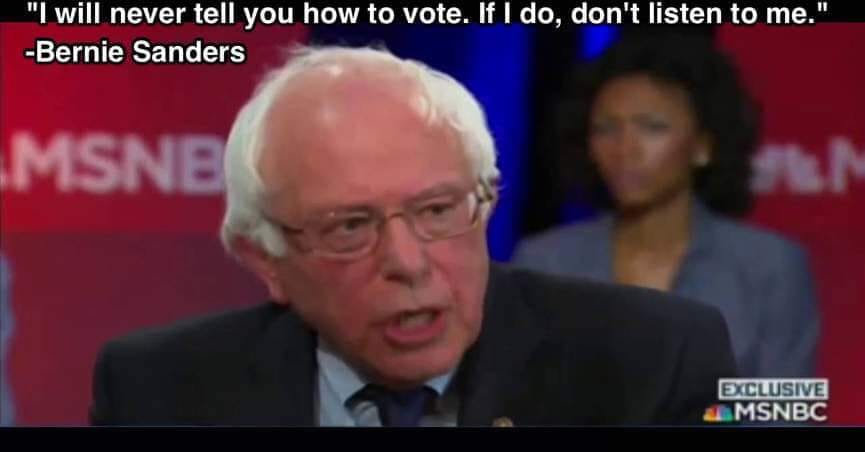
The image is a close-up shot of Bernie Sanders, likely from a television broadcast. He is speaking with a direct gaze toward the viewer, and his expression is serious. He is wearing a dark suit and tie, and eyeglasses. Behind him, slightly out of focus, is a person with dark hair who is partially cut out of the frame. The background is a deep red color, with the "MSNBC" logo visible in white. Text overlayed on the top left of the image states: “I will never tell you how to vote. If I do, don't listen to me.” A "MSNBC Exclusive" logo is in the bottom right corner. The image is cropped so we can only see part of the room he is in. It appears to be a professional media setting.
Foucauldian Genealogical Discourse Analysis
This image, coupled with the quoted statement, is ripe for Foucauldian analysis. The statement itself functions as a discourse about political authority and the relationship between leaders and followers.
- Power/Knowledge: Sanders' claim of not telling people how to vote seems to establish power through this very refusal. It positions him as a leader who respects autonomy, creating a specific type of relationship with his audience. This is not about absence of power, but a different exercise of it.
- Genealogy: Looking at the historical genealogy of this statement – how such refusals have been used throughout political history – might reveal that it’s a technique often employed by those seeking to appear anti-authoritarian while still maintaining considerable influence. It's a claim to a certain kind of virtue.
- Disciplinary Power: We might analyze how this statement shapes the subject – the voter – by encouraging self-regulation. It asks the voter to critically assess, and thus “discipline” themselves, by rejecting any attempts at direct instruction.
- Normalization: By claiming he won't tell people how to vote, it normalizes the idea that voters should be able to make informed decisions, and that to tell them how to vote is a breach of some implicit social contract.
Critical Theory
From a Critical Theory perspective (drawing on thinkers like Adorno & Horkheimer, or the Frankfurt School), this image and statement can be seen as engaging with the dynamics of ideology and emancipation.
- Ideology Critique: The statement challenges the traditional top-down model of political leadership, which relies on the transmission of directives. However, one could critique this as a subtle form of ideological operation: by appearing to reject authority, Sanders may strengthen his own legitimacy.
- Emancipatory Potential: The emphasis on individual decision-making could be interpreted as promoting a degree of autonomy and critical thought, potentially empowering citizens to resist manipulation.
- Culture Industry: This may also be viewed as an example of how politicians package themselves as authentic and relatable within the “culture industry” - shaping an image to appeal to the voter, but perhaps obfuscating deeper systemic issues.
Marxist Conflict Theory
From a Marxist viewpoint, the statement could be seen as reflecting a struggle over power within the political arena.
- Class Struggle: While not explicitly addressing class, the emphasis on individual agency could be interpreted as a way to depoliticize systemic issues related to economic inequality. Focusing on the voter’s individual choice might distract from the structural forces that shape those choices.
- Hegemony: The claim of non-instruction can be seen as an attempt to achieve hegemony, that is, to gain consent rather than coercion. It’s a way of presenting oneself as a leader who respects the will of the people, thus legitimizing their power.
- Superstructure: The broadcast setting, the MSNBC logo, and the politician all comprise aspects of the superstructure—the cultural and ideological forces that support the underlying economic base.
Postmodernism
A postmodern analysis might focus on the breakdown of grand narratives and the fluidity of power dynamics.
- Deconstruction: The statement can be "deconstructed" to reveal its inherent contradictions. The act of telling people not to be told how to vote is itself a form of instruction.
- Simulacra & Simulation: The image itself, as a mediated representation of Sanders, is a simulacrum – a copy without an original. It’s a constructed image designed to evoke a particular response.
- Rejection of Meta-Narratives: Sanders appears to reject the idea of a singular, authoritative voice telling people what to believe. This aligns with a postmodern rejection of grand narratives and universal truths.
Queer Feminist Intersectional Analysis
This is the least directly applicable lens, but a queer feminist intersectional reading could be attempted.
- Power Dynamics: The statement appears to level the playing field, granting the voter agency. However, the context of political power inevitably includes the historical and ongoing marginalization of various groups (women, LGBTQ+ individuals, people of color, etc.). This statement could, unintentionally, obscure how unequal power dynamics continue to shape voting decisions for those who are already disadvantaged.
- Representation: We could question who is being represented through this statement. Does it reflect the experiences of all voters, or does it privilege the perspective of a particular demographic?
- The Gaze: The direct gaze of Sanders, while appearing empowering, might also be analyzed through the lens of the “male gaze” - how power dynamics influence how we perceive and interpret imagery.
I hope this multi-layered analysis is helpful! Let me know if you'd like me to delve deeper into any particular theoretical perspective.
simple-description (llama3.2-vision)
This meme features a photo of Bernie Sanders with a quote from him. The image is a still from a TV interview where Sanders is speaking. The quote is from a 2017 interview on MSNBC's "The Rachel Mad In The
tesseract-ocr
"L will never tell you how to vote. If | do, 3 listen to me." -Bernie Sanders ¥ - S - 7 y f | cd ei. Eis ome