First Seen
2023-05-10T21:03:35+00:00
simple-description (llama3.2-vision_11b)
The meme is a humorous critique of leftism, specifically the tendency to prioritize ideological purity over pragmatism and nuanced understanding of complex issues. The image depicts a person holding a sign that says "Leftism is a religion" and "You will be offended" with a "trigger warning" icon, implying that leftists are overly sensitive and self-righteous.
detailed-analysis (gemma3-27b-vision)
Okay, here's an analysis of the image broken down into sections based on the theoretical frameworks you requested. It's important to note that these frameworks often overlap and inform one another, so there will be some interconnectedness.
Visual Description
The image is a two-panel cartoon with stark, simple line drawings on a gray background.
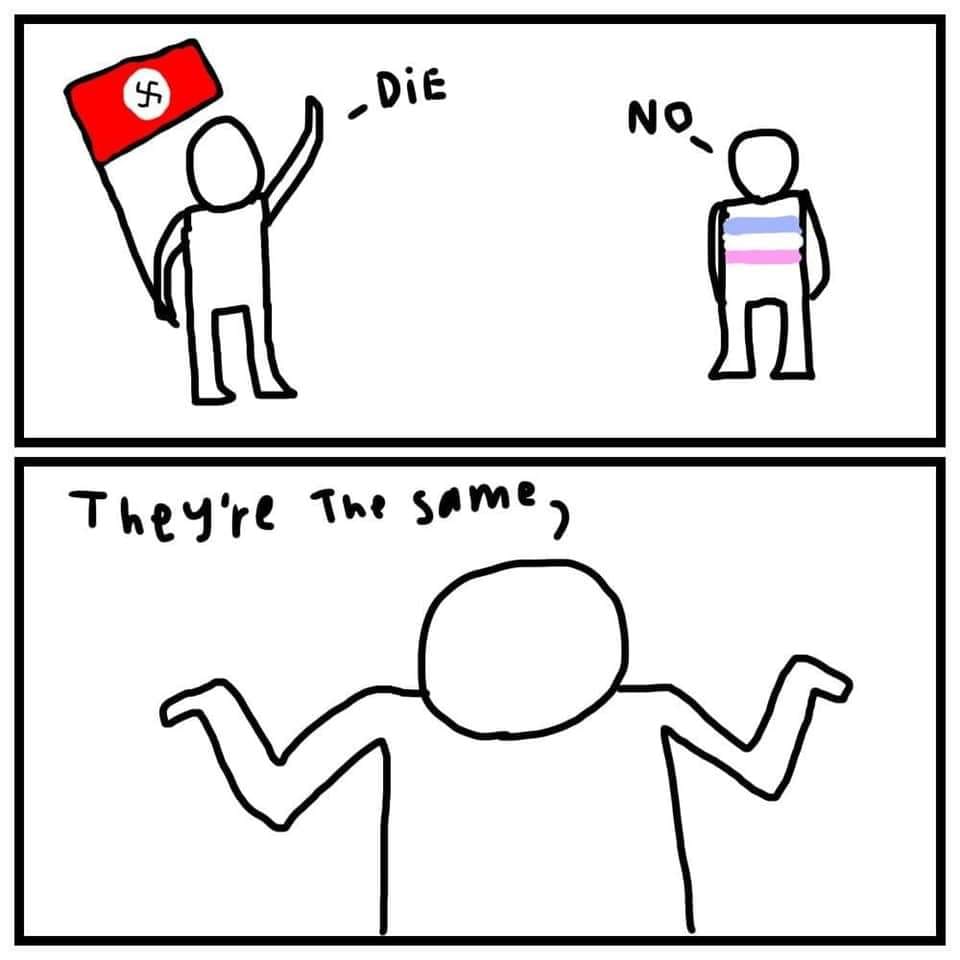
- Panel 1: Depicts two stick figures facing each other. The figure on the left is holding a flag with a swastika on it. A speech bubble above it reads “DIE”. The figure on the right is wearing the colors of the trans flag and has a speech bubble saying "NO".
- Panel 2: Shows the two figures merged into one, forming a somewhat distorted, ambiguous shape. Above this, handwritten text reads: "They're the same".
The style is purposefully rudimentary, emphasizing the symbolic weight of the content over aesthetic detail. The starkness contributes to the directness of the message.
Queer Feminist Intersectional Analysis
This image is deeply rooted in current political and cultural debates around hate speech, identity, and the connections between various forms of oppression.
- Equating Oppressions: The core claim—"They're the same"—is provocative. It draws a parallel between the historical violence of Nazism and the contemporary targeting of transgender individuals. This equivalence is controversial, as the scale and context of these oppressions differ dramatically. However, the cartoon suggests that the structure of the hate is similar—both target marginalized groups based on identity, with the goal of dehumanization and ultimately, violence.
- Transgender Exclusion & Dehumanization: The image highlights the rising tide of anti-trans legislation and rhetoric that equates transgender existence with a threat to societal norms. This rhetoric often frames transgender individuals as dangerous, predatory, or morally corrupt, echoing the dehumanizing language used by the Nazis.
- Intersectional Framing: A queer feminist intersectional analysis underscores that oppression is not monolithic. The image points to the interconnectedness of various forms of oppression, including fascism, transphobia, and potentially other marginalized identities not explicitly depicted.
- Critique: This cartoon engages with the challenge of how to discuss the relative harms of different oppressive systems. While some criticize equating oppression as minimizing the horrors of the Holocaust, others argue that recognizing the shared logic of dehumanization is crucial for building solidarity and combating all forms of hate.
Critical Theory
The image strongly evokes themes central to Critical Theory, particularly the Frankfurt School's work on the "instrumentalization of reason" and the dangers of ideology.
- Dehumanization as a Tool of Power: The image illustrates how ideologies like Nazism and transphobia operate by stripping targeted groups of their humanity. This dehumanization is not merely prejudice; it's a crucial step toward justifying violence and oppression.
- The Logic of Domination: The cartoon implies that the underlying logic driving both Nazism and transphobia is the same: a desire to maintain social order and power by identifying and eliminating perceived threats to the dominant group. This echoes Adorno and Horkheimer's critique of the "dialectic of enlightenment" – how reason, when divorced from ethics, can be used for domination.
- The Production of the "Other": Both scenarios involve the creation of an "Other"—a group defined as different and dangerous—that is then subject to discrimination and violence. The image suggests that the mechanisms of "Othering" are remarkably consistent across different forms of oppression.
- Cultural Critique: The cartoon is a form of cultural critique, aiming to expose the hidden connections between seemingly disparate forms of prejudice and violence.
Foucauldian Genealogical Discourse Analysis
Michel Foucault’s concept of genealogy can be applied to understand how both Nazism and transphobia emerge as discourses within specific historical contexts.
- Discursive Construction of "Deviance": Foucault argued that concepts like "madness" or "criminality" aren’t inherent qualities but are constructed through discourse. Similarly, the cartoon suggests that both Nazism and transphobia rely on constructing certain identities as "deviant" or "abnormal."
- Power/Knowledge: Foucault's concept of power/knowledge is central. Both Nazism and transphobia are sustained by systems of knowledge that legitimize and justify discrimination. This knowledge isn't necessarily "true" but is produced and circulated through institutions, media, and social norms.
- Genealogy as Uncovering Discontinuities: A genealogical approach would focus on tracing the historical development of both Nazism and transphobia, not to find a single origin, but to reveal the contingent and discontinuous ways in which these discourses emerged.
- The Body as a Site of Control: Both ideologies attempt to regulate and control bodies – Jewish bodies in the case of Nazism, and transgender bodies in the case of transphobia. This control is achieved through various means, including violence, legal restrictions, and social exclusion.
Marxist Conflict Theory
While not the most central framework, a Marxist perspective can offer some insights.
- Oppression as a Tool of Class Control: From a Marxist perspective, the image could be seen as highlighting how ideologies like Nazism and transphobia serve to divide the working class and prevent solidarity. By targeting marginalized groups, the ruling class can deflect attention from systemic inequalities and maintain its power.
- Scapegoating: Both scenarios involve scapegoating—blaming a marginalized group for societal problems. This can serve to unite the dominant group and divert attention from the root causes of inequality.
- Ideology and False Consciousness: The image suggests that both Nazism and transphobia are forms of ideology that distort reality and perpetuate false consciousness. They obscure the underlying economic and social structures that contribute to inequality.
Postmodernism
A postmodern reading would focus on the breakdown of grand narratives and the fluidity of identity.
- Deconstruction of Categories: The image challenges fixed categories of identity. By equating Nazism and transphobia, it suggests that the boundaries between different forms of oppression are more fluid and permeable than we often assume.
- Rejection of Universal Truths: Postmodernism rejects the notion of universal truths or objective standards of morality. This perspective would emphasize the constructed nature of both Nazism and transphobia, as well as the subjectivity of experience.
- The Simulacrum: One could argue that the image represents a "simulacrum"—a copy without an original—where the distinction between different forms of oppression becomes blurred.
Important Note: This is an interpretive analysis, and different readers may come to different conclusions. The image is deliberately provocative and open-ended, inviting debate and critical reflection.
simple-description (llama3.2-vision)
This meme is a simple comic strip that compares the differences in how people react to the deaths of Adolf Hitler and Anne Frank. The top panel shows a person holding a Nazi flag, shouting "Die!" (a play on the German word for "die"), and another person responding with "No!" The bottom panel shows the same person, now with a rainbow flag, and the same response, "They're the same!" The text emphasizes the absurdity of equating the deaths of two people with vastly different backgrounds and experiences.
tesseract-ocr
vie NO T ‘ )