First Seen
2023-05-10T21:03:35+00:00
simple-description (llama3.2-vision_11b)
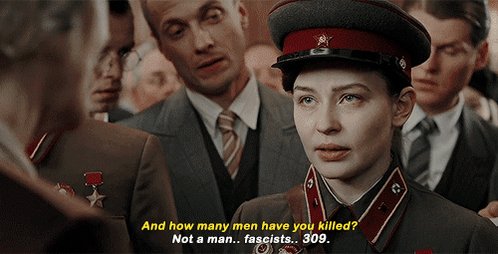
The meme is a screenshot of a movie scene from "The Interview" (2014) where James Franco's character, Dave Skylark, is being interviewed by a North Korean journalist. The meme shows a shocked expression on Franco's face with the caption "I'm not a fan of the left" written in a mock-up of the movie's font. The image is a play on the movie's satirical tone, poking fun at the idea that a celebrity would be asked about their politics in a real interview.
detailed-analysis (gemma3-27b-vision)
Okay, let's break down this image and the text accompanying it through several theoretical lenses.
Image Description:
The image appears to be a still from a film, likely set in the mid-20th century, based on the clothing and style. The focus is on a woman in a Soviet-style uniform, complete with a peaked cap adorned with insignia and medals. Her expression is stern, focused, and potentially confrontational. She is likely addressing someone off-screen. Surrounding her are a number of men, all in suits, presumably a panel or audience. Their expressions range from attentive to skeptical and, in some cases, disapproving. The color palette is muted, predominantly dark reds, browns, and grays, contributing to a sense of formality and potentially severity. The text overlay reads: "And how many men have you killed? Not a man...fascists...309."
Foucauldian Genealogical Discourse Analysis
This image and phrase provide fertile ground for Foucault's Genealogical analysis. Here's how:
- Power/Knowledge: The question "How many men have you killed?" isn't a simple request for information. It is a disciplinary act. It seeks to establish power through the categorization of lives. The woman is attempting to define who counts as a person worthy of moral consideration. By dismissing the killed as "not men...fascists," she constructs a justification for violence and asserts her own power. It suggests a system of thought where some lives (those deemed "fascist") are less valuable and therefore disposable.
- Discourse & Truth: The statement is an example of how 'truth' is constructed through discourse. The woman is creating a narrative that legitimizes her actions and the actions of those she represents. She's defining a specific historical and political context where killing "fascists" is not considered murder, but an act of righteousness. The discourse serves to normalize violence.
- Genealogy of Morality: A genealogical approach might explore how the concept of "fascist" became synonymous with dehumanization. What historical events, social forces, and rhetorical strategies contributed to the construction of this category, and thus, the justification for killing based on it? Foucault would investigate how the concept of “the enemy” emerged and was used to legitimize violence.
Critical Theory
This image deeply aligns with core tenets of Critical Theory, especially those related to ideology and power dynamics.
- Ideology & Justification of Violence: The woman’s statement represents a clear example of ideological justification for violence. She is presenting a specific worldview that positions "fascists" as enemies of the people. This allows for the normalization of killing as a necessary act to uphold the desired political order.
- The “Other” & Dehumanization: By labeling the killed as “not men…fascists,” the woman engages in a process of othering. This dehumanization allows her to distance herself and her group from the moral implications of taking lives. The “other” becomes something less than human, thereby removing any moral obligation toward them.
- Power Structures & Legitimization: The woman's position of authority (implied by her uniform and the setting) is crucial. She embodies the power of the state to define morality and justify violence. The men surrounding her could be interpreted as representatives of a system that upholds and legitimizes this ideology.
- Frankfurt School connection: This image recalls the concerns of the Frankfurt School regarding the instrumentalization of reason and the dangers of ideology, particularly those tied to totalitarian regimes.
Marxist Conflict Theory
From a Marxist perspective, this image illustrates the inherent conflicts within class struggle and political ideology.
- Class Conflict & Ideological Warfare: The underlying conflict is likely rooted in a broader historical struggle between competing ideologies (Communism vs. Fascism). The statement is a manifestation of that conflict, where dehumanization is used as a weapon to mobilize support and justify violence.
- State Apparatus & Violence: The woman, as a representative of the state (implied by the uniform), wields the power of violence to suppress opposing classes. The statement itself is a demonstration of that power – the ability to define the enemy and mandate their elimination.
- False Consciousness: While not explicitly present in the image, one could argue that the men surrounding her are either complicit in the ideology or operating under “false consciousness,” accepting the narrative presented without critical examination.
- Material Conditions: It is essential to remember that these ideological conflicts are often rooted in material conditions – the struggle for resources, power, and control.
Postmodernism
A postmodern reading would focus on the deconstruction of grand narratives and the instability of meaning.
- Deconstruction of Truth: The image challenges the notion of objective truth. The woman’s statement implies that ‘truth’ is subjective and contingent on ideological positioning. What constitutes a "man" is being redefined based on political allegiance.
- Discourse & Representation: A postmodern analysis would emphasize how language and representation shape our understanding of reality. The term "fascist" is not a neutral descriptor, but a socially constructed label that carries ideological baggage.
- Fragmentation of Meaning: The statement itself is fragmented and incomplete. The dismissal of the killed as "not men" creates a dissonance that highlights the instability of meaning.
- Rejection of Metanarratives: The image undermines the idea that there is a single, overarching narrative that can explain the world. It suggests that history is contested and that different groups have different interpretations of events.
Queer Feminist Intersectional Analysis
While not immediately apparent, an intersectional analysis (using Queer and Feminist lenses) could highlight underlying power dynamics.
- Gender & Power: The fact that the woman is in a position of authority within a potentially patriarchal context (Soviet/Communist state) is notable. She’s challenging gender norms by occupying a traditionally male space, but she’s also exercising power in a way that perpetuates violence, even if it is against an opposing ideology.
- Dehumanization & Marginalization: Dehumanization is a common tactic used to justify violence against marginalized groups. The dismissal of the killed as "not men...fascists" parallels the ways in which other groups are dehumanized based on their gender, sexuality, race, or other social categories.
- Violence & Patriarchy: The image hints at the connection between violence and patriarchal structures. While the woman is acting within a political context, her actions are still rooted in a system of power that historically prioritizes male dominance.
- Intersectional Oppression: Examining the context of the setting, one might consider how other forms of oppression (based on race, class, ethnicity, etc.) intersected with the conflict between Communism and Fascism.
Let me know if you'd like me to elaborate on any of these analyses or explore other theoretical frameworks!
simple-description (llama3.2-vision)
This meme is an image from the 2017 film "The Darkest " in which a character, played by actress , is asked how many men she has killed. The image is a still from the movie, with the character's response, "And how many men have you killed? Not " written in yellow text at the top of the image.
tesseract-ocr
‘ we ¢ a “aS 5 a ‘ * z ‘ 5 » = . se ie: > ae r ef - % fox ae y h\ JA a Pp yj “ FS rN at) Va ee re ae