First Seen
2023-05-10T21:03:35+00:00
simple-description (llama3.2-vision_11b)
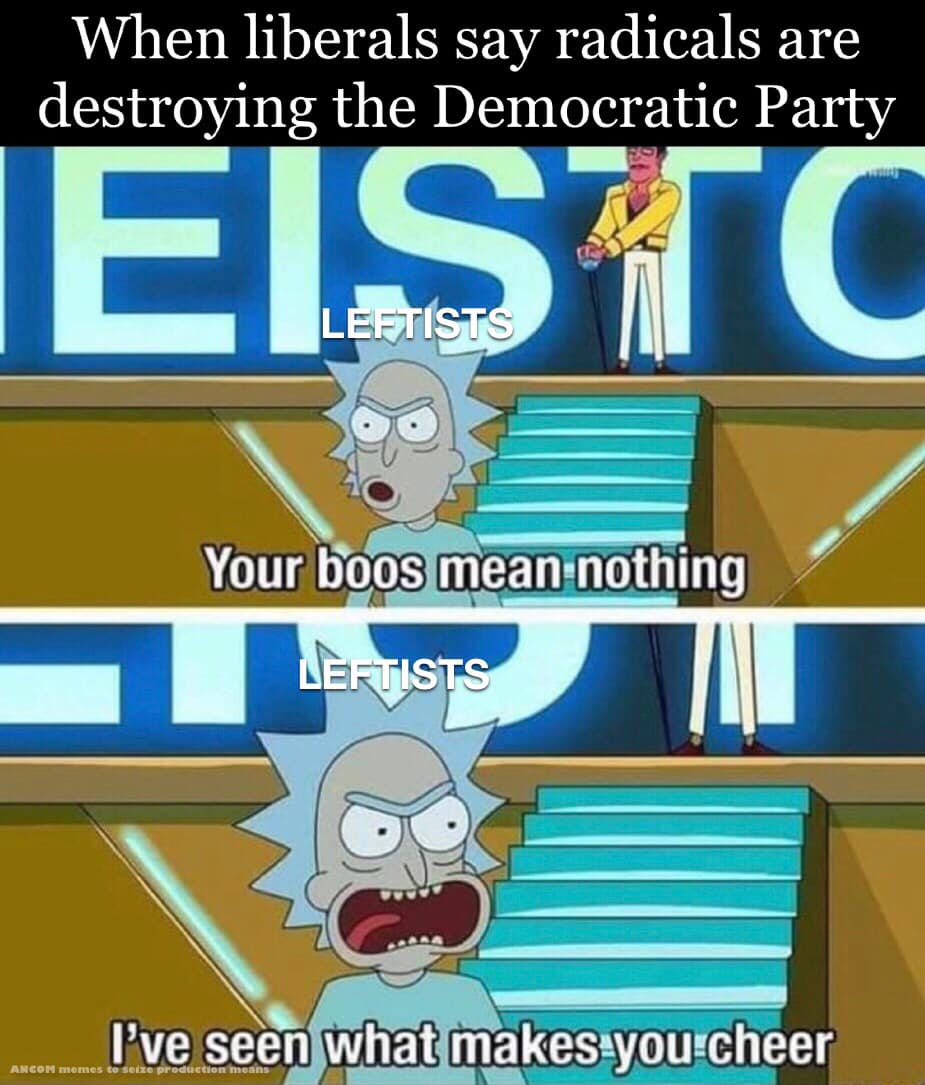
The meme is a humorous take on the stereotype that leftists are overly sensitive and quick to take offense. The image depicts a person with a shocked expression, captioned "when you finally understand the nuance of a left-wing argument" and "when you realize you've been arguing with a troll the whole time". The meme pokes fun at the idea that leftists are often perceived as being overly emotional or easily offended, and that they can be easily swayed by opposing viewpoints.
detailed-analysis (gemma3-27b-vision)
Okay, let's break down this meme using the requested theoretical frameworks. It's a complex image and meme format, so each section will be correspondingly detailed.
Visual Description
The meme utilizes a screen capture from the animated television series Rick and Morty. It depicts Rick Sanchez, a cynical scientist, standing on a stage with blue stadium seating and a large blue backdrop emblazoned with the word "LEFTISTS" in large, white capital letters. He is shouting into a microphone, appearing distressed or angry. Text overlays are present:
- Top text: “When liberals say leftists are destroying the Democratic Party.”
- Middle text (over the "LEFTISTS" backdrop): "Your boos mean nothing."
- Bottom text: "I've seen what makes you cheer."
The meme's impact relies on the show’s established character—Rick’s dismissive, nihilistic attitude—and the contrast between the stadium setting which suggests a rally/protest, and Rick's blatant disregard for the audience's reaction.
Foucauldian Genealogical Discourse Analysis
This meme engages with power dynamics and the construction of 'leftist' identity through discourse. A Foucauldian approach would not focus on the ‘truth’ of whether leftists are destroying the Democratic party, but rather on how that narrative is constructed and what power relations it reinforces.
- Discourse: The meme participates in a specific discourse surrounding the Democratic Party's internal conflicts—specifically, the tension between moderate liberals and more radical leftist factions. It’s a discourse about political strategy, legitimacy, and the “correct” path forward.
- Power/Knowledge: The meme implicitly positions Rick (and therefore, the creator) as holding a certain knowledge, a cynical understanding of what motivates political actors. The message is that the audience’s (liberals’) reactions—their “boos” of leftists—are superficial, driven by unseen forces. This is a power play—asserting a superior level of insight.
- Genealogy: Tracing the history of the terms “leftist” and “liberal,” we see they’ve evolved. Originally denoting broad ideological camps, they have become increasingly granular, with internal divisions and shifting definitions. The meme leverages these shifting definitions by positioning "leftists" as somehow outside the accepted norms of the Democratic party, and therefore subject to condemnation.
- Disciplinary Power: The meme could be seen as attempting to discipline leftist discourse by framing them as a destructive force, discouraging more radical ideas.
Critical Theory
From a critical theory perspective, this meme can be analyzed as a form of cultural critique, or a reflection of ideological conflict. It’s connected to themes of the culture industry and the construction of political realities.
- Ideology: The meme suggests that the outrage directed at "leftists" by liberals is a form of false consciousness—a distraction from the underlying power structures at play. It implies there are deeper motivations driving the anger, possibly related to maintaining the status quo within the Democratic Party.
- Hegemony: The Democratic Party, as a dominant political force, exercises a degree of cultural hegemony. The meme challenges this hegemony by suggesting that even those within the party are manipulated by unseen forces. It suggests the liberal mainstream is not as progressive or critical as it claims.
- Mass Culture: The meme is disseminated through social media, becoming part of the “mass culture” that critical theorists like Adorno and Horkheimer warned about. It participates in the cycle of commodification and simplification of complex political issues.
- Enlightenment Dialectic: The meme presents a cynical dismissal of protest and dissent, potentially halting the process of critical self-reflection within the Democratic Party.
Marxist Conflict Theory
A Marxist interpretation would center on the inherent class struggles playing out within the Democratic Party.
- Class Conflict: While not directly about economic classes, the meme points to a conflict within the dominant political class. It suggests that differing ideological factions (liberals vs. leftists) represent different interests and strategies for maintaining power.
- False Consciousness: The meme implies that liberals are operating under a “false consciousness,” unable to see the true motivations behind their anger towards leftists. They are reacting to surface-level ideological differences, rather than recognizing the underlying power dynamics.
- Superstructure: The Democratic Party can be viewed as part of the “superstructure” (political and ideological institutions) that reinforces the underlying economic base. The conflict between liberals and leftists represents a struggle over how to maintain that base, not a fundamental challenge to it.
- Ideological Struggle: The meme is an intervention in the ongoing “ideological struggle” between different factions within the party. It attempts to discredit the liberal perspective and position leftists as a genuine force for change.
Postmodernism
A postmodern lens would deconstruct the meme's meaning, highlighting its reliance on irony, parody, and fragmentation.
- Meta-Narrative: The meme actively undermines the idea of a single, coherent narrative about the state of the Democratic Party. It suggests that all political claims are ultimately suspect and that truth is subjective.
- Simulacra and Simulation: The image of Rick Sanchez is a simulacrum—a copy without an original. His cynical persona is detached from any genuine political engagement. The meme itself can be seen as a simulation of political debate, lacking any real substance.
- Deconstruction of Language: The terms "liberal" and "leftist" are themselves subject to deconstruction. The meme highlights the ambiguity and fluidity of these categories, suggesting they are not fixed or essential.
- Irony and Parody: The meme relies on irony—the contrast between Rick's disdain and the political context—to convey its message. It’s a form of parody that mocks the seriousness of political debate.
Queer Feminist Intersectional Analysis
While not immediately apparent, an intersectional analysis can reveal some underlying dynamics.
- Marginalization within Marginalization: Radical "leftists" often encompass queer, feminist, and anti-racist ideologies. The meme implicitly portrays these perspectives as destructive within the Democratic Party, reinforcing a hierarchy where moderate liberalism is seen as the "acceptable" form of progressivism.
- The "Good" vs. The "Bad" Progressive: The meme sets up a binary between "reasonable" liberals and "radical" leftists, implying that only the former are legitimate voices for change. This can be seen as a way to silence marginalized perspectives and maintain the status quo.
- Silencing Dissent: Radical leftists are often the most vocal advocates for addressing systemic inequalities. The meme can be interpreted as an attempt to silence these voices and discourage demands for more transformative change.
- Intersectionality and Power: The meme’s focus on internal Democratic Party conflict obscures the larger power dynamics at play—the ways in which systemic inequalities affect marginalized communities. It’s a form of "intra-group violence" that distracts from the need for broader social justice.
In conclusion, this meme is a complex cultural artifact that engages with various theoretical frameworks. It's a nuanced commentary on power dynamics, ideology, and the ongoing struggle for political dominance. It is important to note that each perspective offers a unique way of interpreting the meme, and there is no single "correct" reading.
simple-description (llama3.2-vision)
The meme is a humorous comparison between the reactions of "leftists" and "leftists" when they hear that the Democratic Party is being destroyed by radical leftists. The image shows two versions of Rick from the animated TV show "Rick and Morty" standing on a staircase with a sign reading "LEFTISTS" in the background. The first version says "When liberals say radicals are destroying the Democratic Party", and the second version says "When liberals say radicals are destroying the Democratic Party" with the word "LEFTISTS" crossed out and replaced with "LEFTISTS". The text at the top of the image reads "When liberals say radicals are destroying the Democratic Party".
tesseract-ocr
When liberals say radicals are destroying the Democratic Party | eae Your boosimeanmothing 7 ov Nd | Se ae W oe ed Meee ss ie ap RESIGN Senay