First Seen
2023-05-10T21:03:35+00:00
simple-description (llama3.2-vision_11b)
This meme is a play on the stereotype that liberals (often referred to as "liberals" or "leftists") are overly sensitive and emotional, while conservatives (referred to as "conservatives" or "right-wingers") are more stoic and logical. The meme is a joke about how liberals are so emotionally invested in their opinions that they can't even take a joke about themselves being "emotional" without getting upset. The text "I'm not emotional, I'm just passionately expressing my opinions" is a tongue-in-cheek acknowledgment of this stereotype.
detailed-analysis (gemma3-27b-vision)
Okay, let's break down this meme through several theoretical lenses. It's a layered piece, so we can get a good amount of analysis from it.
Visual Description
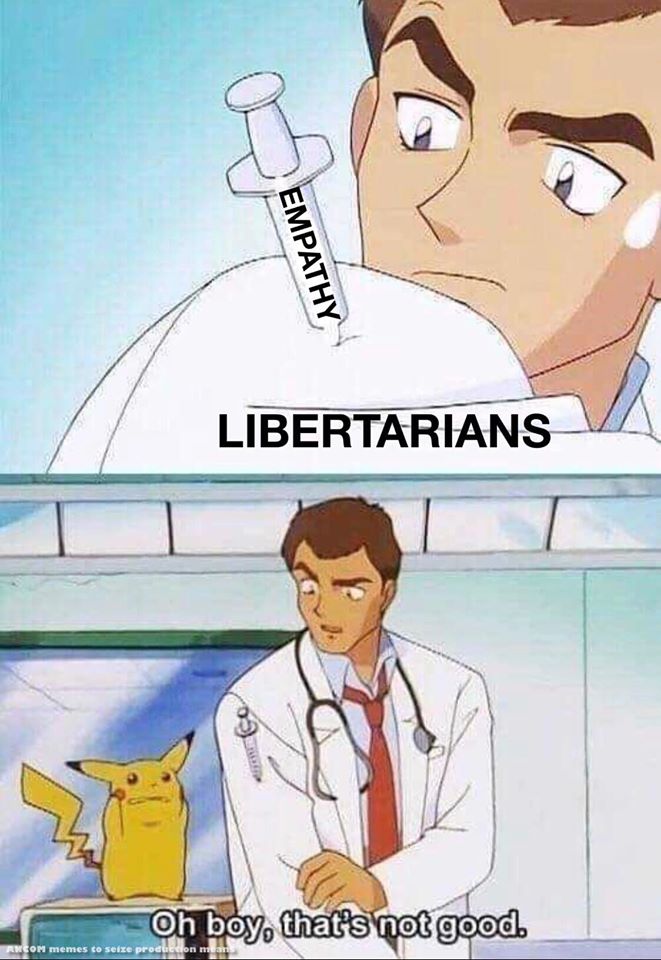
The meme utilizes a two-panel format. The top panel features an anime-style image of a man in a doctor’s coat, looking distressed, with the word "EMPATHY" superimposed on a syringe he’s holding. This is positioned directly above the word "LIBERTARIANS" in bold, black font. The bottom panel shows the same doctor figure looking concerned at Pikachu (from Pokemon), who is clearly distressed, using a speech bubble to say "Oh boy, that's not good." The image quality suggests a screencap from a classic anime. The visual style draws on tropes of concerned medical professionals. The bright yellow of Pikachu offers a strong color contrast. The meme relies on a clear, recognizable format—the “Drake format” adapted with a different character—for quick consumption and relatability.
Foucauldian Genealogical Discourse Analysis
This meme can be read through a Foucauldian lens by examining the discourses surrounding empathy, libertarianism, and their perceived incompatibility.
- Discourse & Power/Knowledge: The meme posits a discourse where empathy is understood as something external to, and even opposed by, libertarian ideology. It implies that libertarianism, as a system of thought, actively rejects or is incapable of incorporating empathy. This isn't presented as an objective truth, but as a widely held perception (or a satirical commentary on that perception). The power lies in defining what libertarianism is through this exclusion.
- Genealogy: We can trace a historical “genealogy” of the association between libertarianism and perceived lack of compassion. This meme doesn't delve into that history directly, but it relies on a pre-existing understanding that libertarian emphasis on individual responsibility and limited government is seen by some as leading to a lack of care for the vulnerable or those in need.
- Disciplinary Power: The meme subtly frames empathy as a form of “medicine” that must be administered to the “patient” of libertarianism. This reinforces the idea that compassion is a corrective force needed to fix a perceived deficiency in the ideology. It implies that those who subscribe to libertarianism require this external injection of empathy.
- Subjectification: The meme suggests how individuals are "subjectified" by the discourses of both libertarianism and empathy. Being labeled a "libertarian" or being seen as lacking empathy shapes how others perceive and interact with that person, influencing their self-understanding and social positioning.
Critical Theory
From a Critical Theory perspective (drawing heavily on the Frankfurt School), the meme can be analyzed in terms of how it critiques and reproduces ideology.
- Ideology Critique: The meme acts as a form of ideology critique by exposing the perceived tension between libertarian principles and basic human compassion. It suggests that the focus on individual liberty and minimal state intervention can lead to a callous disregard for the suffering of others.
- Reification: The meme “reifies” (treats as concrete entities) the abstract concepts of libertarianism and empathy, presenting them as opposing forces. This simplifies complex ideologies and social phenomena, potentially obscuring nuances and contradictions.
- Domination and Power: It subtly critiques the systems of domination inherent in libertarian thought—the emphasis on individual rights potentially overshadowing collective responsibility and the needs of marginalized groups. By associating libertarianism with a lack of empathy, the meme implicitly challenges the power structures that benefit from prioritizing individual freedom over social welfare.
- Mass Culture: As a meme, the image circulates within mass culture, contributing to the ongoing debate about libertarianism and its consequences. It’s a form of cultural commentary that reflects and shapes public opinion.
Marxist Conflict Theory
Through a Marxist lens, we can interpret the meme as revealing a fundamental conflict between individualistic ideology and collective welfare.
- Class Conflict: The meme taps into a perceived conflict between those who prioritize individual economic freedom (often associated with libertarianism) and those who advocate for social safety nets and collective responsibility (representing a more socialist or progressive perspective). The “lack of empathy” can be seen as a symptom of prioritizing capital accumulation and individual profit over the needs of the working class.
- Ideology as False Consciousness: The meme implies that libertarian ideology can function as a form of “false consciousness,” masking the inherent contradictions and inequalities of capitalist society. The emphasis on individual responsibility obscures the structural factors that contribute to poverty and suffering.
- Exploitation & Alienation: The lack of empathy can be seen as a consequence of a system that encourages competition and self-interest, leading to the exploitation of others and the alienation of individuals from one another.
Postmodernism
From a Postmodern perspective, the meme destabilizes fixed meanings and highlights the constructed nature of ideologies.
- Deconstruction: The meme “deconstructs” the notion of a coherent, rational libertarian ideology by exposing its perceived emotional deficit. It challenges the claim that libertarianism is a complete and consistent worldview.
- Simulacra and Simulation: The meme functions as a “simulacrum” – a copy without an original. It’s a representation of a representation, drawing on pre-existing images (the anime style, Pikachu, the “Drake format”) to create a new layer of meaning.
- Relativism: The meme acknowledges that interpretations of empathy and libertarianism are subjective and contingent on context. There's no single, objective truth about these concepts.
- Irony & Parody: The image relies on irony and parody. It's not a straightforward endorsement of any position, but rather a playful critique that invites multiple interpretations.
Queer Feminist Intersectional Analysis
This is perhaps the most challenging lens, but we can still find connections.
- Interconnected Oppressions: The perceived lack of empathy in libertarianism can be connected to a broader pattern of disregard for the needs of marginalized groups, including LGBTQ+ individuals, people of color, and people with disabilities. Intersectional analysis recognizes how these forms of oppression are interconnected.
- Care Ethics: Feminist care ethics emphasizes the importance of relationships, empathy, and responsibility to others. The meme implicitly critiques libertarianism for its perceived rejection of these values. A feminist reading might see the prioritization of individual rights as a way to evade responsibilities to vulnerable populations.
- Power Dynamics: The meme subtly challenges power dynamics by suggesting that libertarian ideology often serves to protect the privileges of those who already have power, while leaving marginalized groups to fend for themselves. The lack of empathy is seen as a manifestation of this power imbalance.
- Challenging Normative Ideals: Queer theory challenges normative ideals and assumptions. The meme can be read as a critique of libertarianism's reliance on individualistic assumptions that may exclude or marginalize those who do not conform to mainstream norms.
I hope this detailed analysis provides a thorough breakdown of the meme through these various theoretical lenses. Let me know if you'd like me to elaborate on any particular aspect!
simple-description (llama3.2-vision)
This meme is a humorous take on the stereotype that libertarians are overly sensitive to criticism and have a strong sense of self-pity. The image features a character from the popular anime "Pokémon" called Professor Kukai, who is known for his calm and rational personality. The text "LIBERTARIANS" is placed above the character, implying that they are being treated for their emotional sensitivity. The text "EMPATHY" is shown being injected into the character, symbolizing the idea that they need to be "cured" of their emotional sensitivity.
tesseract-ocr
= ee P EB ‘ ~w > S| | / pertains WA 4a— aoe iN \ A | % A ee | | a cs -