First Seen
2023-05-10T21:03:35+00:00
simple-description (llama3.2-vision_11b)
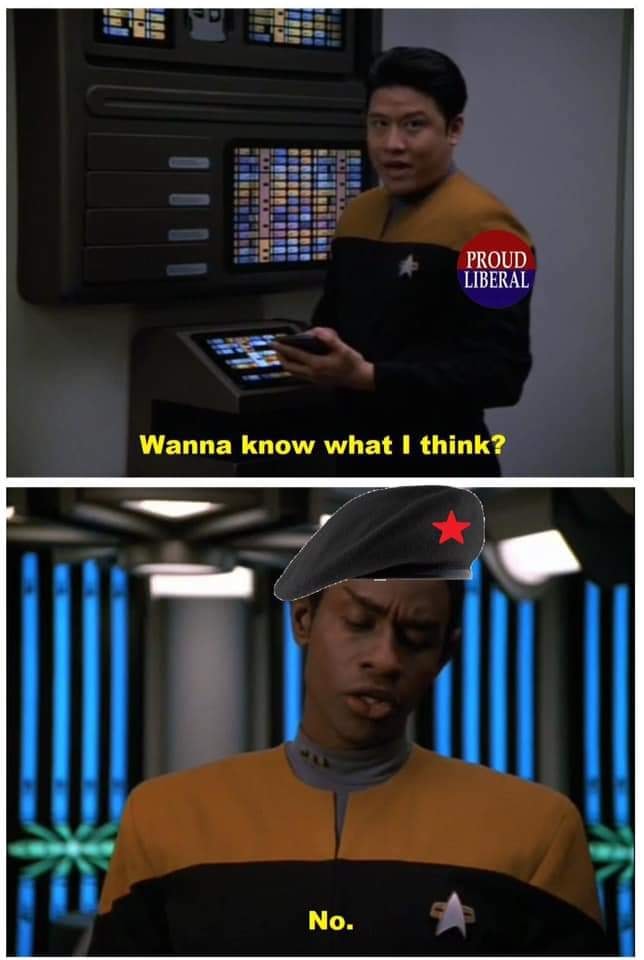
The meme is a screenshot from Star Trek: The Next Generation, where a character, Lieutenant Worf, is being interrogated by a Klingon commander. The meme is captioned "I refuse to respond to questions about my political beliefs" with the text "I refuse to respond to questions about my political beliefs" written in a Klingon font, implying that the character is being asked to disclose their left-wing affiliations, but is refusing to answer.
detailed-analysis (gemma3-27b-vision)
Okay, here's a breakdown of the image using the requested theoretical frameworks. I'll organize it into sections, only including analyses where the framework applies. Given the nature of the meme and its pointed political messaging, several of these frameworks do apply.
Visual Description
The image is a two-panel meme using a screencap from Star Trek: The Next Generation featuring Geordi La Forge (LeVar Burton).
- Panel 1: Geordi is at a console, looking towards the viewer with a quizzical expression. Text overlaid reads "Wanna know what I think?" The "Proud Liberal" tag is over his chest.
- Panel 2: Geordi is in the same setting, but now he wears a Soviet Ushanka (a fur hat with ear flaps) emblazoned with a red star. His expression is stern and dismissive. The text overlaid reads, "No."
The visual juxtaposition and alteration of the image (adding the hat) form the central joke of the meme. It's clearly designed to be provocative and make a political statement.
Foucauldian Genealogical Discourse Analysis
This image is rife with potential for a Foucauldian reading. The meme performs a kind of discursive disruption.
- Discourse & Power: The meme plays on the discourse surrounding political affiliation. "Liberal" is presented initially, but is immediately subverted with the visual of a communist/Soviet symbol. Foucault argues that discourses create power/knowledge relations. The meme challenges the assumed coherence of "Liberal" identity by associating it with a historical (and often demonized) political ideology.
- Genealogy: The image implicitly draws on the genealogy of both "Liberalism" and "Communism," two ideologies that have frequently been framed as oppositional. It questions the ‘natural’ boundaries of these identities. The image doesn't present either as ‘true’ but rather as historically constructed and potentially overlapping.
- Subject Formation: The image seems to critique the way people readily adopt (and then rigidly adhere to) political labels. The Geordi character, initially presented as embodying "proud liberalism," then rejects any expectation of explaining his thoughts, signaling a refusal to be categorized or defined. The meme suggests individuals are not simply "Liberals" or "Communists," but rather complex beings whose thoughts cannot be neatly packaged into existing ideological boxes.
Critical Theory
This meme lends itself to analysis through the lens of Critical Theory, particularly regarding ideology and power structures.
- Ideological Critique: The meme functions as a critique of Liberal ideology, suggesting that its principles may be similar to (or ultimately lead to) what is perceived as extreme leftist ideology. It subverts the commonly held assumption that Liberalism and Communism are fundamentally opposed.
- Domination & Resistance: It hints at the ways in which dominant discourses (e.g., the anti-communist rhetoric of the Cold War) can shape our perceptions and limit our understanding of political ideologies. The "No" is a form of resistance, a refusal to articulate a position within a framework that demands conformity.
- False Consciousness: The initial presentation of Geordi as a "Proud Liberal" might be seen as a form of false consciousness – a naive acceptance of dominant ideology. The later addition of the Ushanka is a jarring interruption of that consciousness, suggesting a realization of deeper, more complex political undercurrents.
Marxist Conflict Theory
The meme clearly engages with themes central to Marxist conflict theory.
- Class Struggle/Ideological Struggle: While not directly depicting physical struggle, the meme represents an ideological struggle. It questions the boundaries between seemingly opposing political camps. The meme suggests a tension inherent in modern political thought, that the perceived differences between ideologies may be a construct.
- Hegemony: The image can be read as critiquing the cultural hegemony of neoliberalism, the dominant ideology in many Western countries. By presenting a "Liberal" who implicitly aligns with communist symbolism, it disrupts the accepted narrative of how these ideologies relate to each other.
- Revolution/Radicalism: The Ushanka, with its association with the Soviet Union, historically represents radical political thought. The juxtaposition with the initial “proud liberal” framing suggests that liberal thought may be a stepping-stone towards (or at least shares certain affinities with) more radical ideologies.
Postmodernism
The meme embodies several elements associated with postmodern thought.
- Deconstruction: The meme "deconstructs" the seemingly stable categories of "Liberal" and "Communist." It reveals their constructed nature and challenges the idea that they are fixed or mutually exclusive.
- Irony & Parody: The image employs irony by placing a symbol of one ideology onto a figure initially presented as embracing another. This ironic juxtaposition invites the viewer to question the assumptions underlying both ideologies.
- Rejection of Grand Narratives: The meme implicitly rejects the "grand narratives" of political thought, the sweeping explanations of history and society that attempt to impose a single, coherent meaning on complex phenomena. It suggests that political identities are fluid and fragmented, rather than fixed and stable.
- Simulacra and Simulation: The meme might be seen as a representation of simulation: a copying of political stances. The meme itself is a simulation of thought, a visual shortcut to a complex idea.
Let me know if you'd like me to delve deeper into any particular framework or aspect of the meme.
simple-description (llama3.2-vision)
The meme is a humorous exchange between two characters in a Star Trek: The Next Generation episode. The first character, a crew member, asks "Wanna know what I think?" and the second character, a security officer, responds with "No." The meme is a play on the idea that the second character's response is a very literal and unexpected answer to the question.
tesseract-ocr
eS Br ttt ae r = NG SS, Wanna know what | think? oe oe By a —— *| | |= | | ie gal ff F LC | i