First Seen
2023-05-10T21:03:35+00:00
simple-description (llama3.2-vision_11b)
The meme features a photo of a person in a Star Trek: The Next Generation uniform, with the text "I'm not going to pay for your privateschool education" and "I'm not going to pay for your healthcare". The meme is a commentary on the perceived hypocrisy of the wealthy elite, particularly those who have benefited from socialist systems, such as the UK's National Health Service, and are now advocating for privatization.
detailed-analysis (gemma3-27b-vision)
Okay, let's break down this image through the lenses you've requested. It's a fascinating combination of pop culture and political messaging.
Visual Description
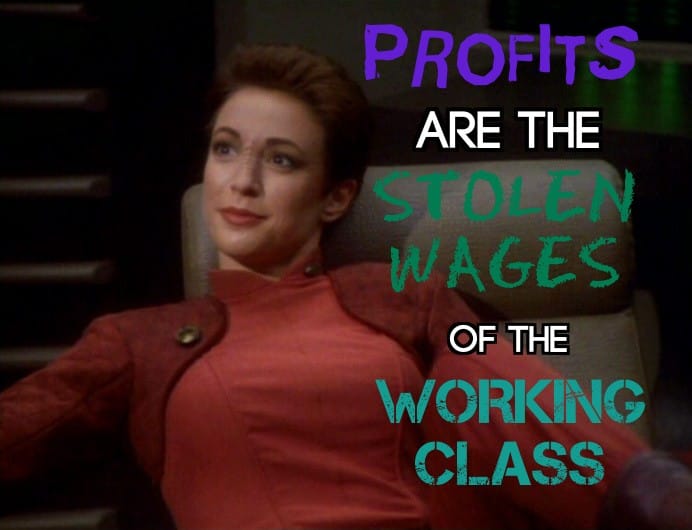
The image depicts Deanna Troi (Marina Sirtis), a character from Star Trek: The Next Generation. She is wearing her signature red uniform. Her expression is thoughtful, almost melancholy. She’s in a fairly standard Star Trek set—a corridor—which is dark, focusing attention on her. Overlayed on the image, in bright, eye-catching colors (purples, teals, and yellows), is text reading "PROFITS ARE THE STOLEN WAGES OF THE WORKING CLASS". The text is very dominant, contrasting with the overall muted tones of the image.
Marxist Conflict Theory
This image is strongly rooted in Marxist conflict theory. The core message – "PROFITS ARE THE STOLEN WAGES OF THE WORKING CLASS" – is a classic Marxist sentiment.
- Exploitation: The statement explicitly frames profits as arising from the exploitation of labor. Marxist theory posits that workers create value through their labor, but capitalists (those who own the means of production) capture that value as profit, rather than fully compensating the workers. This differential is seen as a form of theft.
- Class Struggle: The message implicitly acknowledges class struggle. The "working class" is positioned as the exploited group, while those who benefit from profits are seen as the exploiting class. The statement itself is an act of ideological struggle, attempting to raise class consciousness.
- Alienation: While not directly stated, the image can evoke a sense of alienation. Troi, a character often focused on empathy and emotion, set against a stark and potentially dehumanizing context, suggests the disconnect between labor and the fruits of that labor.
- The Use of a Sci-Fi Character: The choice of Deanna Troi is interesting. She’s not a traditionally “working class” character in the show's narrative. Using her can be read as an attempt to broaden the scope of the message—that exploitation isn't limited to industrial labor, but permeates all aspects of society, even those that seem futuristic or utopian. It also might subtly suggest that even in a more advanced society, issues of economic justice can persist.
Critical Theory
The image, through the lens of Critical Theory, goes beyond a simple economic critique and functions as a form of cultural critique.
- Ideology: The message challenges the dominant ideology of capitalism, which often naturalizes profit as a just reward for risk-taking and innovation. By framing profits as “stolen,” the image attempts to de-naturalize this ideology.
- Power Dynamics: The statement isn’t just about money; it’s about power. Profits represent the power of capital to control labor and shape society. The image implicitly asks viewers to question who holds power and how that power is maintained.
- Emancipatory Goal: Critical theory aims at emancipation and social transformation. The image, as a call to recognize exploitation, implicitly suggests the need for social change to redistribute wealth and power.
- The Medium Matters: The use of a pop-culture image (a screenshot from a beloved TV show) is significant. This form of media repurposing can make a complex political message more accessible and engaging to a wider audience.
Foucauldian Genealogical Discourse Analysis
From a Foucauldian perspective, this image is not simply a statement of truth, but an intervention in a discourse about value, labor, and profit.
- Power/Knowledge: Foucault emphasized the interconnectedness of power and knowledge. The statement doesn’t just describe exploitation; it constructs it as a problem. It uses language to create a specific understanding of economic relations.
- Genealogy: A Foucauldian genealogical approach would trace the historical emergence of the concept of “profit” and its relationship to the concept of “wages.” It would explore how these concepts have been defined, contested, and used to legitimize certain power structures.
- Disciplinary Power: The image can be read as resisting the “disciplinary” forces of capitalism that normalize exploitation. By challenging the dominant narrative, it attempts to disrupt the systems of control that maintain inequality.
- Subjectivation: The image attempts to subjectivate (create a subject) that recognizes the relationship between profits and stolen wages. It’s an attempt to create a consciousness that challenges the status quo.
Postmodernism
There’s a subtle postmodern element to the image, specifically through its use of remix and appropriation.
- Intertextuality: The image blends a popular cultural text (Star Trek) with a political message. This blending of different codes is a hallmark of postmodernism.
- Deconstruction: While not a full-blown deconstruction, the image implicitly challenges the "naturalness" of capitalist logic by placing it in a seemingly unrelated context.
- Loss of Grand Narratives: While the image presents a clear political message, the postmodern sensibility is present in the recognition that there are multiple ways to interpret economic relations.
- Simulation: The use of a screenshot—a digital representation of reality—could be seen as a commentary on the increasingly simulated nature of modern life.
Queer Feminist Intersectional Analysis
While the image's primary message centers on class, an intersectional reading can reveal additional layers of meaning.
- Interlocking Systems of Oppression: A queer feminist lens would recognize that class exploitation doesn't operate in isolation. It intersects with other forms of oppression based on gender, sexuality, race, and other social categories. This image, while focused on class, acknowledges the need to look at these forms of oppression as well.
- Labor and Reproduction: Feminist theory often highlights the unpaid labor of care work (typically performed by women) as a form of exploitation. While this image doesn’t directly address this, it opens the door for examining how profit is also generated through the exploitation of reproductive labor.
- Marginalized Labor: The image also invites reflection on the specific ways in which marginalized groups (e.g., LGBTQ+ individuals, people of color) are disproportionately impacted by economic exploitation.
- Deconstructing Capitalist Norms: Both queer and feminist theories challenge the normative structures that underpin capitalism. This image, by questioning the legitimacy of profit, can be seen as an attempt to deconstruct those structures.
In conclusion, this image is a surprisingly rich and complex piece of political commentary. It utilizes pop culture, visual aesthetics, and a powerful message to challenge the foundations of capitalist ideology and invite viewers to question the systems of power that shape their lives.
simple-description (llama3.2-vision)
The meme is a still image from the TV show Star Trek: The Next Generation, featuring a character (Deanna Troo...), but the image is not described here. The text overlayed on the image reads: "Profits are the Stolen Wages of the Working Class."
tesseract-ocr
PRorits & ARE THE ee WORKING CLASS