First Seen
2023-05-10T21:03:35+00:00
simple-description (llama3.2-vision_11b)
The meme is a humorous image of Che Guevara, a Marxist revolutionary, with a caption that implies he's a "leftist" (a term often used to describe someone who supports socialism or communism) who's "not actually a leftist" because he's a capitalist. The meme pokes fun at the idea that someone who advocates for socialism or communism can also be a capitalist, highlighting the complexity of left-wing ideologies.
detailed-analysis (gemma3-27b-vision)
Okay, let's break down this image using the requested theoretical frameworks. It's a complex piece and has strong political overtones, so these lenses can provide insightful interpretations.
Visual Description
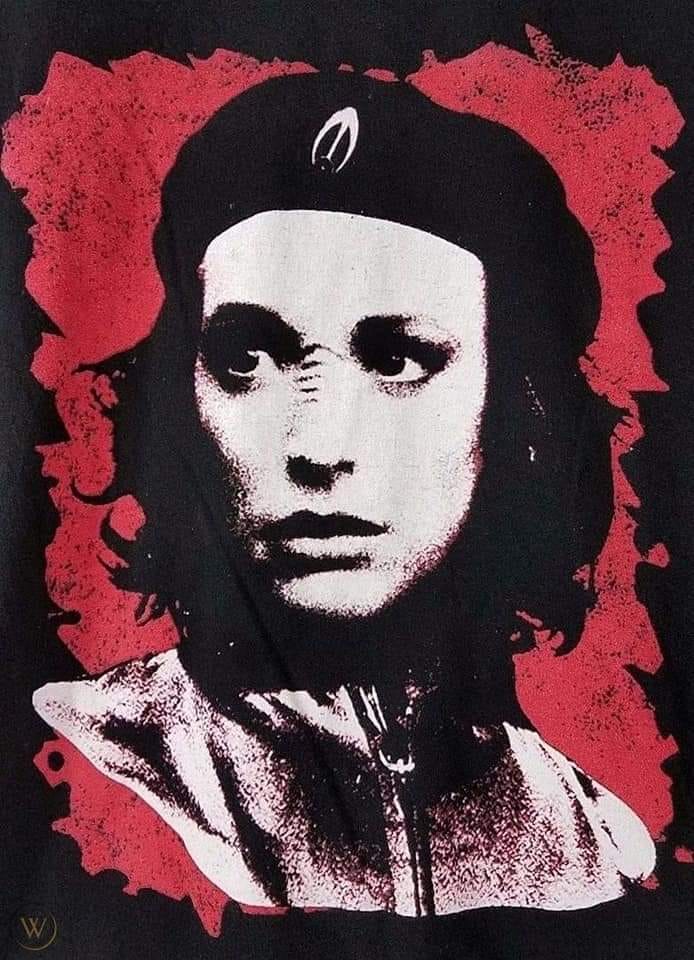
The image is a stark, high-contrast portrait of a woman. It appears to be a screen print or a similar method that lends itself to a graphic, almost propaganda-style aesthetic. Here’s a breakdown:
- Subject: The subject is a young woman, likely intended to be a depiction of a revolutionary or a strong female figure. She wears a military-style cap.
- Color Palette: The image relies heavily on a limited color scheme— predominantly black, white, and a vibrant, textured red background. The red is aggressive and visually dominant.
- Style: The image is not realistic. It utilizes shading and hatching for definition, but it's highly stylized. The emphasis is on conveying emotion and symbolic meaning rather than accurate representation. It evokes the feel of Soviet or Cuban revolutionary posters.
- Composition: The portrait is a bust (head and shoulders), filling most of the frame. Her gaze is direct and intense, creating a confrontational effect. The lighting is harsh and theatrical.
- Texture: The red background has a grainy, uneven texture which adds to the feeling of political unrest or urgency.
Foucauldian Genealogical Discourse Analysis
This image can be analyzed through a Foucauldian lens by examining the discourses surrounding revolutionary figures, specifically female ones.
- Discourse of Revolution: The image participates in a larger discourse of revolution and political struggle. The military cap and intense gaze signal a commitment to a certain ideology, framing the subject as a representative of a particular power dynamic.
- Construction of the "Revolutionary Subject": The image actively constructs the ideal "revolutionary subject." It's not about the woman as an individual, but about a carefully crafted representation of revolutionary fervor. The stark, idealized portrayal simplifies and essentializes the experience of struggle.
- Power/Knowledge: The image is a demonstration of power/knowledge. Those who created it have the power to define who is considered a revolutionary, how they should look, and what message they should convey. The image is a tool for shaping perceptions and mobilizing support.
- Genealogy: A genealogical analysis could trace the historical origins of this image's visual language. It’s strongly reminiscent of early 20th-century Soviet and Cuban propaganda, which employed similar visual techniques to construct heroic figures. Tracing these roots helps understand how power operates through representation and symbolism.
Critical Theory
Applying a Critical Theory perspective, particularly drawing from the Frankfurt School, allows us to unpack the image's ideological function.
- The Culture Industry: The image can be viewed as a product of the "culture industry," designed to circulate a specific ideology and shape public consciousness. It doesn't present a neutral representation of reality but actively promotes a particular worldview.
- Ideology: The image likely operates as an ideological tool, presenting a romanticized and potentially simplified view of revolution. It could be seen as an attempt to legitimize violence, control, or a specific political system.
- Authoritarian Tendencies: The stark, forceful imagery and the heroic representation of the subject could be interpreted as reinforcing authoritarian tendencies. It could be seen as a call to obedience, conformity, and unwavering loyalty to a cause.
- Reification: The woman in the image becomes reified – a symbol rather than a complex individual. This process dehumanizes the subject, reducing them to a mere vehicle for an ideology.
Marxist Conflict Theory
From a Marxist perspective, this image is best understood as a product of class struggle and a tool for mobilizing the proletariat.
- Class Consciousness: The image is designed to cultivate class consciousness among the oppressed or disenfranchised. The depiction of a strong, determined woman as a revolutionary figure serves to inspire action and resistance.
- The Revolutionary as a Symbol: The woman embodies the ideals of the revolutionary class, representing their aspirations for liberation and social change. The image is a call to arms, urging the masses to overthrow the existing power structures.
- Propaganda: The image functions as propaganda, aiming to persuade people to join the revolutionary cause. It simplifies complex issues and presents a clear-cut narrative of good versus evil.
- Ideological Struggle: The image is part of a larger ideological struggle between the ruling class and the oppressed. It challenges the dominant ideology and offers an alternative vision of society.
Postmodernism
A postmodern interpretation of the image focuses on its manipulation of signs and its rejection of grand narratives.
- Simulacra and Simulation: The image can be seen as a simulacrum—a copy without an original. It’s a representation of a representation, creating a hyperreality divorced from concrete reality.
- Deconstruction of the Hero: While appearing to present a hero, the image could be deconstructed to reveal the constructed nature of heroism. It challenges the notion of a single, authentic revolutionary subject.
- Loss of Grand Narratives: The image suggests a rejection of traditional grand narratives (like the inevitability of progress or the triumph of reason). It embraces fragmentation, ambiguity, and the relativity of truth.
- Intertextuality: The image draws heavily on the visual language of Soviet and Cuban revolutionary posters, creating a sense of intertextuality. It engages in a dialogue with other images and symbols, blurring the boundaries between past and present.
Queer Feminist Intersectional Analysis
This is a complex analysis but critical to consider.
- Reclaiming Female Agency: On the surface, the image appears to empower a woman in a traditionally male-dominated revolutionary space. However, it's important to question whose agency is being represented and for what purpose. Is it a genuine attempt to include women in revolutionary struggles, or is it a symbolic gesture that reinforces patriarchal power structures?
- Intersectionality: Consider how gender intersects with other axes of oppression (class, race, nationality, etc.). Is the woman in the image presented as a universal symbol of revolution, or is her identity shaped by specific social and political contexts?
- Masculinity and the Military: The image invokes the traditionally masculine world of the military. How does this imagery reinforce or challenge gender norms? Does it contribute to the masculinization of revolutionary struggles?
- Subverting or Reinforcing Norms: Does the image truly subvert patriarchal norms, or does it simply repackage them in a revolutionary guise? Is the woman presented as an independent agent, or is she defined by her role in the struggle? It's vital to question the underlying power dynamics at play.
Let me know if you'd like me to elaborate on any of these interpretations, or if you'd like me to apply other theoretical frameworks!
simple-description (llama3.2-vision)
The meme is a humorous image of a woman with a sarcastic expression, likely from a TV show or movie. The image is captioned "I'm not arguing, I'm just explaining why I'm right". The meme pokes fun at the tendency to argue or debate in a way that's not necessarily a genuine conversation.
tesseract-ocr
ae = ee a bs a iu ij Be Be Oe see a % os othe S ee Bg " to a % ae (ao . 4 bn a So mY oN ; bo ee 4 a WN sn ae y I poe Cee Ve ee TRY) OPS, Be Re Wey EO ye E ON