First Seen
2023-05-10T21:03:35+00:00
simple-description (llama3.2-vision_11b)
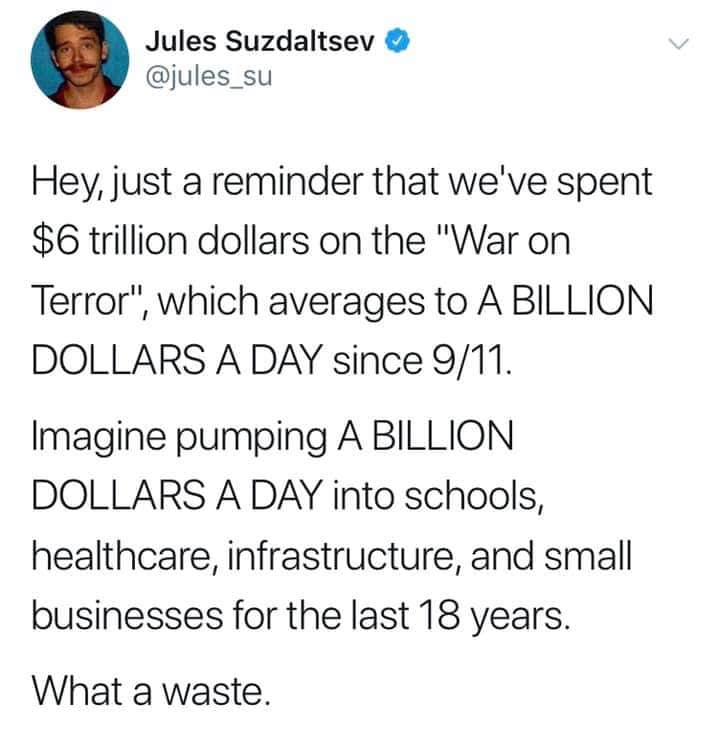
The meme is a humorous commentary on the financial burden of the US military's actions, specifically the wars in Iraq and Afghanistan. It highlights the staggering amount of money spent on these conflicts, using a tongue-in-cheek comparison to everyday expenses. The text reads: "We've spent more on Iraq and Afghanistan wars than we have on kids' healthcare, education, and infrastructure in 20 years."
detailed-analysis (gemma3-27b-vision)
Okay, let's break down this Twitter post from Jules Suzdaltsev, employing the requested theoretical frameworks where applicable.
Visual Description
The image is a screenshot of a Twitter post. It displays a profile picture – a portrait of a man with glasses – labeled "Jules Suzdaltsev" with a blue verification checkmark and the username "@jules_su". Below the profile information is the text of the tweet, consisting of several sentences highlighting the financial cost of the "War on Terror" and contrasting it with alternative spending possibilities. The tweet is posted on a Twitter background that has light-blue color scheme.
Foucauldian Genealogical Discourse Analysis
This tweet is deeply amenable to a Foucauldian analysis.
- Discourse of "Terror": The very phrase "War on Terror" is a key discursive formation. Foucault would argue this isn't a neutral description of events, but a production of reality. The “War on Terror” has created the categories of "terrorist" and "counter-terrorism," defining who is legitimate and illegitimate, safe and dangerous. It has naturalized certain security measures (surveillance, military intervention) as necessary, obscuring the power dynamics at play.
- Genealogy of Power/Knowledge: A genealogical approach would trace the historical emergence of this discourse. What prior anxieties, events, and power structures paved the way for the "War on Terror" to be constructed? It’s not simply a response to 9/11 but is built on a longer history of colonialism, security states, and the justification of intervention. The tweet implicitly challenges the taken-for-granted truth of this discourse.
- Power/Knowledge Relation: The tweet highlights how knowledge (the data on spending) is inextricably linked to power. The sheer scale of spending on the "War on Terror" is presented as a stark contrast to alternative possibilities, implicitly questioning the legitimacy of the current allocation of resources. The statement challenges the assumed "rationality" of prioritizing military spending over social programs.
- Biopower: This is less explicit, but can be argued. The "War on Terror" can be seen as a form of biopower – an attempt to manage and control populations through security measures, surveillance, and the definition of "threats." The enormous investment in this "war" signifies a prioritization of security (managing life) over the well-being of the population.
Critical Theory
This tweet aligns strongly with critical theory’s focus on questioning established power structures and ideologies.
- Ideology Critique: The tweet performs an ideology critique of the "War on Terror." It dismantles the notion that this spending is simply a necessary response to a threat. By highlighting the alternative uses for the money, it exposes the interests served by this allocation of resources.
- Domination & Emancipation: Critical theory is concerned with understanding and overcoming domination. This tweet can be seen as an attempt to expose the ways in which the "War on Terror" has become a self-perpetuating system, benefiting certain groups (military-industrial complex, politicians) at the expense of others. The implicit suggestion is that redirecting funds could lead to a more just and equitable society.
- Reason & Instrumental Rationality: The tweet points to a skewed application of rationality. While the "War on Terror" is often justified as "rational" in terms of national security, the tweet argues that it’s instrumentally rational (serving specific interests) but not substantively rational (aligned with broader social well-being).
Marxist Conflict Theory
From a Marxist perspective, this tweet highlights the inherent contradictions within capitalist systems.
- Class Conflict: The enormous spending on the "War on Terror" can be seen as benefiting a specific class – the military-industrial complex, arms manufacturers, and associated corporations – at the expense of the working class and the poor. The funds diverted to war could have been used to address social inequalities and improve the lives of marginalized groups.
- Capital Accumulation: The “War on Terror” can be understood as a mechanism for capital accumulation. It creates a demand for military equipment, technology, and services, generating profits for corporations. The tweet implicitly suggests that this profit-driven motive underlies the continued investment in the “war”.
- State as an Instrument of Class Rule: The state, in Marxist terms, is an instrument of class rule. The tweet suggests that the state has prioritized the interests of the capitalist class by allocating vast resources to military spending.
Postmodernism
Postmodernism is less directly applicable, but relevant aspects can be identified.
- Deconstruction of Grand Narratives: The tweet challenges the "grand narrative" of the "War on Terror" – the idea that this is a necessary and justifiable struggle against a monolithic enemy. By questioning the logic of this narrative and highlighting alternative uses for the funds, it deconstructs its presumed validity.
- Relativity of Truth: While not explicitly stated, the tweet implicitly suggests that there is no single, objective truth about the “War on Terror.” Different perspectives and priorities (e.g., social welfare vs. national security) shape our understanding of the situation.
- Critique of Meta-Narratives: The tweet questions the meta-narrative of constant security and militarization, presenting an alternative vision of how resources could be allocated to build a more just and equitable society.
Queer Feminist Intersectional Analysis
This framework is the least directly applicable, but can add nuance.
- Intersectional Impacts of War: Wars disproportionately impact marginalized groups – women, people of color, LGBTQ+ individuals – who bear the brunt of violence, displacement, and economic hardship. The tweet doesn’t explicitly address this, but an intersectional analysis would highlight these unequal impacts.
- Feminist Critique of Militarization: Feminist thought often critiques the militarization of society, arguing that it reinforces patriarchal power structures and normalizes violence. The tweet implicitly resonates with this critique by questioning the prioritization of military spending over social programs that could benefit women and marginalized communities.
- Queer Critique of Security States: Queer theory often critiques the ways in which security states (like those built around the “War on Terror”) can be used to justify discrimination and control over marginalized groups. The focus on surveillance and control can disproportionately target LGBTQ+ individuals and communities.
In conclusion, this simple tweet is rich with analytical potential. It offers a starting point for critically examining the historical, political, and economic forces that have shaped the "War on Terror" and its impact on society. The choice of theoretical lens influences the specific insights one draws from the tweet, but all these frameworks illuminate the complex power dynamics at play.
simple-description (llama3.2-vision)
The meme is a humorous and satirical commentary on the war on terror and the US government's spending habits. The text reads: "Hey, just a reminder that we've spent $6 trillion on the war on terror, which is equivalent to $2.5 billion a day since 9/11. Imagine pumping $2.5 billion a day into schools, healthcare, infrastructure, and small businesses for the last 18 years. What a waste."
tesseract-ocr
g Jules Suzdaltsev @ @jules_su Hey, just a reminder that we've spent $6 trillion dollars on the "War on Terror", which averages to A BILLION DOLLARS A DAY since 9/11. Imagine pumping A BILLION DOLLARS A DAY into schools, healthcare, infrastructure, and small businesses for the last 18 years. What a waste.