First Seen
2023-05-10T21:03:35+00:00
simple-description (llama3.2-vision_11b)
The meme is a play on the Star Wars franchise, specifically referencing the character Jar Jar Binks, who was known for his awkwardness and lack of combat skills. The image is likely a photo of Jar Jar Binks, with the text "Leftism" overlaid on top, implying that the character's awkwardness is a metaphor for the perceived flaws of left-wing politics. The meme is likely meant to be humorous and satirical, poking fun at the idea that left-wing ideologies are flawed or ineffective.
detailed-analysis (gemma3-27b-vision)
Here's an analysis of the image broken down into sections as requested. Note that some sections may be more relevant than others depending on the image's content. I will do my best to address the themes present, even if they require interpretation.
Visual Description
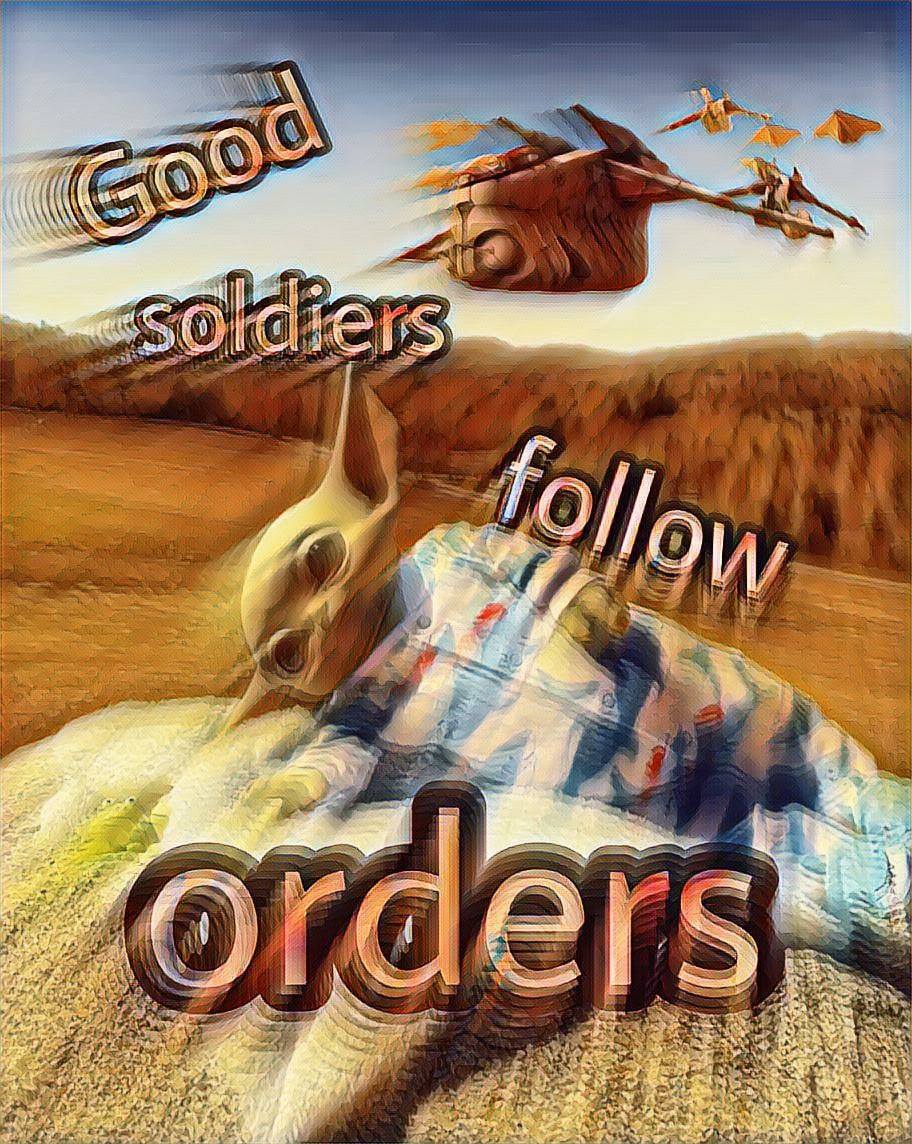
The image is a surreal, digitally manipulated composition combining elements of a desert landscape, military imagery, and consumer waste. The foreground features a large mound constructed almost entirely of discarded plastic bottles and containers, evoking a landfill or a disturbing monument to consumerism. Superimposed over this mound, and in a perspective that creates a layered depth, is a section of a soldier in uniform – a shoulder and arm appear to be emerging from or buried within the plastic waste.
Above, in the sky, are digitally inserted or painted military aircraft - helicopters - seemingly engaged in a flight formation.
The text “Good Soldiers Follow Orders” is overlaid on the image in a prominent, somewhat glossy, digital font. The words are spaced out, creating a layered effect that mirrors the layered visuals of the composition. The overall color palette is warm and earthy in the landscape, with the bright colors of the plastic and the metallic tones of the aircraft providing visual contrast. The overall impression is unsettling, juxtaposing natural and artificial elements and implying a connection between military authority, consumer culture, and environmental degradation.
Foucauldian Genealogical Discourse Analysis
The image powerfully illustrates Foucault's concepts of power/knowledge and discipline. The phrase "Good Soldiers Follow Orders" is a direct assertion of disciplinary power. The image doesn't just state this power; it visualizes it.
- Discipline and Normalization: The command implies that "goodness" is defined by obedience and conformity. This normalizes a system where questioning authority is seen as deviance. The soldiers are the disciplined subjects, created through the systems of training and expectation.
- Power/Knowledge: The image couples the idea of obedience with the literal foundation of that obedience being built on refuse – consumer waste. This suggests a system where control is maintained through the manipulation of desire and the production of excess. The knowledge system that supports this is the capitalist consumer culture.
- Genealogy: Examining the historical trajectory of this "good soldier" figure, one could trace the evolution of military training, the rise of consumerism, and the intertwining of these forces. The landfill/waste mound is a genealogical artifact – the result of historical power relations manifested as physical waste.
- Panopticon: While not a literal panopticon, the aircraft in the sky can be seen as representing surveillance and control, constantly monitoring and enforcing obedience.
Critical Theory
The image readily lends itself to a critical theoretical reading. It's a critique of several interlocking systems of power.
- Ideology: The phrase "Good Soldiers Follow Orders" is ideological – it naturalizes a power dynamic. The image questions this naturalization by showing the foundation of that power as being literally "trash" or waste.
- Commodification: The vast mound of plastic bottles highlights the commodification of everything in contemporary society. The "good soldier" is, in a way, another commodity – a tool used by those in power.
- Alienation: The soldier seemingly emerging from the waste heap can be read as a symbol of alienation. They are disconnected from nature, from meaning, and reduced to a mere instrument of power.
- The Culture Industry: The consumer waste can be seen as a product of the “culture industry” (Adorno and Horkheimer) – a system that churns out mass-produced goods and reinforces conformity.
Marxist Conflict Theory
From a Marxist perspective, the image highlights class conflict and the inherent contradictions of capitalism.
- The Means of Production & Waste: The plastic bottles represent the products of capitalist production and the waste generated by a system driven by profit. The “good soldiers” are the protectors of this system, tasked with maintaining the power structures that benefit a small elite.
- False Consciousness: The phrase "Good Soldiers Follow Orders" can be interpreted as contributing to "false consciousness" – the acceptance of a system that ultimately exploits and alienates the working class.
- Imperialism & Resource Exploitation: The production of plastic and the need for resources to create it are inherently linked to imperialism and the exploitation of resources from developing countries. The soldiers, as agents of power, are implicated in this exploitation.
- Contradiction: The image demonstrates the fundamental contradiction of capitalism - the relentless pursuit of growth leading to environmental destruction and unsustainable consumption.
Postmodernism
The image exhibits several characteristics associated with postmodernism:
- Pastiche & Juxtaposition: The combination of disparate elements – military imagery, consumer waste, desert landscape – is a characteristic of postmodern pastiche.
- Deconstruction of Grand Narratives: The image challenges the traditional "grand narratives" of patriotism, heroism, and progress. The soldier is not a glorious figure, but a product of a decaying system.
- Hyperreality & Simulation: The digitally manipulated nature of the image contributes to a sense of hyperreality – a blurring of the lines between reality and simulation. The landscape and aircraft may not be "real" in the traditional sense, but they are more real as an image than any "authentic" representation.
- Ambiguity & Irony: The image is intentionally ambiguous and ironic. It doesn't offer easy answers, but rather prompts the viewer to question the assumptions underlying the relationship between power, consumption, and obedience.
Queer Feminist Intersectional Analysis
This section is more challenging to apply directly, but intersections can be found:
- Masculinity & Violence: The soldier inherently represents a traditionally masculine figure associated with power, violence, and control. A queer feminist reading could critique this representation and its impact on gender roles and expectations. The association with waste highlights the unsustainable "power" of this traditional masculinity.
- Environmental Justice: The placement of the waste mound in a landscape subtly brings up environmental justice issues. Pollution and waste disproportionately impact marginalized communities. The soldier, as a representative of power, is complicit in these injustices.
- Intersectional Power Dynamics: The image could be interpreted as a metaphor for the ways in which multiple systems of power (patriarchy, capitalism, colonialism) intersect to create oppression and environmental destruction. The "good soldier" is a product of these intersecting systems.
- Deconstructing "Orders": The phrase "follow orders" is inherently about hierarchy and control. A feminist reading could analyze how this dynamic reinforces patriarchal structures and silences dissenting voices. The soldier's embeddedness in waste could suggest a failure of these "orders" to sustain anything meaningful.
I hope this analysis is helpful. It’s important to remember that art interpretation is subjective, and different viewers may find different meanings in this image.
simple-description (llama3.2-vision)
The meme features a screenshot from the Star Wars franchise, specifically a scene where a character is giving orders to others. The text "Good soldiers follow orders" is overlaid on the image, with the words "Good" and "orders" highlighted in a bold font. The image is likely meant to be humorous or ironic, suggesting that the character's instructions are being taken literally and that the others are indeed following them.
tesseract-ocr
GW lO WX od ~ pee A ne iS Ri. eS | — a A (eo Cave — sa OOS aa ate eT ee : ge | os ge Bie 'h a : Pd —e i ore SEE ie » | Fae See is i Sait, ps > Mare - > Pie Ca i - E ~~ Sa —_ : e : ea: : ast. fh We 4 4 °F “"cteed i Lf aN a an yest] AS ae ae wa \\ i ‘ ‘ a § Ms iN i A y y i f (3 aS a Zz ve \ i fi Fi AN 2 =" a s ~ bio a oe aoe i) Q— Aes Se ; ra Go eel Ni Rien cee ae “ee JU See aes aN (ee AR Oe ! ie Pe ek BASS Breer eee Be Al § Boos Hae ABE. u pas foe psi A) os ARAN tne oe a Cre OR “as.