First Seen
2023-05-10T21:03:35+00:00
simple-description (llama3.2-vision_11b)
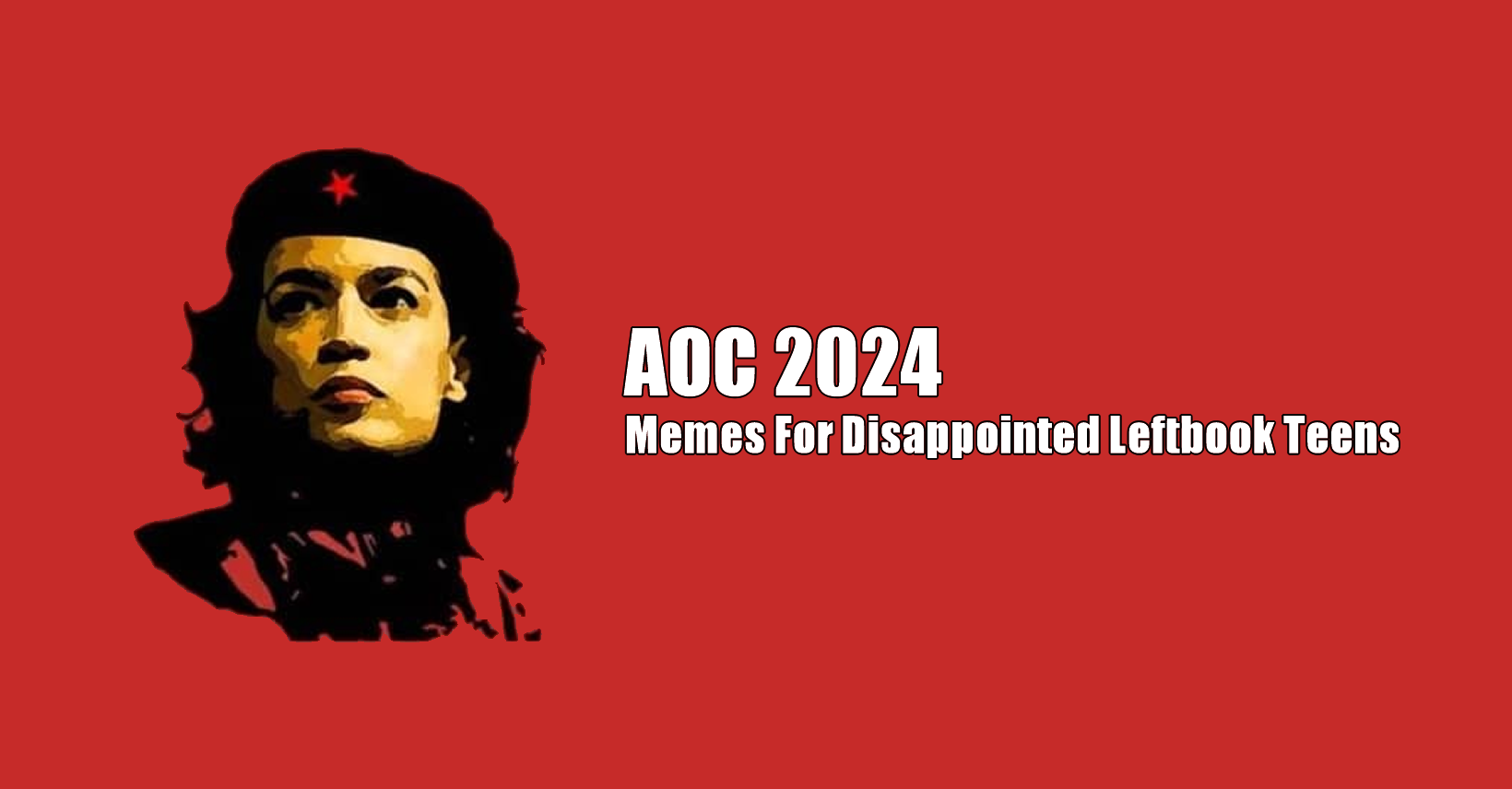
The meme is a play on the image of AOC (Alexandria Ocasio-Cortez) with a caption "AOC 2024" and the text "I'm not a socialist, I'm a socialist who has to pretend to be a moderate to get elected". The meme is poking fun at the idea that AOC, a self-proclaimed socialist, has to tone down her left-wing views to appeal to a broader audience.
detailed-analysis (gemma3-27b-vision)
Okay, let's break down this image with the requested theoretical lenses. It’s a fairly charged image, and the theoretical frameworks will help unpack the layers.
Visual Description
The image is a stark, high-contrast graphic. It features a stylized portrait of Alexandria Ocasio-Cortez (AOC), rendered in a manner strongly reminiscent of the iconic Che Guevara poster. AOC is depicted wearing a red star symbol on her hat. The background is a solid, saturated red. The text "AOC 2024 – Memes For Disappointed Leftbook Teens" is overlaid in white. The image's overall aesthetic is designed to evoke revolutionary iconography. The style leans toward stencil art or graphic propaganda.
Foucauldian Genealogical Discourse Analysis
This image is ripe for Foucauldian analysis. It isn't about "truth" but about power/knowledge. The visual discourse deliberately constructs AOC through the lens of revolutionary figures.
- Genealogy of the Revolution: The image doesn't represent AOC as herself, but rather through the historical and discursive construction of "the revolutionary." The image draws on the pre-existing history and the associated power structures with the Che Guevara image. This visual borrowing isn’t innocent; it activates those histories (both positive and negative) in relation to AOC.
- Power/Knowledge and Representation: The choice to represent AOC as Che Guevara isn’t about accurate representation. It's about positioning her within a specific regime of truth – one where radical political action, even violence (associated with Che), is normalized and even romanticized. The image isn’t simply stating a fact; it’s producing a meaning, a particular way of understanding AOC and her politics.
- Discipline and Subjectification: The target audience ("Disappointed Leftbook Teens") is significant. The image attempts to subjectify them—to create a subject position within a specific political discourse. It suggests they are a disenfranchised group that seeks radical solutions, and AOC is positioned as the figurehead for that discontent.
Critical Theory (Frankfurt School)
From a critical theory perspective (think Adorno, Horkheimer, Marcuse), this image is deeply problematic.
- Culture Industry: The meme format itself is a product of the culture industry. It commodifies political dissent, turning potentially radical ideas into easily digestible, shareable content. The image is designed to circulate rapidly, but without necessarily prompting deeper critical thought.
- Pseudo-Individualization: The targeting of "Disappointed Leftbook Teens" is a tactic of pseudo-individualization. It appears to offer a personalized message, but in reality, it seeks to herd a group into a pre-defined ideological category.
- Critique of Instrumental Reason: The image’s appeal relies on symbolic association and emotional response. It sidesteps reasoned argument in favor of visually arresting iconography. This is a manifestation of the critique of instrumental reason—the reduction of complex issues to easily manipulated symbols.
- Authoritarian Tendencies: The appropriation of Che Guevara's image, a figure associated with revolutionary violence and authoritarianism, is a troubling indicator. Critical theory would argue that such imagery romanticizes power and suppresses critical reflection on the dangers of unchecked political force.
Marxist Conflict Theory
From a Marxist perspective, this image can be analyzed as a representation of class struggle and ideological conflict.
- Ideological Apparatus: The image functions as an ideological apparatus, reinforcing a particular worldview. It suggests that the current system is failing and that radical change is necessary. The appeal to "disappointed" youth indicates a sense of alienation and disenfranchisement—classic symptoms of class conflict.
- False Consciousness: While seemingly empowering, the image could also be interpreted as reinforcing "false consciousness"—a distorted understanding of social relations. By focusing on symbolic representation (the image) rather than material conditions (economic inequality, systemic oppression), it may distract from the root causes of social problems.
- Hegemony: The image attempts to challenge the hegemonic order—the dominant ideology that maintains the status quo. However, it does so through a symbolic gesture that may not translate into concrete political action.
- Revolutionary Symbolism: The use of Che Guevara imagery is a clear call for revolution, suggesting that the current system is beyond repair and that radical change is necessary.
Postmodernism
From a postmodern perspective, the image is a playful, self-referential pastiche of revolutionary imagery.
- Simulacra and Simulation: The image is not a direct representation of AOC or her politics; it's a simulacrum—a copy without an original. It’s a simulation of revolution, divorced from the material conditions that gave rise to the historical Che Guevara.
- Hyperreality: The image exists in a realm of hyperreality, where signs and symbols have become more real than the things they represent. The emotional impact of the image may be stronger than any actual political substance.
- Deconstruction of Meaning: The image challenges traditional notions of meaning and representation. By juxtaposing AOC with Che Guevara, it creates a complex and ambiguous message that resists easy interpretation.
- Playfulness and Irony: The meme format itself is inherently playful and ironic. It suggests that political discourse can be treated as a form of entertainment.
Queer Feminist Intersectional Analysis
This lens is a little more complex, as the image doesn’t explicitly engage with queer or feminist themes. However, it's possible to analyze it through this framework:
- Critique of Patriarchal Revolution: Historically, many revolutionary movements (including those associated with Che Guevara) have been deeply patriarchal, marginalizing women and queer people. This image could be interpreted as a critique of that history—a reclamation of revolutionary iconography by a woman. However, it's important to note that the image doesn't explicitly address these issues.
- Representation and Visibility: AOC is a visible queer woman in a position of political power. This image provides another layer of representation, but it also raises questions about how her identity is constructed and framed.
- Intersectionality: The image represents the intersection of multiple identities—gender, sexuality, class, race—but it doesn't explicitly address how these identities interact.
- Co-option: Some may argue the image co-opts the visual language of historically patriarchal revolutionary iconography to serve a progressive candidate. This could be seen as reinforcing those structures, even with good intentions.
Important Note: This analysis is based solely on the image itself. Context (where it's shared, who created it, etc.) would be crucial for a more complete understanding.
Let me know if you’d like me to expand on any of these analyses, or if you have other theoretical frameworks you’d like me to apply!
simple-description (llama3.2-vision)
This meme is a humorous take on the 2024 AOC (Alexandria Ocasio-Cortez) campaign, poking fun at her left-wing politics. The image features a cartoonish, exaggerated portrait of AOC with a determined expression, accompanied by the text "AOC 2024: Memes For Disappointed Leftbook Teens" and the phrase "Memes For Disappointed Leftbook Teens" in a smaller, more playful font. The overall tone is lighthearted and satirical, implying that AOC's campaign is not meeting the expectations of her left-wing supporters.
tesseract-ocr
x as = ee Hr) ; ae LUC TA RE TT OT CTS OT) CCT BS ae .