First Seen
2023-05-10T21:03:35+00:00
simple-description (llama3.2-vision_11b)
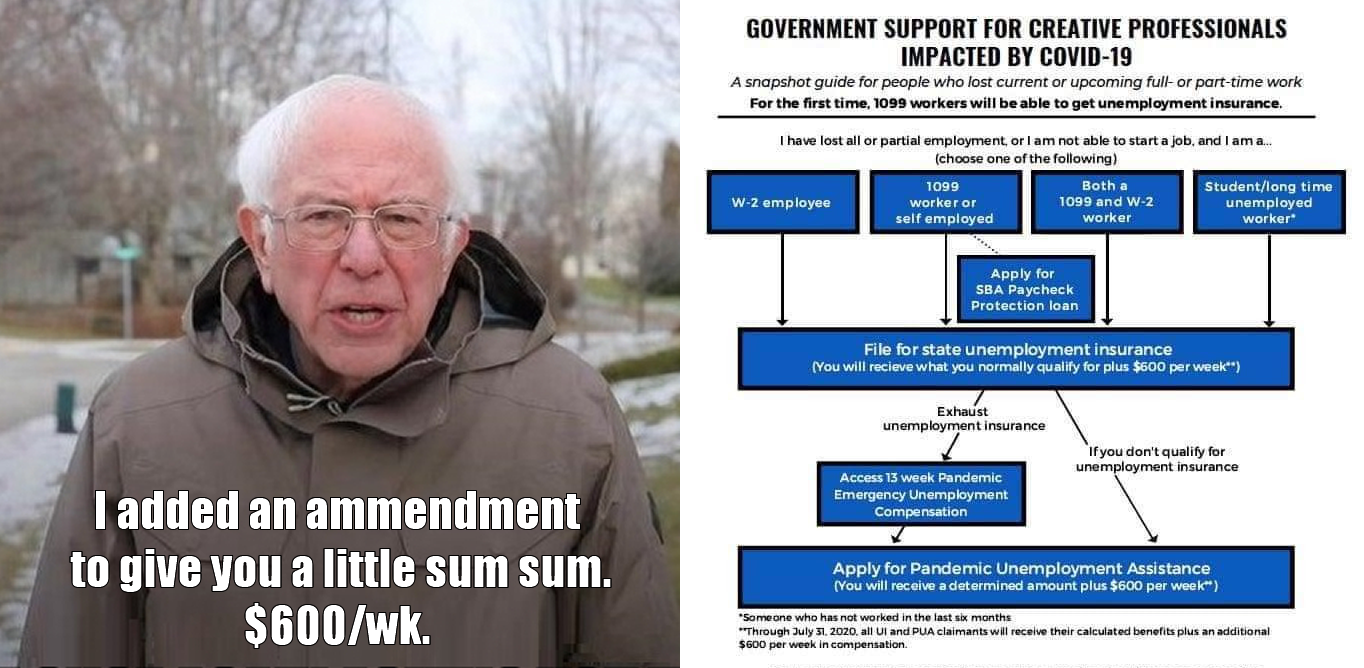
This meme is a satirical representation of left-wing politics, specifically the idea that the government will provide for everyone's needs. The image features a screenshot of a government assistance program, with a humorous twist on the typical "I get by with a little help from my friends" song by The Beatles, changed to "I get by with a little help from the government."
detailed-analysis (gemma3-27b-vision)
Okay, here's an analysis of the image, broken down into sections according to the frameworks you requested. It’s important to note that applying these frameworks to a single image is always a bit of a stretch – they are more suited to larger cultural texts or social structures. However, we can identify elements within the image that resonate with these approaches.
Please note: The image is a flow chart detailing government support for those impacted by COVID-19, specifically those in the "gig economy" (1099 workers) or traditional employment. It also includes an image of a man in military uniform. This analysis will consider both the content of the flow chart and the addition of the image of the military man.
Visual Description
The image is a digitally created flow chart outlining access to unemployment benefits for individuals impacted by the COVID-19 pandemic. The chart is titled “Government Support for … impacted by COVID-19.” It focuses on support for “1099 workers,” “W-2 employees,” and “students/long-time unemployed workers.” The chart depicts a series of decision points, leading to different pathways for applying for financial assistance through programs like the Small Business Administration (SBA), state unemployment insurance, and Pandemic Unemployment Assistance (PUA). Notably, it highlights an extra $600 per week benefit through certain programs.
Overlaid on the chart is a photo of a man in military uniform. He's looking off to the side, and the image is slightly desaturated. Handwritten text is imposed on the image reading "I added an amendment to give you a little sum sum $600/wk." This handwritten text is overlaid prominently in front of the chart.
The overall visual impression is of a bureaucratic process presented alongside a figure implying individual agency.
Foucauldian Genealogical Discourse Analysis
Michel Foucault’s work focused on power dynamics manifested through discourse (language and systems of thought). This image lends itself to this analysis by highlighting how state power is exercised through the creation and management of welfare programs.
- Discourse and Power: The flow chart is a discourse – it defines who qualifies for aid, how they apply, and the terms of that aid. This creates a system of categorization and control. By defining ‘eligible’ and ‘ineligible’ subjects, it exercises power.
- Genealogy: Examining the "genealogy" of this program (tracing its historical development) reveals how the definition of "work," "employment," and "need" have shifted, particularly with the rise of the gig economy. The $600/week supplement is a particularly interesting point – it was a temporary measure born out of crisis and highlights how the state is willing to intervene economically under specific circumstances.
- Panopticism: While not a direct example, the bureaucratic flow chart evokes the feeling of being monitored and assessed. Applicants must navigate a complex system to “prove” their eligibility, mirroring the surveillance of the Panopticon.
- The Addition of the Soldier: The addition of the soldier introduces the idea of military power being tied to the delivery of these economic benefits. This is a subtle but important link – the idea that support for citizens is tied to the strength and authority of the military.
Critical Theory
Critical Theory, stemming from the Frankfurt School, focuses on exposing power structures and challenging dominant ideologies.
- Ideology: The image implicitly promotes the idea that the state is a benevolent provider of aid. This reinforces the ideology of state legitimacy. However, the complex and often opaque nature of the application process (represented by the flow chart) suggests that accessing aid isn’t straightforward, potentially masking the inherent power imbalances.
- Commodification of Labor: The focus on "workers" and their ability to qualify for aid reinforces the capitalist emphasis on labor as a commodity. The flow chart doesn’t address the systemic issues that lead to unemployment; it simply offers a temporary solution to maintain the flow of labor.
- Critique of Rationality: The flow chart itself is an expression of bureaucratic rationality. While appearing objective, it relies on specific definitions and categories that may not accurately reflect lived realities.
- The Soldier: The hand-written addition of the soldier, claiming to be the one who added the $600, injects a personalized, almost authoritarian claim of responsibility. It suggests that benevolent government aid is dependent on the intervention of a powerful individual.
Marxist Conflict Theory
This framework views society as structured by class conflict.
- Class Struggle: The image implicates the vulnerability of workers (particularly 1099/gig economy workers) to economic shocks. It highlights the precarity of labor under capitalism, where workers are often at the mercy of market forces.
- The State as an Instrument of the Ruling Class: From a Marxist perspective, the state’s provision of aid is not necessarily altruistic. It could be seen as a strategy to maintain social stability and prevent widespread unrest by mitigating the worst effects of economic crisis.
- Exploitation of Labor: The aid is a temporary fix that doesn’t address the underlying causes of economic inequality or the exploitation of labor. It simply provides a safety net, allowing the system to continue functioning.
- The Soldier: The image of the soldier could be interpreted as a symbol of the state’s coercive power, deployed to maintain the status quo and protect the interests of the ruling class.
Postmodernism
Postmodernism challenges grand narratives and emphasizes subjectivity, fragmentation, and the instability of meaning.
- Deconstruction of Authority: The handwritten claim of responsibility by the soldier actively destabilizes the perceived objectivity of the chart. It injects a subjective, personalized claim into what appears to be a neutral bureaucratic process.
- Fragmentation of Identity: The chart’s categorization of workers (W-2, 1099, student) highlights the fragmentation of the modern labor market and the blurring of traditional employment categories.
- The Simulacrum: The aid program itself could be seen as a “simulacrum” – a copy without an original. It’s a representation of support that may not address the underlying issues.
- Meta-Narrative: The image challenges the "meta-narrative" of a benevolent, all-powerful state by inserting a personal, somewhat boastful claim of authorship.
Queer Feminist Intersectional Analysis
This framework analyzes power dynamics through the lens of gender, sexuality, race, class, and other intersecting identities. It's the most difficult to apply directly, but points can be made.
- Precarity and Gendered Labor: The gig economy, heavily represented by the "1099 worker" category, often disproportionately affects women and people of color, who are more likely to be employed in precarious or low-wage work. The aid program, while helpful, doesn’t address these systemic inequalities.
- Intersectional Vulnerability: Individuals facing multiple forms of oppression (e.g., women of color, LGBTQ+ individuals in precarious employment) may face additional barriers to accessing aid.
- The Soldier as a Symbol of Patriarchy: The image of the soldier, traditionally associated with masculinity and power, could be interpreted as reinforcing patriarchal structures.
- Care Work and Aid: The aid program can be seen as a form of “care work,” but this care is often delivered through bureaucratic systems that lack empathy or understanding of individual needs.
- Lack of Specificity: The image doesn’t account for marginalized populations' specific needs in the flow chart, and is therefore an example of power imbalances.
Disclaimer: This is an interpretive analysis, and other readings are possible. These frameworks are complex and nuanced, and applying them to a single image necessarily involves some simplification and speculation.
simple-description (llama3.2-vision)
The meme features a photo of Bernie Sanders, a former US Senator, sitting in a chair in the cold, looking unimpressed. The text overlayed on the image reads: "I added an amendment to give you a little sum sum. $600/wk." The meme is a humorous take on the COVID-19 relief bill, specifically the $600 weekly unemployment benefit, and Sanders' deadpan expression is used to poke fun at the idea of a politician's response to a crisis.
tesseract-ocr
zz ss a . fii Lig : GOVERNMENT SUPPORT FOR CREATIVE PROFESSIONALS u% Pe 7 = IMPACTED BY COVID-19 ‘ , ‘ , A snapshot guide for people who lost current or upcoming full- or part-time work a] a : + For the first time, 1099 workers will be able to get unemployment insurance. “% —eEeEeEeEEeEEeEeE—E——E—E—Ee—Ee—e—e—e—e—ee_eeee ane | have lostaall or partial employment, or lam not able to start a job, and | am a. . e& is (choose one of the following) a pa vi fe ory i lie - aoe _——. nm - A eT Roa Ae LC hed mee To $ ‘i rx if oe I Pree Reaper cis ‘i “7 ore Naas a Ba Ue a << Cee tara teaied . Gere Te seetereyery stele sia tren) _ o Exhaust 7 unemployment insurance Ifyou don't qualify for ' es a ee unemployment Insurance | added an ammendment <a (\ if Ty | NA a alla) oa gece Ulsy to i] Yt Wu | c l ittl é 5 HN m S u Hi 0 Pee es aerate ll a areata “Someone who hes not worked inthe last sk month $600/wk Ree ee anc pr eancctsial tate 0 $600 per week in compensation.