First Seen
2023-05-10T21:03:35+00:00
simple-description (llama3.2-vision_11b)
The meme is a humorous commentary on the perceived divide between leftists and communists. The image is likely a graph showing the results of a poll or survey, with a significant portion of respondents identifying as "leftist" or "communist" in one or both categories. The meme's text likely reads "I'm a leftist, but I'm not a communist" or something similar, poking fun at the idea that being a leftist doesn't necessarily mean you're a communist.
detailed-analysis (gemma3-27b-vision)
Okay, here's an analysis of the Instagram post, broken down into sections based on the requested theoretical frameworks. Not all frameworks will be relevant or significantly applicable, so some sections will be brief or absent.
Visual Description
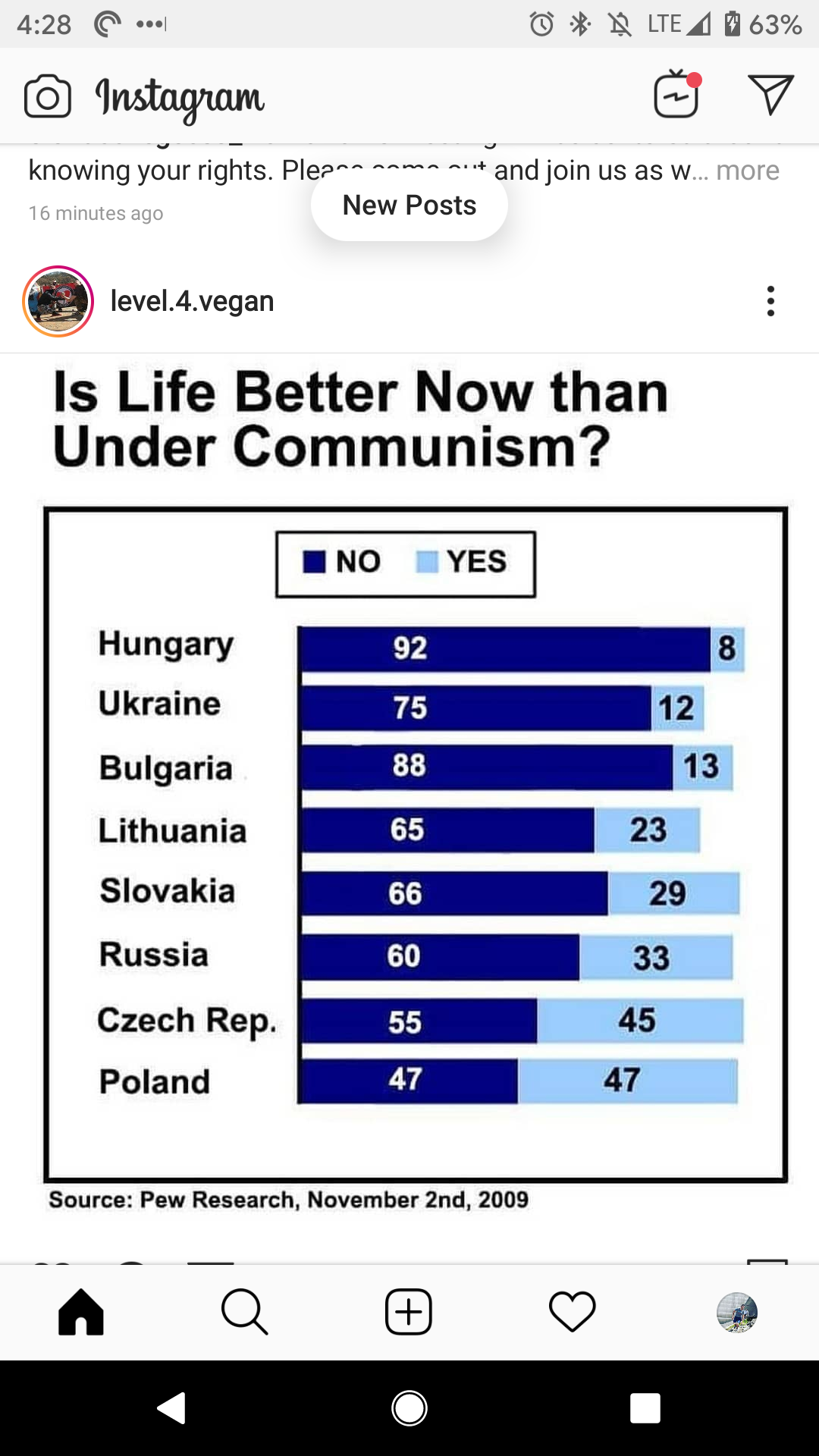
The image is a screenshot of an Instagram post from an account called "level.4.vegan." The post presents a bar graph comparing perceptions of quality of life between life now and life under communism in several Central and Eastern European countries (Hungary, Ukraine, Bulgaria, Lithuania, Slovakia, Russia, Czech Republic, and Poland). The bars are color-coded: dark blue represents the percentage of respondents who say life is now better, and light blue indicates the percentage who say life under communism was better. The post cites "Pew Research, November 2nd, 2009" as its source. The background is the standard Instagram interface showing bottom navigation icons (home, search, etc.).
Foucauldian Genealogical Discourse Analysis
This post is a snapshot within a much larger discourse surrounding the legacy of communism and the construction of post-communist identity. A Foucauldian approach focuses on how the question itself – "Is life better now than under communism?" – has produced certain understandings and silences.
- Power/Knowledge: The Pew Research study itself isn’t neutral. Its design, questions, and even the selection of countries reflect the power dynamics of Western/global research institutions. The "truth" of the data is not inherent, but produced through this specific apparatus of knowledge.
- Genealogy: Tracing the genealogy of this question reveals its roots in Cold War narratives. The very framing implies a comparison between two inherently opposed systems, validating the liberal-capitalist triumph as a natural and inevitable outcome. What has been lost in this narrative? The experiences of those who did benefit from aspects of communist systems (e.g., guaranteed employment, social services)? The nuances of life before 1989?
- Disciplinary Power: The presentation of the data as percentages categorizes and normalizes opinions, potentially disciplining alternative narratives. It reinforces a "quantitative" way of understanding a complex historical and lived experience.
Critical Theory
From a Critical Theory perspective, particularly drawing on the Frankfurt School, this post reveals the power of ideology and the "culture industry" to shape perceptions of the past.
- Ideology: The post reinforces the dominant Western narrative that life is demonstrably better under capitalism than under communism. This serves to legitimize the post-1989 transition and obscure the inequalities and hardships that many experienced.
- Instrumental Reason: The focus on quantifiable data ("percentages") exemplifies instrumental reason—reducing complex social phenomena to numbers for the sake of control and efficiency. This ignores the qualitative aspects of life—e.g., social cohesion, meaning, purpose—that are not easily captured by statistics.
- Reification: The data reifies "communism" and "capitalism" as abstract systems, obscuring the lived experiences of individuals within those systems. It treats them as monolithic entities rather than dynamic and contested social formations.
- Hegemony: The consistent "no" responses in most countries may indicate the successful establishment of a hegemonic narrative that frames capitalism as superior, despite potential shortcomings.
Marxist Conflict Theory
From a Marxist standpoint, this post reflects the ongoing class struggle and the ideological battle between competing socio-economic systems.
- Base and Superstructure: The survey results can be seen as part of the "superstructure" – the ideas, values, and beliefs that reinforce the "base" – the underlying economic system. The dominant narrative that capitalism is better serves to legitimize the capitalist mode of production and the resulting class relations.
- False Consciousness: The high percentage of "no" responses might be interpreted as a reflection of "false consciousness"—a situation where people internalize the values and beliefs of the dominant class, even if those values are detrimental to their own interests.
- Historical Materialism: Understanding the historical context of these countries is crucial. The post-communist transition involved massive privatization, economic restructuring, and the emergence of new class divisions. The survey results may reflect the experiences of those who benefited from this transition versus those who were left behind.
- Ideological Struggle: The post itself can be seen as an intervention in the ongoing ideological struggle between capitalism and alternative socio-economic systems.
Postmodernism
A postmodern perspective might challenge the very idea of a "true" or objective comparison between life under communism and life now.
- Grand Narratives: The question implies a "grand narrative" of progress – that history moves towards a better future, and capitalism represents that future. Postmodernism rejects such totalizing narratives, arguing that truth is relative and context-dependent.
- Deconstruction: Deconstructing the question reveals its inherent biases and assumptions. "Better" is a subjective term, and its meaning varies depending on individual values and perspectives.
- Fragmentation: The experiences of life under communism and life now are fragmented and diverse. The survey results present a simplified and homogenized picture, obscuring the complexities and contradictions of lived experience.
- Simulacra and Simulation: One could argue that the "communist past" is often a simulacrum—a copy without an original—constructed through memory, nostalgia, and political rhetoric.
Queer Feminist Intersectional Analysis
This framework emphasizes how gender, sexuality, and other marginalized identities intersect with economic and political systems to shape experiences.
- Intersectionality: While the survey doesn’t explicitly address gender or sexuality, it's crucial to recognize that experiences under both communism and capitalism were deeply shaped by these factors. The impacts of economic transition on women (e.g., increased economic insecurity, reduced access to social services) and LGBTQ+ individuals (e.g., exposure to discrimination, lack of legal protections) were likely different from those experienced by heterosexual men.
- Patriarchy and Capitalism: This framework would explore how patriarchy operates within capitalism to create specific forms of oppression. The post-communist transition often involved the reassertion of traditional gender roles and the commodification of women's bodies.
- Queer Erasure/Reconfiguration: Communism, while nominally progressive on LGBTQ+ rights in some ways, often suppressed queer expression in practice. Capitalism, while providing some spaces for queer visibility, also exposes LGBTQ+ individuals to new forms of economic exploitation and discrimination.
- Critical of Universal Claims: A queer feminist approach would challenge the idea that "life is better now" for everyone. It would highlight the experiences of those who continue to be marginalized and oppressed under the current system.
Let me know if you'd like me to elaborate on any of these points or focus on a particular theoretical framework.
simple-description (llama3.2-vision)
The meme is a screenshot of a Reddit post that shows a chart from a 2009 Pew Research survey about the relationship between communism and happiness. The chart lists 8 countries and their responses to the question "Is life better now than under communism?" The text at the top of the image reads "Is life better now than under communism?" with a "no" and "yes" option below it. The chart shows that in 2009, most people in these countries believed that life was better now than under communism, with only one country (Bulgaria) showing a significant "no" response.
tesseract-ocr
4:28 © evel © # W LEM 63% (0) Instagram VW knowing your rights. Pleers --~- ~ and join us as w... more 16 minutes ago New Posts level.4.vegan : Is Life Better Now than Under Communism? Hungary ey 8 Ukraine 75 12 Bulgaria iT) 13 Lithuania 65 23 Slovakia 66 29 Russia 60 33 Czech Rep. 55 45 Poland yA 47 Source: Pew Research, November 2nd, 2009 A Q Q a