First Seen
2023-05-10T21:03:35+00:00
simple-description (llama3.2-vision_11b)
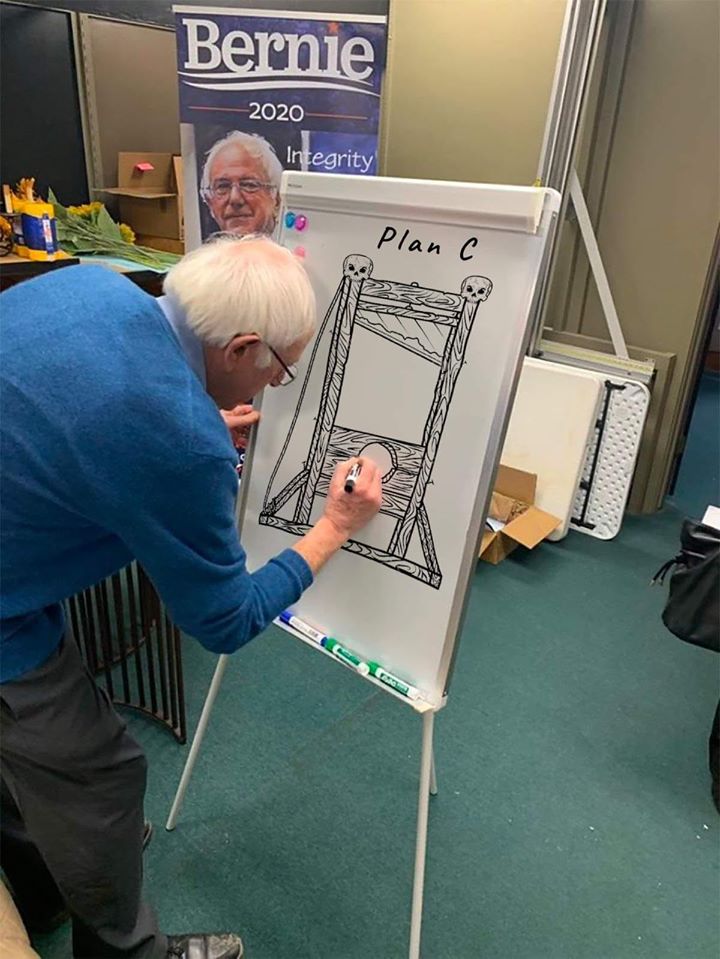
The meme features a drawing of a guillotine with the caption "I can show you my plans" in a mocking tone, referencing Bernie Sanders' 2020 presidential campaign slogan "Not Me. Us." It implies that the speaker's plans are as extreme and violent as the guillotine, a symbol of the French Revolution's Reign of Terror.
detailed-analysis (gemma3-27b-vision)
Okay, here's an analysis of the image, broken down into sections addressing the requested theoretical frameworks, only where applicable. Given the visual content, some sections will be more robust than others.
Visual Description
The image shows an elderly man, presumably Bernie Sanders (based on the banner behind him), drawing on a whiteboard on an easel. He’s dressed in a navy blue long-sleeved shirt and grey pants. He’s in the act of sketching a detailed drawing of a guillotine, writing the words “Plan C” at the top. The background shows a room decorated with political paraphernalia, prominently including a banner for Bernie Sanders’ 2020 presidential campaign with the word “Integrity” underneath. There are also bottles of something, potentially juice or water, and a few scattered items on a table to the left. A white plastic folding table and a black bag are visible in the lower right corner. The overall lighting is somewhat dim and the room appears to be a meeting or event space.
Foucauldian Genealogical Discourse Analysis
This image is ripe for a Foucauldian reading. The drawing of the guillotine, and the labeling of it as "Plan C", immediately brings to light a discourse of power and violence. Foucault’s genealogical method focuses on uncovering the historical conditions that gave rise to specific knowledge and power relations.
- Historical Context: The guillotine is historically tied to the French Revolution, a period of radical upheaval aimed at overthrowing the aristocracy and establishing a new order. This historical connection inherently links the drawing to ideas of revolution, justice, and the power to decide who lives and dies.
- Discourse of Revolution: The image sets up a discourse where the guillotine isn't presented as a relic of the past, but as a potential "Plan C." This implies a perceived inadequacy of existing methods or plans ("Plan A" and "Plan B"), suggesting a growing frustration with the status quo and the need for drastic action.
- Power/Knowledge: The image raises questions about who is proposing this “Plan C” and what kind of knowledge justifies it. The connection between Bernie Sanders (a political figure with a history of appealing to the marginalized) and the symbol of revolutionary violence is particularly provocative. It suggests a shift in acceptable forms of political expression.
- Discipline and Control: Although the guillotine represents extreme violence, Foucault also argued that power operates not only through repression but also through discipline and normalization. This image can be seen as a disruption of those norms, a moment where the threat of extreme force is openly visualized.
Critical Theory
From a Critical Theory perspective (drawing on the Frankfurt School), the image can be interpreted as a symptom of societal alienation and the failure of traditional political systems.
- Reason & Enlightenment: Critical Theorists often critique the Enlightenment project as having created a "instrumental reason" that prioritizes efficiency and control over human values. The image of the guillotine, despite its connection to Enlightenment ideals of justice, can be seen as a terrifying manifestation of this logic taken to its extreme.
- Mass Culture & Propaganda: The image, particularly in the context of a political campaign, can be seen as an example of how political symbols are employed to evoke emotional responses and manipulate public opinion. Is the intention to genuinely advocate for revolutionary violence, or simply to shock and provoke? The ambiguity is key.
- Critique of Capitalism: Bernie Sanders is famously associated with democratic socialism and critiques of capitalism. The guillotine, historically associated with the overthrow of aristocratic structures, can be seen as a metaphor for the dismantling of capitalist systems and the redistribution of wealth and power.
- Alienation & Resentment: The drawing can be interpreted as an expression of deep-seated alienation and resentment towards those in power, a feeling that the system is rigged and that drastic measures are necessary to achieve justice.
Marxist Conflict Theory
The image is particularly resonant when viewed through a Marxist lens.
- Class Struggle: The guillotine is inherently a symbol of class struggle and the overthrow of oppressive structures. It represents the historical culmination of conflict between the proletariat (working class) and the bourgeoisie (ruling class).
- Revolutionary Violence: Marxists often see revolutionary violence as a necessary, albeit unfortunate, consequence of systemic inequality and exploitation. The image suggests a potential escalation of this conflict.
- Ideology & False Consciousness: The image challenges the dominant ideology that perpetuates the status quo. It forces viewers to confront the underlying power dynamics that shape their lives.
- Capitalist Crisis: The image can be interpreted as a response to a perceived crisis of capitalism, a sense that the system is failing to meet the needs of the majority of people.
Postmodernism
A postmodern reading would focus on the image's deconstruction of meaning and its playful (or cynical) appropriation of symbols.
- Simulacra & Hyperreality: The image could be seen as a simulacrum – a copy without an original. The guillotine has lost its historical context and become a mere signifier of revolution, divorced from any concrete reality.
- Irony & Parody: The image could be interpreted as a form of ironic commentary on the state of contemporary politics. The labeling of the guillotine as "Plan C" suggests a sense of absurdity and hopelessness.
- Deconstruction of Grand Narratives: Postmodernism rejects "grand narratives" – overarching explanations of history and society. The image disrupts any attempt to provide a simple or coherent account of political struggle.
- Fragmentation & Pluralism: The image reflects a fragmented and pluralistic political landscape, where competing ideologies and symbols clash with one another.
Queer Feminist Intersectional Analysis
This is the most difficult framework to apply directly, but it’s possible to make some connections.
- Power Dynamics: The guillotine as a symbol of state violence historically disproportionately impacts marginalized groups, including queer and trans people, as well as people of color. Its presence in this context is thus unsettling.
- Intersectionality: Intersectionality acknowledges that oppression is not singular, but interlocking. The figure of the guillotine could represent the multiple forms of oppression faced by individuals at the intersections of different identities.
- Challenging the State: Queer and feminist thought often critiques the state as a site of patriarchal and heteronormative power. The image's implicit rejection of the status quo could be seen as aligned with these critiques.
- Violence & Liberation: Queer feminist theory grapples with the complex relationship between violence and liberation. The image raises questions about whether violence is ever a legitimate means of achieving social justice.
Disclaimer: The interpretation of any image is subjective. The above analysis offers one possible reading based on these theoretical frameworks. The actual intent of the image's creator is unknown and may be different.
simple-description (llama3.2-vision)
The meme features a drawing of a guillotine on a whiteboard, with the caption "Plan C" written above it. The drawing is a humorous and satirical take on the idea of a "Plan C" being a last resort or a desperate attempt to solve a problem. The image is likely meant to be ironic or sarcastic, implying that the person is desperate and willing to resort to extreme measures.
tesseract-ocr
Ae ise i —— | — 7 ip eo’ Se - a5 a ah ie [iz=—2 \ ¢ SS lL elie a || oD ay _ y ae * zB ee