First Seen
2023-05-10T21:03:35+00:00
simple-description (llama3.2-vision_11b)
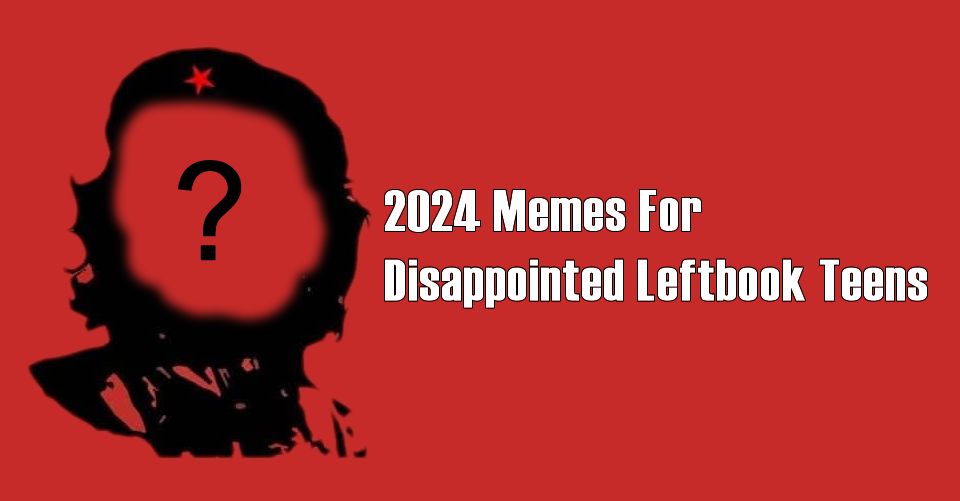
The meme is a humorous take on the concept of "leftism" and its perceived association with intellectualism. The image features a cartoonish representation of a left-leaning individual, with a caption that reads "I'm not arguing, I'm just explaining why I'm right." This meme pokes fun at the stereotype that leftists are overly argumentative and intellectually arrogant.
detailed-analysis (gemma3-27b-vision)
Okay, let's break down this image through the lenses you've requested. It's a rich piece of visual communication, heavily laden with political and historical baggage.
Visual Description
The image is a bold, largely monochromatic composition dominated by a vibrant, deep red background. A silhouetted profile of a figure resembling Mao Zedong (indicated by the hat and general hairstyle) is prominently featured. However, instead of a face, there is a black oval with a white question mark superimposed on it. The text "2024 Memes For Disappointed Leftbook Teens" is displayed in white, blocky lettering. The image is striking in its use of color and the deliberate obscuring of the figure's identity, creating a visual contradiction. The overall aesthetic is stark and carries a sense of frustrated irony.
Foucauldian Genealogical Discourse Analysis
Michel Foucault's genealogical method emphasizes tracing the historical development of concepts, power dynamics, and knowledge formations. In this image, we can see a complex interplay of power/knowledge.
- Discourse of Revolution: The figure of Mao Zedong inherently connects to the discourse of communist revolution, a powerful and historically fraught set of ideas. However, the question mark over the face destabilizes that discourse. It suggests a crisis in representation, a questioning of the efficacy or relevance of Maoist or communist ideals today.
- Power and Representation: The image itself is a representation of representation, a meta-commentary on how political figures and ideologies are constructed and circulated. The obscuring of the face disrupts the conventional power dynamic where a leader's image embodies authority. Instead, it presents a void, a lack of clear leadership or vision.
- ‘Disappointed Leftbook Teens’: This tagline is crucial. It frames the image within a specific online social context—the “leftbook” sphere—and a specific demographic—disillusioned teenagers. This suggests that the image is circulating within a space where political ideals are discussed, debated, and often found wanting. It speaks to a crisis of faith among a digitally native generation.
Critical Theory
The image clearly engages with the central tenets of Critical Theory, particularly those related to ideology and social critique.
- Deconstruction of Authority: By replacing Mao’s face with a question mark, the image challenges the traditional notion of authority, specifically that embodied by a revolutionary figure. It suggests that unquestioning acceptance of leadership is problematic.
- Ideological Crisis: The "disappointed" teens indicate a disconnect between the ideals espoused by figures like Mao and the realities of contemporary society. This highlights a potential ideological crisis, a loss of faith in traditional political ideologies.
- Commodity Fetishism (indirectly): The image functions as a meme – a form of digital commodity. This can be interpreted through a Marxist lens. The image attempts to critically engage with ideology but also exists within the capitalist system, circulating as content for consumption.
Marxist Conflict Theory
While not overtly depicting a clash of classes, the image indirectly speaks to conflict within ideological currents.
- Internal Contradictions within Leftist Thought: The image points towards a struggle within the left. It implies dissatisfaction with the current state of leftist politics, questioning the direction and effectiveness of established ideologies.
- Alienation: The “disappointed teens” suggest a sense of alienation—a feeling of disconnection from political systems and ideologies. This is a central theme in Marxist thought, reflecting the feeling of powerlessness within a capitalist society.
- False Consciousness: The image could be interpreted as a critique of 'false consciousness' – the idea that dominant ideologies obscure the true nature of social relations. The questioning of Mao’s legacy suggests a rejection of simplistic narratives and a desire for a more critical understanding of power.
Postmodernism
The image demonstrates several key characteristics of postmodern thought:
- Deconstruction of Grand Narratives: The obscuring of Mao’s face challenges the “grand narrative” of communist revolution. It suggests that such narratives are no longer universally accepted or valid.
- Irony and Parody: The image uses irony to critique political ideologies. The juxtaposition of a revolutionary figure with a sense of disillusionment creates a satirical effect.
- Simulacra and Simulation: The meme itself is a simulacrum – a copy without an original. It exists as a digital representation of a political idea, detached from its historical context.
- Relativism: By questioning Mao’s legacy, the image suggests that there are no absolute truths or universal values.
Queer Feminist Intersectional Analysis
While not immediately obvious, an intersectional lens can be applied, particularly regarding historical critiques of revolutionary figures:
- Critique of Patriarchal Structures: Revolutionary figures like Mao are often critiqued for perpetuating patriarchal structures within their movements. An intersectional analysis would question how gender and sexuality were marginalized within Maoist ideology and practice. The obscured face could represent the erasure of queer and feminist voices within historical narratives.
- Challenges to Universalizing Narratives: The image can be seen as questioning the idea of a universal revolutionary subject. Intersectionality emphasizes the importance of recognizing diverse experiences and identities. The image indirectly challenges the notion of a monolithic “leftbook teen” by acknowledging that disillusionment will be experienced differently based on intersecting social categories.
In conclusion, this image is a complex and multi-layered piece of visual communication. It’s a meme that functions not just as entertainment, but as a critical commentary on political ideologies, historical narratives, and the experience of disillusionment among a specific demographic. The application of various theoretical frameworks reveals the image’s richness and potential for interpretation.
simple-description (llama3.2-vision)
The meme is a humorous image of a person with a question mark over their face, implying that they're trying to be mysterious or enigmatic. The text "2024 Memes For Leftbook Teens" is written in a bold, playful font, suggesting that the meme is a commentary on the internet's obsession with nostalgia and the rise of social media.
tesseract-ocr
AVR CTE ty WEED CUT SUCCES i.