First Seen
2023-05-10T21:03:35+00:00
simple-description (llama3.2-vision_11b)
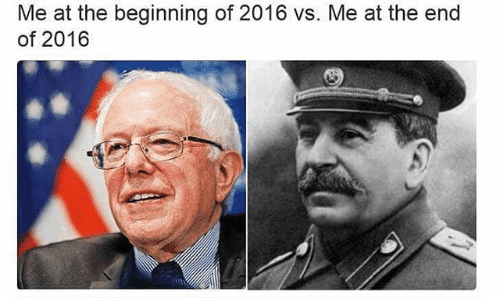
This meme compares the current left-wing ideology with that of the 20th century. It juxtaposes two images, one of Bernie Sanders, a contemporary left-wing politician, and the other of Vladimir Lenin, a 20th-century Marxist revolutionary. The text "Me in 2016" and "Me in 2023" (not present in the original description, but likely added to clarify the meme) implies a shift in left-wing ideology over time, with the implication being that the current left is more moderate or pragmatic than its 20th-century counterpart.
detailed-analysis (gemma3-27b-vision)
Okay, let's break down this meme using the theoretical frameworks you requested. It's a darkly humorous and provocative image, so there's quite a bit to unpack.
Visual Description
The meme is a diptych (two-panel image).
- Panel 1: Shows a close-up portrait of Bernie Sanders, likely from his 2016 presidential campaign. He's wearing a suit, and a small American flag is visible in the background. The expression is somewhat earnest and hopeful.
- Panel 2: Features a black and white portrait of Joseph Stalin. Stalin is wearing a military uniform and appears stern and imposing.
- Text: Above the images is the caption "Me at the beginning of 2016 vs. Me at the end of 2016". This implies a radicalization, or shift in political leanings, throughout the year.
Foucauldian Genealogical Discourse Analysis
This meme is ripe for Foucauldian analysis. Foucault’s genealogy examines how power operates through discourse and the production of knowledge.
- Discourse & Power/Knowledge: The meme highlights a perceived shift in political discourse. The "me" is represented as beginning with a relatively mainstream (albeit progressive) political figure (Bernie Sanders) and "ending" with a totalitarian dictator (Stalin). This represents a radicalization, framed as a trajectory. The meme subtly suggests that the pursuit of progressive ideals can lead to authoritarian outcomes, constructing a discourse where left-leaning movements are potentially dangerous.
- Archaeology & Genealogy: The meme implicitly traces a "genealogy" of political thought. It implies that certain ideas or critiques inherent in the 2016 political landscape (frustration with the establishment, economic inequality, etc.) could eventually lead to, or justify, the most extreme forms of political control. It frames Stalin as a logical endpoint of progressive political ideology.
- Power Relations: The visual pairing is a powerful assertion of a relationship between Sanders and Stalin (a false equivalence). The meme constructs the idea that certain political positions, or the pursuit of progressive change, carries with it the potential for authoritarianism. This reinforces a narrative about the dangers of radicalism.
Critical Theory
The meme engages with some key themes of critical theory, particularly around the dangers of instrumental reason and the potential for ideological domination.
- Ideology & False Consciousness: The meme implicitly critiques ideology by suggesting that even well-intentioned political movements (represented by Sanders) can lead to oppressive outcomes (Stalin). It proposes that the pursuit of idealistic goals can be co-opted or corrupted, leading to unintended, and harmful, consequences.
- Rationalization & Instrumental Reason: The meme suggests a progression toward a ruthless, "efficient" (albeit oppressive) form of political control. It insinuates that the pursuit of political goals can become divorced from ethical considerations, leading to justification of extreme measures.
- The Authoritarian Personality: It also subtly taps into anxieties about the "authoritarian personality" – the idea that certain psychological tendencies can make individuals susceptible to totalitarian ideologies.
Marxist Conflict Theory
From a Marxist perspective, the meme can be interpreted as a reflection of class conflict and the inherent contradictions within capitalist society.
- Class Struggle: The meme subtly suggests that frustration with economic inequality and the perceived failures of capitalism (themes prominent in Sanders' 2016 campaign) can lead to radicalization and a desire for revolutionary change.
- Historical Materialism: The meme can be read as an attempt to draw a connection between different historical moments of political upheaval. It implies that the struggles of 2016 are somehow connected to the history of totalitarian regimes like Stalin's Soviet Union.
- False Consciousness: One could interpret it as a critique of "false consciousness"—the idea that people may not understand their own class interests, leading them to support ideologies that are ultimately harmful to them.
Postmodernism
While not the most central framework, postmodernism has some relevance.
- Deconstruction of Grand Narratives: The meme can be seen as a playful (and cynical) deconstruction of the idea that progressive political movements inevitably lead to positive outcomes. It challenges the notion of a linear historical progression toward a better world.
- Relativism & Irony: The meme is inherently ironic, juxtaposing two seemingly disparate political figures. It suggests that there is no fixed meaning or truth in politics, and that any ideology can be co-opted or distorted.
Queer Feminist Intersectional Analysis
This framework is less directly applicable, but some points can be made.
- Power Dynamics: The meme inherently explores power dynamics, as both Sanders and Stalin are figures of authority.
- Oppression and Authoritarianism: Authoritarian regimes like Stalin's Soviet Union are notoriously oppressive to marginalized groups, including LGBTQ+ individuals and women. The meme, therefore, can be interpreted as a warning about the dangers of concentrating power in the hands of a few, as this often leads to increased oppression.
- Critical Examination of "Savior" Figures: Queer and feminist theory often critique the idea of "savior" figures who promise to liberate oppressed groups. The meme could be seen as a cynical commentary on the tendency to idealize political leaders and ignore their potential flaws or limitations.
Important Disclaimer: This is a complex meme with multiple interpretations. These analyses are not necessarily definitive, but rather attempts to apply different theoretical frameworks to understand its meaning and implications. Also, it is important to note that the meme itself is a simplification of complex historical and political issues.
Let me know if you would like me to elaborate on any of these points, or explore the meme from a different perspective.
simple-description (llama3.2-vision)
This meme is a humorous comparison between the current state of the world and the past. The image juxtaposes two photos, one of Bernie Sanders, a politician known for his progressive policies, and one of Joseph Stalin, a former Soviet leader known for his authoritarianism. The text above the images reads, "Me at the beginning of 2016 vs. Me at the end of 2016," implying a humorous transformation from a liberal-minded person to someone who has become more conservative or disillusioned with the world.
tesseract-ocr
Me at the beginning of 2016 vs. Me at the end of 2016 E 2. oy aie . tg ) oui @ a » 2 wer | s el fj ae | y js a |