First Seen
2024-02-03T01:46:08.523405+00:00
simple-description (qwen3.5_2b-q8_0)
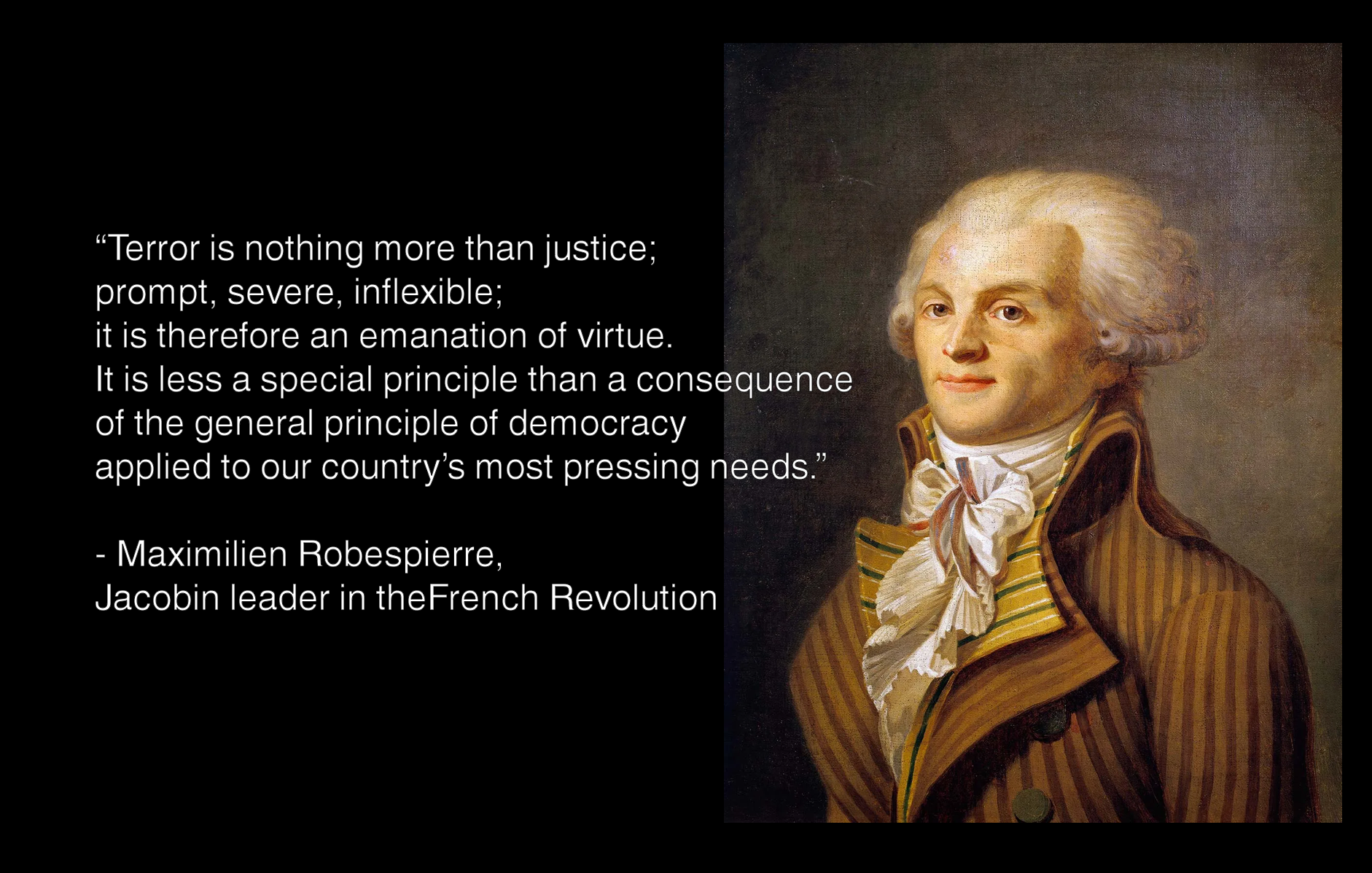
This meme features a portrait of Maximilien Robespierre, a leader in the French Revolution. The text explains his philosophy that "Terror is nothing more than justice; prompt, severe, inflexible; it is therefore an emanation of virtue." This connects to the Leftism category as Robespierre is a radical revolutionary leader who sought to establish social equality and strong governance through strict laws.
simple-description (llama3.2-vision_11b)
The meme is a screenshot of a quote from the French Revolution's leader Maximilien Robespierre, where he argues that the revolution's goal of equality and freedom is threatened by the rise of a tyrannical government. The quote emphasizes the need for the people to take control of their government and ensure it doesn't become a tyranny. The meme is likely used to criticize the current state of politics, where the government's power is being used to control and manipulate the people, rather than serving the people's interests.
detailed-analysis (gemma3-27b-vision)
Okay, let's break down this image and the accompanying quote through the lens of the theoretical frameworks you've requested. Not every framework will apply equally or at all, so I'll be selective and explain why.
Visual Description
The image is a portrait painting of Maximilien Robespierre, a prominent figure in the French Revolution. He's depicted from the chest up, facing the viewer directly.
- Composition: The portrait is classically composed, with Robespierre occupying the majority of the canvas. The background is a dark, undefined space, drawing attention to the subject.
- Color Palette: The colors are muted and predominantly earth-toned: browns, dark greens, and a pale skin tone. This creates a somewhat somber and austere mood. A vibrant red vest stands out, perhaps subtly hinting at the bloodshed associated with the Reign of Terror he oversaw.
- Facial Expression & Pose: Robespierre appears stoic and composed, with a slightly intense gaze. He's formally dressed in a dark coat with a frilly white shirt and a red vest. His pose is rigid and upright, projecting an image of authority and unwavering commitment.
- Overall Impression: The portrait presents Robespierre as a serious, principled, and somewhat austere figure. It emphasizes his formality and presents him as a man of conviction. The style contributes to a sense of historical distance and gravitas.
Foucauldian Genealogical Discourse Analysis
This framework is highly relevant, given the nature of the quote and Robespierre’s role.
- Discourse of Virtue & Terror: The quote itself is a prime example of a discourse. Robespierre doesn't simply describe 'Terror'; he constructs it as being inseparable from ‘virtue’ and ‘democracy.’ This isn't a natural connection, but one he actively creates through language. He positions Terror not as an aberration, but as a necessary consequence of pursuing a just and democratic society.
- Power/Knowledge: Foucault would be interested in how this discourse served to legitimize the Reign of Terror. The language isn’t just descriptive; it’s an exercise of power. By defining Terror as virtue, Robespierre sought to establish the authority to implement it and silence dissent. Knowledge (the definition of Terror) became inextricably linked to power (the ability to enforce it).
- Genealogy of ‘Justice’ and ‘Virtue’: A genealogical investigation would trace the historical emergence of the concepts of ‘justice’ and ‘virtue’ and how their meanings changed over time. Robespierre isn’t appealing to timeless, universal ideals; he’s drawing on a specific historical context and redefining these terms to suit his political agenda. He presents his actions as a return to a more 'authentic' form of virtue and justice, but this is a constructed narrative.
- Disciplinary Power: The Reign of Terror operated as a form of disciplinary power. It wasn't just about execution; it was about shaping subjects through fear and surveillance. The discourse of virtue and terror served to normalize the use of violence and control.
Critical Theory
This framework fits well, particularly its focus on ideology and power.
- Ideology and Justification: The quote is a clear example of ideology at work. Robespierre's claim that terror is justice serves to conceal the brutal reality of the Reign of Terror and present it as a rational, even moral, undertaking. It’s a way to legitimize violence and suppress opposition.
- Hegemonic Discourse: The idea that Terror is linked to virtue and democracy could be seen as an attempt to establish a hegemonic discourse—a dominant worldview that becomes taken for granted. If people accept this framing, they’re less likely to question the legitimacy of the violence.
- Critique of Enlightenment Reason: Some Critical Theorists (like Adorno and Horkheimer) might argue that this quote exemplifies a dangerous turn in Enlightenment thought. The emphasis on abstract principles ("virtue," "democracy") divorced from concrete reality can lead to instrumental reason—the pursuit of ends without regard for ethical considerations.
Marxist Conflict Theory
This framework is partially applicable.
- Class Struggle and the State: From a Marxist perspective, the Reign of Terror can be seen as a tool used by the Jacobins (representing a rising bourgeois or petit-bourgeois class) to consolidate power and suppress the aristocracy and other perceived enemies of the revolution. The discourse of virtue and terror served to justify this class warfare.
- State Apparatus and Repression: The Reign of Terror was a clear demonstration of the state's repressive apparatus. The quote rationalizes the use of violence to maintain the status quo and suppress challenges to the new order.
- Ideology as False Consciousness: The argument that terror is justice could be seen as a form of false consciousness, masking the underlying class interests driving the violence.
Postmodernism
This lens is less directly applicable, but offers some interesting perspectives.
- Deconstruction of Grand Narratives: Postmodernists would challenge the idea of a singular, universal 'virtue' or 'democracy.' They would argue that these concepts are historically and culturally contingent, and that Robespierre’s claim to be acting in their name is a form of power play.
- Critique of Truth Claims: The idea that terror is justice is a bold claim about truth. Postmodernists would question the possibility of objective truth, arguing that all knowledge is constructed and situated.
- Emphasis on Discourse and Power: Postmodernism shares with Foucault an interest in the relationship between discourse and power. The quote exemplifies how language can be used to construct reality and legitimize domination.
Queer Feminist Intersectional Analysis
This framework has the least direct relevance to the image and quote, but still offers some considerations.
- The Exclusion of Certain Voices: The Reign of Terror systematically silenced and persecuted anyone deemed a counter-revolutionary, often including women who challenged the patriarchal structures of the new regime.
- Intersection of Oppression: While the quote focuses on "virtue," it ignores the ways in which power and violence intersected with gender, class, and other social categories. It doesn’t acknowledge the diverse experiences of those affected by the Terror.
- Patriarchal Structures: The French Revolution, despite its ideals of liberty and equality, often reinforced patriarchal structures. Robespierre's discourse, while appealing to universal principles, may have masked the ways in which the revolution perpetuated gender inequality.
Let me know if you would like me to elaborate on any of these perspectives.
tesseract-ocr
“Terror is nothing more than justice; a , - a 2 prompt, severe, inflexible; —— 2 = . TeM tal -1e-j (ol e- m= Va] Ae =Ual- 160) 0°) Ae Wey It is less a special principle than a consequence a - of the general principle of democracy ‘i \ 7 ot applied to our country’s most pressing needs.” Aa Jf) ee : S v4 , . <= : imili H ; : j ee Sea : ee - Maximilien Robespierre, = ae Teh Jacobin leader in theFrench Revolution as ~~
simple-description (llama3.2-vision)
This meme is a humorous take on the French Revolution's infamous leader, Maximilien Robespierre. The image features a portrait of Robespierre with a quote from his infamous "Criminal of the … ” speech, which is used to make a darkly humorous comment about the current state of politics. The quote is presented in a playful, modern font to contrast with the old-fashioned portrait.