First Seen
2023-05-10T21:03:35+00:00
simple-description (llama3.2-vision_11b)
The meme is a photo of a man with a quote overlayed on it. The text reads: "I'm not a socialist, I'm a socialist in the sense that I believe in the collective ownership of the means of production and the distribution of resources based on need rather than profit, privilege, or social status."
detailed-analysis (gemma3-27b-vision)
Okay, let's break down this image and the quote through the lenses of different theoretical frameworks.
Visual Description
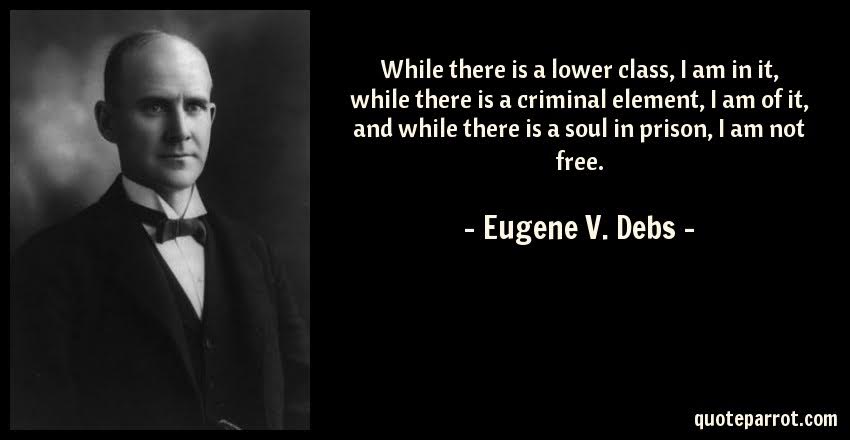
The image is a classic black and white portrait of Eugene V. Debs, a prominent socialist activist and political leader in the United States. He is dressed in a dark suit with a bow tie, appearing serious and resolute. The lighting emphasizes his strong features and gaze, giving a sense of dignity and determination. The background is a dark, neutral space, putting the focus entirely on Debs himself. The portrait style is reminiscent of early 20th century formal photography. Overall, the image communicates a sense of gravitas and the serious commitment of the subject.
Marxist Conflict Theory
This image and quote are deeply embedded in Marxist conflict theory. The quote "While there is a lower class, I am in it; while there is a criminal element, I am of it; and while there is a soul in prison, I am not free" directly addresses class struggle and systemic oppression.
- Class Consciousness: Debs demonstrates a clear identification with the working class, positioning himself within their struggles rather than above or separate from them. This is a key element of developing class consciousness – recognizing one's position within the capitalist system and its inherent inequalities.
- Exploitation & Alienation: The "lower class" is understood in Marxist terms as the proletariat—those exploited by the capitalist class (the bourgeoisie). Debs aligning himself with them highlights his rejection of the capitalist mode of production and its inherent injustices. The "criminal element" suggests those pushed to desperation by the system, and Debs refuses to disassociate from those deemed 'criminals' by the ruling class, recognizing the system is often to blame for their circumstances.
- Solidarity & Collective Liberation: By stating he is "not free" as long as souls are in prison, Debs emphasizes the interconnectedness of the struggle. His freedom is intrinsically linked to the liberation of all oppressed people. This highlights the importance of collective action and solidarity in achieving social change. The implication is that true liberation requires dismantling the systems that create poverty, crime, and imprisonment.
- Ideology & False Consciousness: Debs is rejecting the dominant ideology that justifies social inequalities. He refuses to participate in the labeling and marginalization of the working class and those imprisoned.
Foucauldian Genealogical Discourse Analysis
Foucault’s work examines how power operates through discourse, shaping what is considered 'normal' and 'deviant'. This image and quote allow us to examine this further:
- Power/Knowledge: Debs's statement challenges the power/knowledge nexus. The system defines who is 'criminal', who is 'free', and who belongs to the 'lower class'. Debs actively redefines these categories. By positioning himself with those marginalized by the system, he disrupts the accepted definitions and reveals the power structures embedded within those labels.
- Discipline & Punishment: The reference to prison directly invokes Foucault’s analysis of discipline and punishment. The prison is not merely a place of confinement, but a mechanism for controlling and normalizing individuals. Debs's statement suggests he rejects the legitimacy of this disciplinary power.
- Genealogy of Morality: The quote implicitly questions the moral frameworks that justify social hierarchies. By identifying with the 'lower class' and 'criminal element', Debs challenges the conventional notions of 'good' and 'bad', ‘law abiding’ and ‘criminal’.
- Subjectivity & Power: Debs is not simply a passive subject of power. He actively asserts his subjectivity by choosing to identify with the marginalized. This is a form of resistance.
Critical Theory
A critical theory approach would analyze how the image and quote reveal broader societal structures and power dynamics.
- Domination & Emancipation: The quote highlights the systemic domination of the working class and those trapped within the criminal justice system. Debs's stance is a call for emancipation—liberation from these oppressive forces.
- Critique of Ideology: The quote is a critique of the dominant ideologies that legitimize social inequalities and justify the exploitation of the working class. Debs is challenging the false consciousness that keeps people from recognizing their own oppression.
- The Role of the Intellectual: Debs’s actions exemplify the role of the intellectual as a critic of society and advocate for social change. He is not simply observing the world, but actively engaging in a struggle to transform it.
- Totalizing Systems: Critical theory emphasizes how seemingly neutral structures (like the legal system, economy, and political institutions) often operate to reinforce existing power imbalances. The quote implies Debs sees these systems as inherently unjust.
Postmodernism
Applying a postmodern lens is trickier. Postmodernism tends to deconstruct grand narratives and emphasize difference and fragmentation.
- Challenging Universal Truths: While Debs's message is quite grounded in Marxist ideals (a 'grand narrative' in itself), his act of aligning himself with the marginalized disrupts any claims of universal moral order or natural social hierarchy.
- Deconstruction of Identity: The quote can be interpreted as a deconstruction of identity categories. Debs refuses to define himself solely by his position as a political leader or intellectual. He identifies with those who are typically excluded from mainstream society.
- The Subject and Power: Debs is enacting a resistance to the idea that he can be defined by the ruling class.
Queer Feminist Intersectional Analysis
This is the least directly applicable, but could be considered.
- Intersectionality: Debs’s identification with the marginalized can be extended to consider how class intersects with other forms of oppression, such as race, gender, and sexuality. While not explicitly stated in the quote, it’s important to recognize that those experiencing multiple forms of oppression face unique challenges.
- Challenging Normative Structures: Debs's rejection of the status quo aligns with feminist and queer critiques of normative social structures. He is challenging the idea that there is a 'correct' way to be or a 'normal' place in society.
Let me know if you'd like me to elaborate on any of these analyses!
simple-description (llama3.2-vision)
This meme is a humorous image of a famous quote by Eugene Debs, a 19th-century American politician and labor leader. The quote itself is a 2-line statement that reads: "I am of it, and I am of it, and while there is a lower class, I am in it, and while there is a criminal element, I am of it, and while there is a . . .”
The quote is presented in a plain, white font on a black background, with a black and white image of Eugene Debs on the left side of the image.
tesseract-ocr
While there is a lower class, | am in it, while there is a criminal element, | am of it, — and while there is a soul in prison, | am not i . . : et al)