First Seen
2023-05-10T21:03:35+00:00
simple-description (llama3.2-vision_11b)
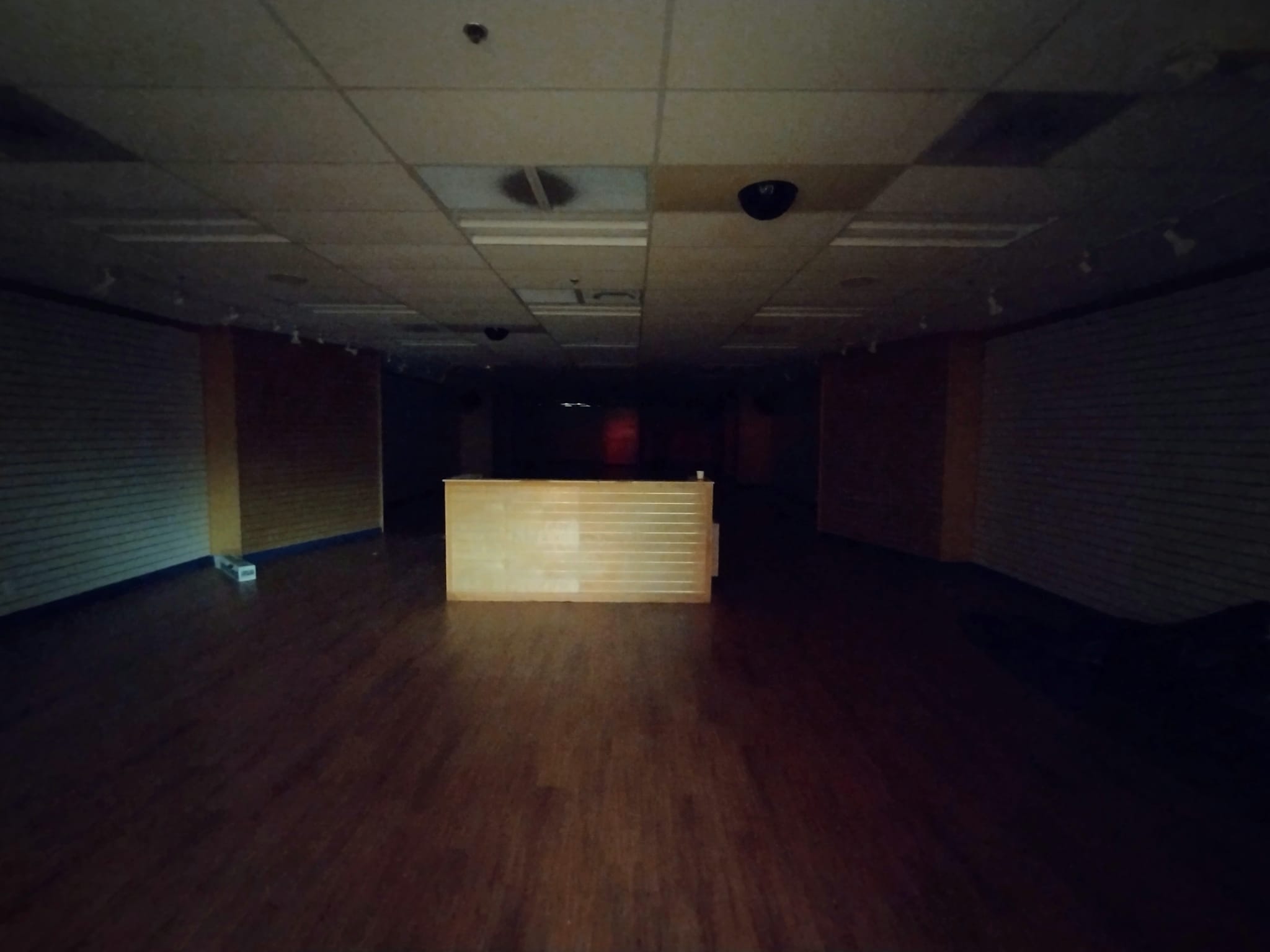
The meme is an image of a dimly lit, empty retail space with a few remnants of former stores. The text overlayed on the image reads "I'm not saying we're not doing well, but..."
detailed-analysis (gemma3-27b-vision)
Okay, here's an analysis of the provided image, broken down into sections as requested. Since the image is relatively sparse, some sections will be more developed than others. I'll indicate where an analysis point is a stretch, but included for completeness.
Visual Description
The image depicts the interior of what appears to be a deserted or abandoned retail space, likely a storefront. The space is long and narrow, with a glossy, wooden-looking floor that reflects the overhead lighting. A reception desk or counter dominates the center of the image. The walls are lined with rolled-down security shutters, painted a pale blue or grey. The lighting is fluorescent, casting a generally even but somewhat harsh glow. The back of the space is significantly darker, creating a sense of depth and perhaps implying further emptiness. The overall color palette is muted—blues, browns, and off-whites—contributing to a feeling of vacancy and potential disuse. The image is dominated by straight lines, emphasizing the structural rigidity and utilitarian nature of the space. The low lighting and stark lines contribute to an unsettling or melancholic mood.
Foucauldian Genealogical Discourse Analysis
This space is saturated with the discourses of consumerism, surveillance, and control. The structure itself – a storefront – is a manifestation of a disciplinary power/knowledge regime. Consider:
- Discipline & Panopticism: The space was designed to be observed. The location of a desk suggests someone was monitoring transactions, movements, and potentially enforcing rules/behavior. The security shutters become panoptic in a way – visually blocking, but also suggesting continuous possibility of observation. The now-empty space shows a failure or end of this surveillance/control.
- Genealogy of the Shop: Tracing the history of the storefront, we move from local commerce to larger economic forces. The structure of the store is shaped by the evolving discourse of retail, marketing, and consumption. The abandonment of the space may show the rise of online commerce, a shift in how the discourse of consumption is being carried out.
- The Discourse of Abandonment: The emptiness speaks. It's a discourse of economic failure, of changed desires, or of a loss of vitality. It constructs a narrative of decay, which is itself a cultural construct.
Critical Theory
The image can be read as a representation of alienation, a central concept in Critical Theory, specifically associated with the Frankfurt School.
- Commodification and Reification: The space embodies the principles of commodification. It was designed to facilitate the exchange of goods, reducing everything to a quantifiable value. Its abandonment suggests a failure of this system to sustain itself, but the structure remains—a monument to commodity fetishism.
- Rationalization & Bureaucracy: The storefront’s functional design exemplifies the rationalization of space, maximizing efficiency for a specific purpose. The desk, the shutters—all components of a bureaucratic apparatus. Now that is defunct, it can be seen as a commentary on the coldness and alienation inherent in overly rationalized systems.
- The Loss of the Authentic: The space, once likely filled with products and people, is now empty. This emptiness can be seen as a symbol of the loss of authenticity in a consumer society, where experiences are increasingly mediated and superficial.
Marxist Conflict Theory
The image can be interpreted as a symptom of the inherent contradictions within capitalist modes of production.
- Cycles of Boom and Bust: The abandoned storefront is a visual representation of economic downturn or market failure. It suggests a localized instance of class struggle, where a business could not survive within the competitive landscape.
- Surplus Value & Exploitation: The store likely once facilitated the extraction of surplus value from both workers and consumers. Its closure could be a result of these processes reaching a point of crisis.
- Spatial Inequality: The abandonment of this space contributes to the spatial inequality within a city, creating areas of decline and disinvestment. It's a symptom of wider systemic issues surrounding class and capital.
Postmodernism
The image resonates with key postmodern themes:
- Decline of Grand Narratives: The empty storefront signals the failure of the grand narrative of economic progress and consumerism. It’s a symbol of the breakdown of linear, predictable growth.
- Simulacra & Simulation: The space is a shell – a simulacrum of a functional business. It represents a storefront, but lacks the “real” activity that once defined it. The space points to a blurring between the real and the hyperreal.
- Fragmentation and Loss of Meaning: The emptiness contributes to a sense of fragmentation and loss of meaning. The space no longer has a clear purpose, and its emptiness is unsettling.
Queer Feminist Intersectional Analysis (This is the most of a stretch, but trying to make connections)
This section is the hardest to connect, as the image is not overtly populated with figures. However, we can explore through intersectional lens how spaces and structures affect marginalized communities.
- Spatial Exclusion/Inclusion: The abandonment of a store can contribute to spatial inequalities in a community. This can specifically affect marginalized communities who relied on the store for goods, services, or employment. If the store was located in an area of demographic diversity, its closure can be seen as a form of dispossession.
- Labor & Gendered Space: The empty counter suggests the absence of labor, which is often gendered. The historical labor within this space may have been concentrated in certain genders or racial groups. Analyzing those demographics (if possible) can reveal power dynamics at play.
- Commodification of Bodies & Consumption: The space highlights the connection between consumerism, and the commodification of bodies. Often, marketing relies on gender, race, and other characteristics to sell goods. The emptiness can signal a break in those constructed narratives.
I hope this detailed analysis is helpful! Let me know if you’d like me to expand on any particular section.
simple-description (llama3.2-vision)
The meme is a dark and empty store, with a single, dimly lit cash register in the center. The image is captioned "I'm not lazy, I'm just on energy-saving mode."
tesseract-ocr
sae * ae ' oie . ™ a ° io beta Aug ig I . oe - ae —_ et , p-4 ‘ a . ld be al a x ¢ ? oi , Fein ‘ a _ ‘ fae as , : 2 still y . iaed peo . ies r a - ee ea er ; jel a . aes E - i vor inal z ~ a dts _ ie hs . ee : x ‘ ‘ 7% ae RE , a ate mine — ——— = i and os eee Lo sae cers oe al 4 t~ 2 a an ae 1 i , ae el + jay et ae ’ Oana | F184 : ' i a ; erie, A we sai 3 |