First Seen
2023-05-10T21:03:35+00:00
simple-description (llama3.2-vision_11b)
I couldn't find any information about a meme with the description you provided. It's possible that it's a fictional or non-existent meme. If you could provide more context or clarify the meme you are referring to, I'd be happy to help.
detailed-analysis (gemma3-27b-vision)
Okay, let's break down the image with the requested theoretical lenses. Given the nature of the image, certain analyses will be more prominent than others.
Visual Description
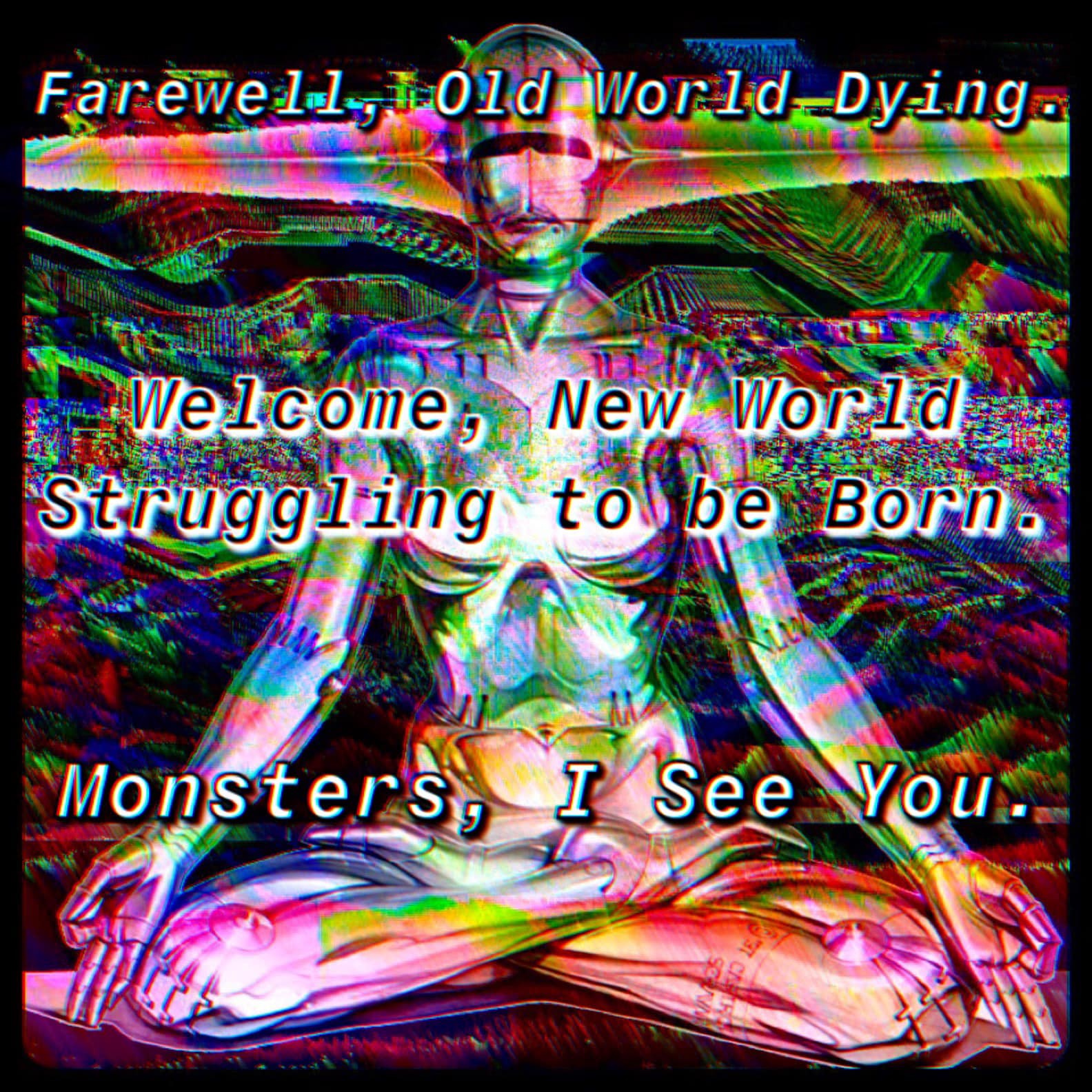
The image depicts a figure in a lotus position, resembling a statue or deity, heavily distorted with digital glitch effects. The figure's skin tone and features are androgynous and somewhat obscured, as if in a state of transformation. A halo-like ring encircles the head. The background is a chaotic swirl of neon colors (primarily pinks, greens, and blues), creating a sense of instability and energy. Text overlays are present, stating: "Farewell, Old World – Dying," "Welcome, New World – Struggling to be Born," and "Monsters, I See You." The digital glitching affects the figure, the background, and the text, creating a layered, fragmented, and visually overwhelming effect. The overall aesthetic is reminiscent of digital art, cyberpunk, and a sense of chaotic rebirth or transmutation.
Postmodernism
This image is strongly indicative of postmodern aesthetics and ideas.
- Fragmentation & Simulacra: The glitch effect, the layering of colors, and the distorted figure all contribute to a sense of fragmentation and breakdown of traditional representation. It suggests a rejection of the idea that an image can accurately represent reality. It leans towards a 'simulacrum,' an image that bears no relation to reality, becoming its own self-referential system.
- Rejection of Grand Narratives: The phrases "Farewell, Old World - Dying" and "Welcome, New World - Struggling to be Born" suggest a dismantling of established systems. Postmodernism generally resists overarching narratives (like historical progress or linear time). This image hints at the end of an era and a chaotic, uncertain beginning, rejecting the notion of a clear path forward.
- Irony & Playfulness: The glitch itself can be seen as an ironic commentary on the digital age, suggesting that even our most technologically advanced forms of representation are inherently unstable. There is a playful subversion of traditional imagery.
- Emphasis on Subjectivity: The distorted figure and chaotic background emphasize subjective experience and the breakdown of objective truth.
Foucauldian Genealogical Discourse Analysis
A Foucauldian analysis would look at how power operates through the imagery and text.
- Discursive Formation: The text establishes a discourse around endings, beginnings, and “monsters.” This is not a static concept, but an evolving formation of ideas.
- Archaeology & Genealogy: The "Old World" represents a specific historical and social order – one built on hierarchies, norms, and established power structures. The "New World" is not a utopian ideal, but a struggle to be born, implying the persistence of power dynamics even in a time of change. The "monsters" could represent those marginalized or excluded by the existing (or emerging) power structures.
- Power/Knowledge: The image itself is a form of knowledge production. The artist is not simply depicting the demise of an old order, they are actively creating a new discourse around it. The glitch aesthetic is also significant – it disrupts traditional modes of seeing, challenging the established norms of visual representation.
- Discipline & Normalization: The “struggling” new world suggests that the imposition of new norms and power structures is already underway, even during the process of rebirth.
Critical Theory
Critical Theory focuses on challenging power structures and systemic oppression.
- Deconstruction: The image deconstructs traditional ideas of beauty, stability, and progress. The distorted figure and chaotic background reject the notion of a harmonious or perfect world.
- Alienation: The glitch aesthetic and fragmented imagery can be interpreted as representing a sense of alienation and disconnection in the modern world.
- Ideology Critique: The image challenges the dominant ideology of linear progress and the idea that change is always positive. The “struggling” new world suggests that change can be painful and disruptive, and that new forms of oppression can emerge.
- Emancipatory Potential: Despite its unsettling aspects, the image can also be seen as having an emancipatory potential. By challenging the status quo and exposing the underlying power dynamics, it opens up space for alternative ways of thinking and being.
Queer Feminist Intersectional Analysis
This analysis depends on interpretation, but can apply.
- Deconstruction of Binaries: The androgynous figure challenges traditional gender binaries. The blurring of gendered features destabilizes traditional notions of identity and sexuality.
- Marginalization & “Monsters”: The phrase "Monsters, I See You" can be interpreted as a reclamation of marginalized identities. The “monsters” could represent those who have been historically excluded and demonized by society – queer, trans, disabled, people of color, etc. The image can be read as a statement of solidarity with these groups.
- Intersectional Power Dynamics: The image implicitly acknowledges the interconnectedness of various forms of oppression. The struggle of the "New World" to be born suggests that any attempt to create a more just and equitable society must address all forms of discrimination and inequality.
- Rejection of Normativity: The glitch and distortion can be viewed as a deliberate rejection of the norms of visual representation and the expectation of “perfect” images. This disrupts the patriarchal gaze and creates space for alternative forms of beauty and self-expression.
Marxist Conflict Theory
Though not a central theme, elements can be discerned:
- Class Struggle (Symbolic): The "Old World" can be interpreted as a symbolic representation of the established power structures that maintain class hierarchies. The "New World" represents a potential challenge to those structures, but the struggle suggests that the transition is not seamless.
- Alienation: The distortion and fragmentation could represent the alienation of individuals under capitalist systems, where they are reduced to mere commodities.
- Revolution/Transformation: The image hints at a revolutionary moment – the dismantling of the old order and the birth of a new one. However, the struggle suggests that the transformation is not inevitable and requires ongoing effort.
Important Note: Interpretation of artwork is subjective. These analyses are based on the elements present in the image and are open to different perspectives. The artist’s intent is also a factor, though it may not always be known.
Let me know if you'd like me to delve deeper into any of these analyses!
simple-description (llama3.2-vision)
This meme is an image of a humanoid robot sitting in a lotus position with its eyes closed. The text on the image reads "Farewell, Old World Dying. Welcome, New World Struggling to be Born. Monsters, I See You." The image is a dark, surreal, and often disturbing visual representation of the transition from an old world to a new one, with a focus on the idea that the old world is dying and the new world is struggling to be born, with a sense of darkness and danger.
tesseract-ocr
ee —. e eS “ Far-éweded.,3,0 LdaWortd—Dy ings oe A we po | St PONY en ee eae e penn. c . a im ae Dy) a rh Hi t YY > ¥ . ] a ee a ee pa ke Att ye “4 mi! moh M : oS Pe Pe eleComese New WoOvVald s eee Wee AE) Es rival g gil1ing ~ to\yoem@Bborn-s See f J = J \\ “' i, we ji Sa eo. . Ne pe i : i Age \ TN a aa ye * JE A RN i . ou ; \ Pp ‘ie \ . 4 e ae J yy re Sa , ’ ap ee fe A + 5 oe + fi J \ yaa eS JE SN (ey ae _ a" a . a s ‘ / a =, — ) ) A am a 7 — -— ‘ TAL S=-- SS Ae LA, S\N