First Seen
2023-05-10T21:03:35+00:00
simple-description (llama3.2-vision_11b)
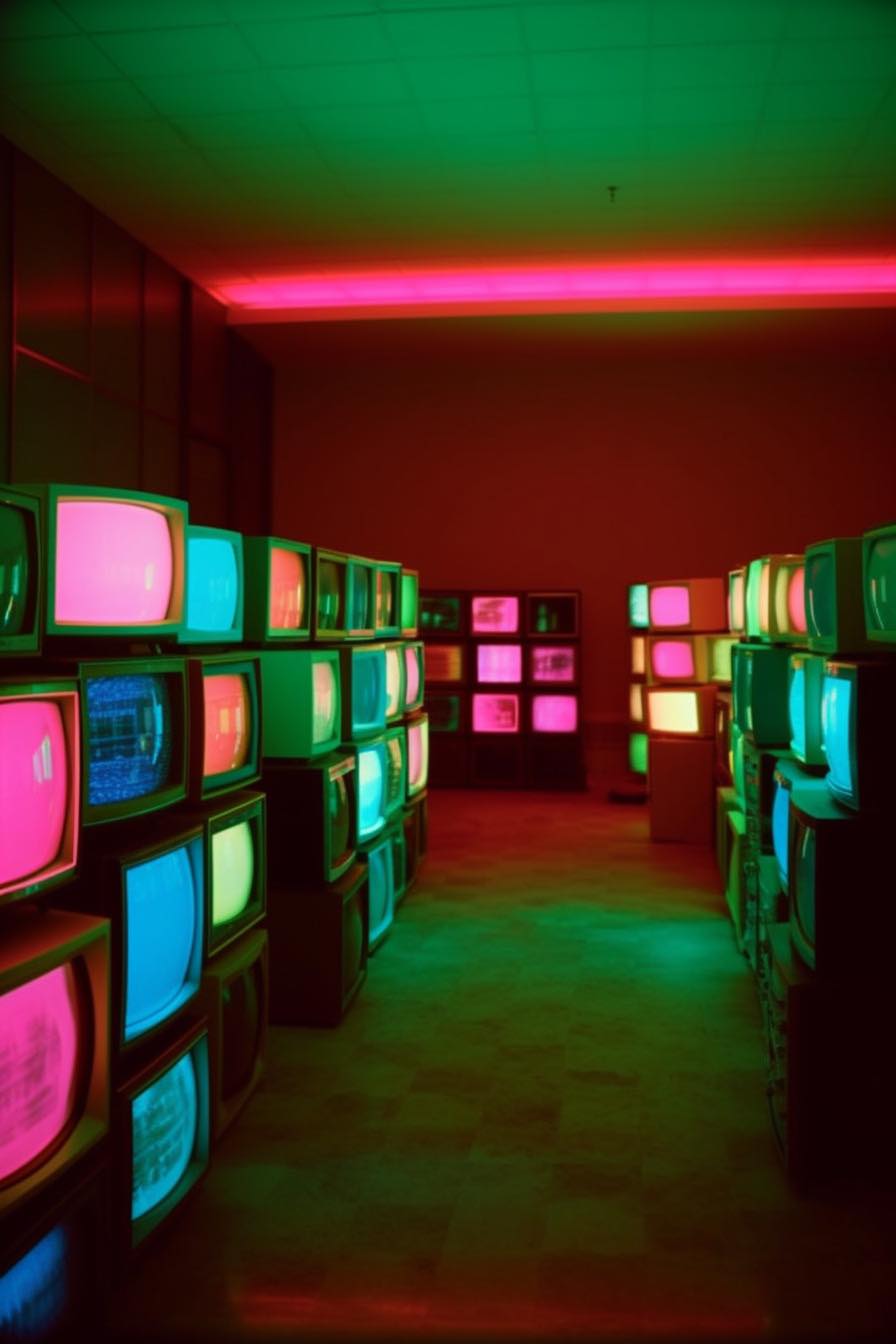
The meme is a picture of a room filled with old computers and TVs, with a sign on the wall that says "Liminality" in bold letters. Liminality refers to a state of transition or in-betweenness, and in this context, it's as if the room is stuck between being a museum of old technology and a futuristic space. The image is captioned "When you're stuck between analog and digital".
detailed-analysis (gemma3-27b-vision)
Okay, let's break down this image using the frameworks you’ve provided.
Visual Description
The image depicts a long, narrow room filled with dozens of vintage CRT televisions. The televisions are arranged in rows, facing inward, creating a sort of labyrinthine corridor. Each television screen displays static, color bars, or distorted images. The color palette is overwhelmingly neon pink and green, with the pink coming from the screens and a fluorescent light running along the ceiling, and the green illuminating the floor. The space feels claustrophobic and disorienting, a brightly lit, yet strangely unsettling environment. There’s a sense of repetition and an almost overwhelming amount of visual information, despite the degraded nature of the imagery. The image lacks any visible human presence. It’s a meticulously constructed and staged photograph, appearing as an installation artwork.
Foucauldian Genealogical Discourse Analysis
This image lends itself strongly to a Foucauldian reading. It's less about a specific "truth" and more about the archaeology of knowledge surrounding technology, power, and surveillance.
- Discipline and Panopticism: The rows of televisions, all “watching” (even though displaying noise), subtly evoke the panoptic model. The sense of being watched—even by empty screens—creates a feeling of self-discipline, even though there's no clear central observer. It's about the possibility of being observed, and the internalization of that possibility.
- Power/Knowledge: The proliferation of televisions, representing the media, embodies how knowledge is constructed, disseminated, and controlled. The static and distorted images suggest the unreliability and fragmentation of information. The power lies in having the means of producing/broadcasting—even if the content is nonsensical.
- Genealogy of Surveillance: The image can be seen as a genealogy of surveillance. While early surveillance involved physical observation, this setup anticipates a digital age where we are constantly monitored through screens, data, and algorithms. The old technology suggests the origins of this constant surveillance.
- Discourse & Normalization: The sheer volume of screens could represent the inundation of discourse—media, advertising, political messaging—that normalizes certain ideas and behaviors. The static suggests the breakdown of coherent discourse.
Postmodernism
The image is deeply rooted in postmodern aesthetics and concepts:
- Simulation and Hyperreality: The image leans into the idea of simulation. The screens display fragmented or nonexistent images, blurring the line between reality and representation. We're not looking at something real; we're looking at representations of representations, reaching a level of hyperreality.
- Fragmentation and Deconstruction: The distorted imagery and chaotic arrangement symbolize fragmentation. The image deconstructs the traditional idea of a "whole" image, or a clear message, instead offering a fractured experience.
- Irony & Parody: There’s a layer of irony in the image. The obsolescence of CRT televisions is juxtaposed with their overwhelming presence. It’s a commentary on our dependence on technology, even as it becomes outdated.
- Loss of Grand Narratives: The static and chaotic arrangement reflect the postmodern rejection of overarching narratives or singular truths. There’s no clear storyline, no dominant message—just a mass of disconnected signals.
Critical Theory
From a Critical Theory perspective, the image highlights the socio-cultural implications of mass media and technology:
- Culture Industry: The repetition of televisions points to the concept of the culture industry. The image suggests how mass-produced media can homogenize experience and stifle critical thought. The lack of diverse content on the screens reinforces this idea.
- Ideology & Hegemony: The image could be interpreted as a critique of how ideologies are embedded within media. Even meaningless static can contribute to the normalization of certain power structures. The sheer scale of the screens suggests the overwhelming power of these structures.
- Alienation & Commodity Fetishism: The image suggests the potential for alienation in a media-saturated world. The individuals are absent, replaced by a labyrinth of screens. The screens themselves could be seen as commodities—objects of desire that disconnect us from authentic experience.
Queer Feminist Intersectional Analysis (potential, more abstract)
This one is less direct, but potentially applicable:
- Disrupted Gaze: The multitude of screens and the lack of any central focal point disrupt the traditional male gaze, forcing the viewer to move their attention in many directions. This could be read as a fragmentation of power dynamics.
- Visibility & Erasure: The static and noise on the screens could represent the silencing or erasure of marginalized voices in media. The absence of diverse images or narratives reinforces this idea.
- Repetition & Constraint: The repetitive arrangement of the screens could symbolize the societal constraints and expectations placed on individuals, particularly those marginalized by gender, sexuality, or other identities. The screens, lined up in rows, could represent the pressure to conform to norms.
Let me know if you’d like me to elaborate on any of these interpretations!
simple-description (llama3.2-vision)
This meme is a photo of a dark room filled with rows of old, glowing television sets. The TVs are all displaying the same static-filled, snowy screen, which is often used to represent a lack of signal or a TV "not working". The image is captioned "When you're trying to get a signal but it's just a bunch of static".
tesseract-ocr
—————— a bn te sf | f i y 4 , )