First Seen
2023-06-05T01:48:56+00:00
simple-description (qwen3.5_2b-q8_0)
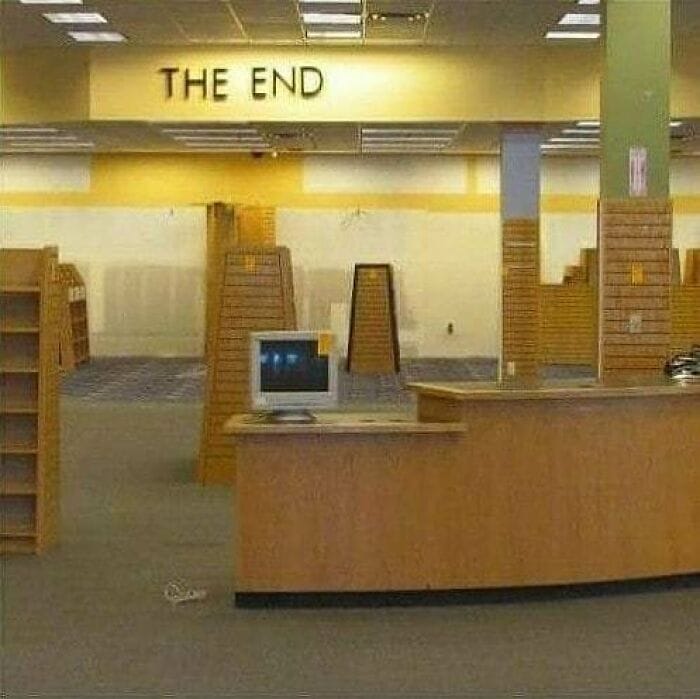
This image captures a feeling of liminality, or being in a transitional space between two distinct states. The scene shows an empty, sterile checkout area marked by the sign "THE END," which acts as a visual marker for the finality of a journey. The abandoned computer and lack of customers suggest a waiting period where the person is stuck in a liminal state, caught between states or locations.
simple-description (llama3.2-vision_11b)
The meme is a humorous image of a library or bookstore with a sign that says "The End" at the front desk, implying that the store has run out of books. This is a play on the common phrase "The End" used in storytelling to indicate the conclusion of a narrative, but in this case, it's applied to a physical space.
detailed-analysis (gemma3-27b-vision)
Okay, here's an analysis of the image, broken down into the requested theoretical frameworks. I'll only include sections where the framework feels genuinely applicable to interpreting the image. Given the nature of the image, several frameworks will be more relevant than others.
Visual Description
The image depicts the interior of what appears to be a bookstore. However, it’s starkly emptied of books. Rows of empty shelving units stretch into the distance. The central focal point is a curved, wooden customer service desk, on which sits a retro computer monitor displaying a blank screen. The monitor seems oddly out of place. Above the shelving, a large sign reads "THE END" in bold, sans-serif lettering. The lighting is fluorescent and institutional, and the overall atmosphere is one of abandonment and decay. A small paper/debris item is on the floor. The carpet is a neutral brown. The color scheme is predominantly muted, consisting of browns, beige, and muted greens. The photograph has a grainy quality, suggesting it may have been taken some time ago or with older equipment. The focus seems deliberately on the emptiness, the bare structures, rather than any detail of what once was.
Foucauldian Genealogical Discourse Analysis
This image lends itself well to a Foucauldian reading. The empty bookstore isn’t simply a space; it’s a site where discourses of knowledge, power, and history have played out.
-
Discipline & Surveillance: Traditionally, bookstores were spaces of curated knowledge, overseen by booksellers (a form of power/knowledge). The arrangement of books disciplined readers towards particular genres or authors. The empty shelves demonstrate the failure of this system. The computer monitor, though inactive, gestures towards more modern surveillance and data collection, representing a shift in how knowledge is organized and controlled.
-
Archaeology of Knowledge: We can "archeologize" the knowledge practices that once occurred here. The empty shelves are remnants of a specific way of organizing and disseminating information—a physical, curated system based on printed books. The emptiness speaks to the discontinuity of this practice, its displacement by new modes of information access (digital, online).
-
Power/Knowledge: The sign “THE END” is potent. It is not merely stating the end of a story, but a statement about the end of an entire episteme—a system of thought and knowledge. The emptiness demonstrates the power of economic forces and consumer habits over the infrastructure of culture. The shift to digital books, for example, represents a new configuration of power/knowledge, one that prioritizes accessibility and speed over the physical, curated experience of browsing.
Critical Theory
From a critical theory perspective (drawing on thinkers like Adorno and Horkheimer), this image can be seen as a visual manifestation of the “culture industry” in decline.
-
Commodification: The bookstore, as a space for accessing and consuming culture, has been reduced to a shell. The shelves should be filled with commodities (books), but their emptiness suggests a failure of that system. It highlights the way in which culture is itself commodified, and how that commodification is precarious and subject to economic forces.
-
Mass Culture & Standardization: The emptiness suggests a potential loss of diversity and nuance. The homogenous, neatly arranged shelves (even in their absence) hint at the standardization inherent in mass-produced culture. A once diverse collection has been removed.
-
Loss of Aura: (Referring to Walter Benjamin’s work) The emptiness robs the space of its “aura” – the sense of history, authenticity, and embodied experience that comes with a physical collection of books. The shift to digital information contributes to the devaluation of this aura.
Marxist Conflict Theory
This image speaks strongly to Marxist themes of class struggle and economic determinism.
- Capitalist Crisis: The empty bookstore is a symptom of a larger crisis within capitalism. The failure of a physical retail space can be attributed to market forces – competition from online retailers like Amazon, changing consumer habits, and economic downturns.
- Alienation: The emptiness can be interpreted as a representation of alienation. The space should be filled with books and people, fostering intellectual and social exchange. The absence of both symbolizes the fragmentation of community and the isolation of individuals within a capitalist system.
- Means of Production: The bookstore represents the means of production of cultural knowledge. The emptiness suggests the shift in who controls those means—from physical bookstores to large corporations that dominate the digital marketplace.
Postmodernism
The image lends itself to a postmodern interpretation due to its fragmentation, lack of clear meaning, and self-reflexivity.
- Simulacra & Simulation: The empty shelves are a simulacrum of a bookstore—a copy without an original. The space mimics the idea of a bookstore, but it lacks the substance (the books) that would make it real. This reflects a postmodern preoccupation with the blurring of boundaries between reality and representation.
- Deconstruction: The sign "THE END" can be seen as deconstructing the notion of narrative closure. It suggests that stories (and the systems that support them) are never truly finished, but rather endlessly fragmented and reinterpreted.
- Loss of Grand Narratives: The image can be read as a symptom of the “loss of grand narratives” that Lyotard describes. The empty bookstore signifies the decline of traditional institutions and the erosion of belief in overarching ideologies.
I tried to cover the topics you requested with some detail. I hope this analysis is helpful! Let me know if you would like me to elaborate on any particular aspect.
simple-description (llama3.2-vision)
This meme is a humorous image of a nearly empty bookstore or library, with a single shelf or desk remaining. The text "THE END" is displayed prominently on a wall or sign above the remaining shelf, implying that the store has finally reached its last book or customer. The image is likely intended to be ironic or humorous, suggesting that the store has been completely depleted of its inventory and is now ready to be closed.
tesseract-ocr
ae . en eet , ne " a a i = oh 5 4 5 oe! iz r J atid ; Pl aoe : yee had 1 = = = a ee : ————