First Seen
2023-05-10T21:03:35+00:00
simple-description (llama3.2-vision_11b)
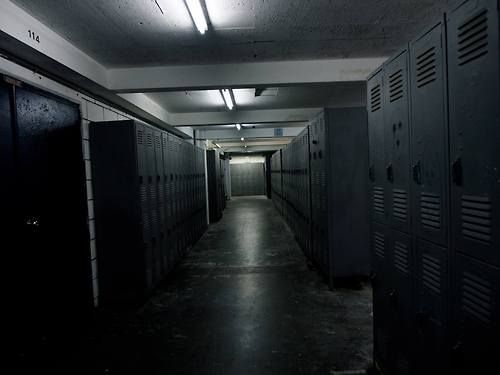
The meme is an image of a dimly lit, abandoned school hallway with a faint glow of a single light bulb in the distance. The text "It's 3am and I'm still in the school" appears on the image, implying a sense of isolation and eeriness.
detailed-analysis (gemma3-27b-vision)
Okay, here's an analysis of the image, broken down into the requested sections, focusing on the applicable theoretical frameworks.
Visual Description
The image depicts a long, dark hallway lined with dark metal lockers. The perspective is a straight-on, central view, creating a strong sense of depth and confinement. The lighting is stark and fluorescent, casting long shadows and highlighting the repetitive structure of the lockers. The hallway appears to be in a school or institutional setting, judging by the lockers. The floor is dark and somewhat reflective. The overall mood is cold, sterile, and somewhat unsettling. There is a sense of isolation and anonymity, emphasized by the lack of people and the oppressive arrangement of the lockers. The image feels almost claustrophobic, despite the perspective showing a space that potentially extends far beyond the frame.
Foucauldian Genealogical Discourse Analysis
This image powerfully evokes a Foucauldian concept of panopticism. The long corridor of lockers, coupled with the stark lighting, suggests a space of surveillance, even if no actual surveillance is present. The lockers create a kind of "cell" for each individual, while the length of the corridor and the potential for unseen eyes (even imagined) creates a constant possibility of being watched.
Foucault argued that institutions like schools, prisons, and hospitals operate through power dynamics manifested in architectural design and the regulation of space. Here, the lockers represent individual containment. The discourse around education, control, and the categorization of students is materialized in the physical space. The repetition of the lockers enforces conformity and a specific ordering of bodies (students) within a system.
A genealogical approach would trace the historical development of this space, seeing how the design of schools evolved to optimize control and discipline. It's not just about what the space is, but how it came to be. The image implies that the power of the institution isn’t necessarily exercised through visible force, but through a subtle, pervasive control of space and the normalization of observation.
Critical Theory
From a Critical Theory perspective (drawing on the Frankfurt School, Adorno, and Horkheimer), this image can be interpreted as a representation of rationalization and alienation. The perfect order of the lockers, the sterile lighting, and the cold atmosphere embody the principles of rationalization – a process by which social life is increasingly dominated by efficiency, calculability, and control.
However, this rationalization doesn’t lead to liberation; instead, it produces alienation. The students who use these lockers are reduced to anonymous units within a system, stripped of individuality and agency. The space reinforces the idea that they are part of a machine-like process, rather than individuals with unique needs and desires. The darkness and the lack of warmth contribute to a sense of dehumanization. The hallway can be seen as a microcosm of a broader societal tendency to prioritize efficiency and control over human connection and well-being.
Queer Feminist Intersectional Analysis
While the image doesn't explicitly depict any specific individuals, a Queer Feminist Intersectional lens allows for a consideration of how such a space could implicitly reinforce normative power structures.
The highly ordered and regulated nature of the hallway reflects societal expectations of conformity. For queer and gender non-conforming students, this can be a particularly oppressive space, as it reinforces the pressure to adhere to heterosexual and cisgender norms. The expectation of neatness and order, combined with the potential for surveillance, can create a hostile environment for those who challenge these norms.
An intersectional analysis would also consider how race, class, and disability intersect with gender and sexuality to further marginalize certain students within this space. A student of color, for example, might face additional scrutiny and surveillance, or be subject to racial profiling. A student with a disability might find the space inaccessible or unwelcoming.
The image, therefore, can be seen as a visual representation of the ways in which institutional spaces can be structured to reinforce power imbalances and create barriers for marginalized groups.
Let me know if you'd like me to elaborate on any of these points, or if you'd like me to apply another theoretical framework!
simple-description (llama3.2-vision)
The meme is an image of a dark and empty hallway in a school, with rows of lockers lining the walls. The text "I'm not arguing, I'm just explaining why I'm right" is written in a bold, white font above the lockers. The image is meant to be humorous, implying that someone is being overly defensive or argumentative.