First Seen
2023-10-31T05:50:27+00:00
simple-description (qwen3.5_2b-q8_0)
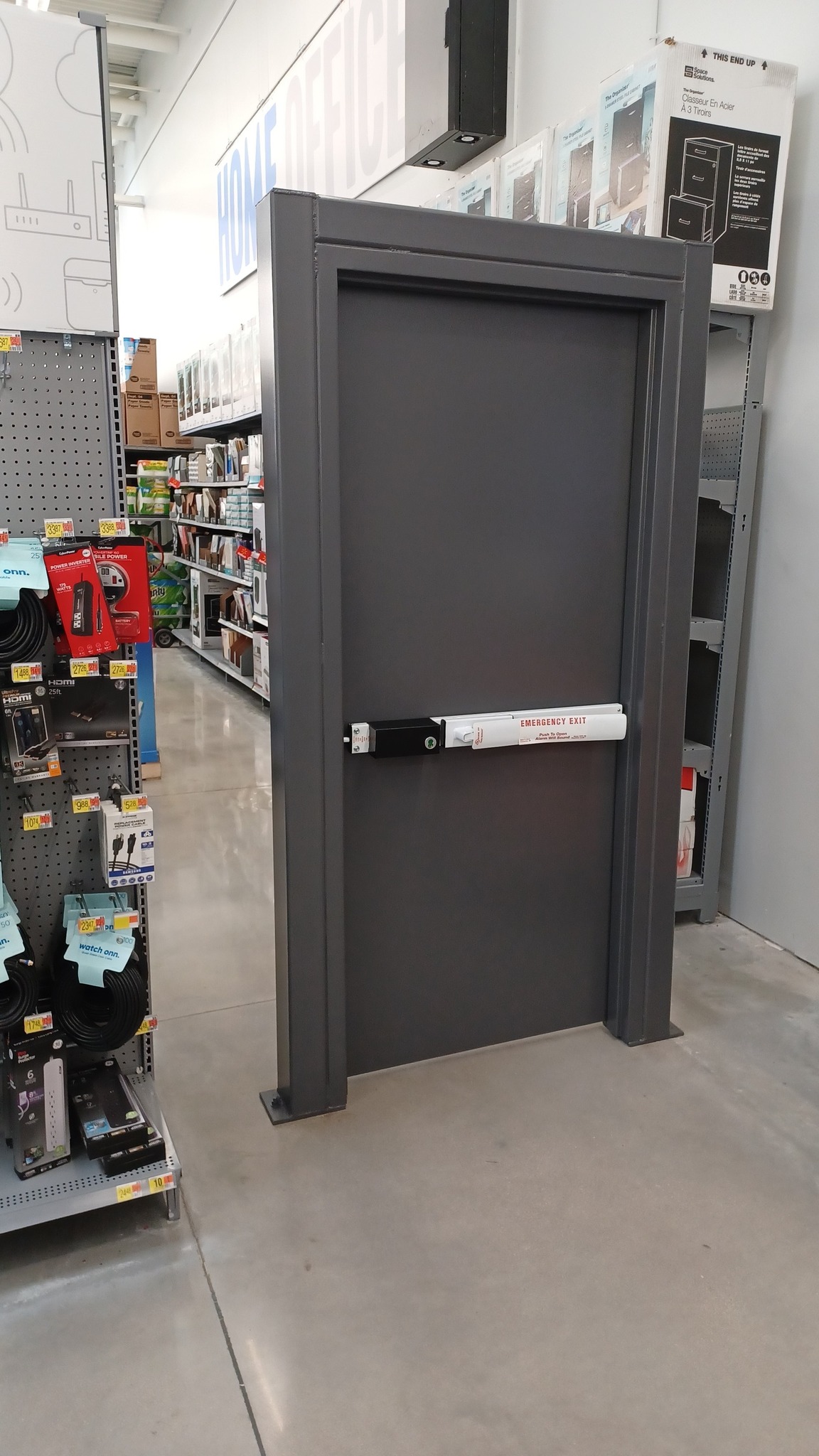
"Liminality describes a transitional, ambiguous space that often feels eerie and strangely familiar, as if standing on the periphery of something. In this image, the dark security door serves as a physical manifestation of that concept, standing as a barrier between the bright store aisle and the dark area beyond. The text 'EMERGENCY EXIT' highlights the absurdity of having a secure gate designated for an exit, turning the ordinary act of standing there into a strangely significant moment of transition."
simple-description (llama3.2-vision_11b)
The meme is a photograph of a large metal door with a sign that says "Emergency Exit" and a smaller sign that says "Not an Emergency Exit". The image is likely humorous because it pokes fun at the idea that an emergency exit is not actually an emergency exit, and the phrase "Not an Emergency Exit" is a clever and ironic twist on the usual expectation of an emergency exit being, well, an emergency exit.
detailed-analysis (gemma3-27b-vision)
Okay, here's an analysis of the image broken down into the requested sections, with considerations of whether each theoretical lens appropriately applies.
Visual Description
The image depicts a standalone emergency exit door within a large retail store (likely Walmart, given the general merchandise and flooring). The door is a heavy, industrial-style metal door, painted a dark gray/black. It has a prominent horizontal push bar labeled "EMERGENCY EXIT" in white lettering. The door is surrounded by shelving units stocked with electronics and cables. There are numerous price tags visible on the merchandise, indicating a retail environment focused on consumer goods. The flooring is a polished concrete. The lighting appears to be fluorescent and bright. The scene evokes a sense of controlled order juxtaposed with the potential for urgent escape. The door is slightly ajar.
Foucauldian Genealogical Discourse Analysis
This image is quite rich when examined through a Foucauldian lens. The emergency exit door isn't just a functional object; it’s a site where power and knowledge intersect.
- Discipline and Surveillance: The very presence of the emergency exit, and the rules governing its use (implied by the signage and regulations), is part of a system of discipline. The store creates the need for an exit by controlling the flow of people and goods, defining the space as requiring a means of escape from perceived dangers (fire, overcrowding, etc.). This ties into the wider disciplinary practices of consumerism, where individuals are positioned as both consumers and potential hazards within the store.
- Panopticon: While not a direct Panoptic structure, the door can be read as a point of potential surveillance. Security cameras are likely present in the area, making the door a potential point of monitoring. The expectation that the door could be used improperly, or that it represents a security risk, fosters a sense of self-regulation among shoppers.
- Genealogy of Safety: Tracing the "genealogy" of this door reveals a history of risk assessment, safety regulations, and the institutionalization of emergency procedures. The door represents the accumulated knowledge and power structures designed to mitigate potential hazards within a commercial space. The emergence of these regulations and door design are linked to a historical shift in societal concerns about safety and liability.
Critical Theory
The image lends itself well to analysis through a Critical Theory framework, particularly concerning the impact of consumer culture.
- Commodification of Safety: The emergency exit door, while necessary for safety, exists within the larger context of commodification. The store itself is a commodity, and safety is presented as a service provided in exchange for consumer spending. The fact that an "emergency" exit is integrated into a consumer landscape suggests that even safety has been absorbed into the logic of the market.
- Rationalization and Control: The meticulous organization of the store, the placement of the exit door, and the emphasis on regulatory compliance all reflect a drive towards rationalization and control. This reflects a broader trend in modern society, where systems are designed to optimize efficiency and minimize risk, often at the expense of individual agency and freedom.
- False Consciousness: The emphasis on safety measures within a space designed for consumerism can be seen as a form of ideological control. It creates the illusion that the store is a safe and regulated environment, masking the underlying power dynamics and exploitative practices of capitalism.
Marxist Conflict Theory
From a Marxist perspective, the image highlights the inherent conflicts within a capitalist system.
- Control of Space: The store represents a privately owned space that dictates the movement and behavior of individuals. The emergency exit, while seemingly offering a means of escape, is ultimately controlled by the store owners. This illustrates the power imbalances inherent in capitalist relations.
- Alienation: The sterile and impersonal environment of the store, along with the emphasis on standardized procedures, contribute to a sense of alienation. Individuals are reduced to consumers and their needs are met through commodified experiences. The exit door is a means of escaping this alienation, but only in a literal and temporary sense.
- Surplus Value: The entire operation of the store, including the maintenance of safety measures like the emergency exit, is geared towards maximizing profit (surplus value). The costs associated with safety are ultimately passed on to consumers, contributing to the accumulation of capital.
Postmodernism
A postmodern reading of the image would emphasize the breakdown of grand narratives and the simulacra.
- Hyperreality: The image suggests a hyperreal environment where the representation of safety (the emergency exit) becomes more important than actual safety. The meticulously designed and maintained exit door creates the illusion of control and security, masking the underlying risks and vulnerabilities.
- Deconstruction of Meaning: The emergency exit, in its context, loses its original, straightforward meaning. It becomes a signifier that is detached from any essential reality. It can be seen as a symbol of both escape and containment, depending on the viewer’s perspective.
- Fragmentation and Discontinuity: The image presents a fragmented and discontinuous experience. The exit door is an interruption in the flow of consumer goods, a stark contrast to the surrounding shelves and merchandise.
Queer Feminist Intersectional Analysis
This lens offers a more nuanced exploration of power dynamics and the lived experiences within the space.
- Safety and Vulnerability: The emergency exit door highlights differing levels of vulnerability for various individuals. Women, LGBTQ+ individuals, and people of color may experience heightened safety concerns within public spaces, and may be more likely to rely on emergency exits as a means of escape from harassment or violence.
- Spatial Politics: The placement of the exit door is not neutral. It reflects the power dynamics that shape the design of public spaces. The door may be positioned in a way that prioritizes the security of the store over the safety of shoppers, or may be inaccessible to individuals with disabilities.
- Intersectional Power Dynamics: An individual’s race, gender, sexuality, and socioeconomic status all intersect to shape their experience of safety within the store. A queer person of color, for example, may face multiple layers of vulnerability, and may be more likely to perceive the emergency exit as a necessary means of escape from discrimination or harassment.
Hopefully, this provides a comprehensive and insightful analysis of the image from multiple theoretical perspectives. Let me know if you’d like me to elaborate on any particular point or explore additional interpretations!
simple-description (llama3.2-vision)
The meme is a photo of a large, metal door in a store with a sign on it that says "EMERGENCY EXIT". The door is in a store's aisle, surrounded by shelves of products, and has a sign that says "EMERGENCY EXIT" in bold letters. The door is meant to be humorous, implying that someone is so desperate to escape the store that they're using the emergency exit in the middle of the aisle.
tesseract-ocr
TE an ig es ee Rai pal ee | it is a | —_—_—__ Seer [ | 1 gy j et CC - | Bc ma = eee a : " ie coer j i if | voit esealb.. in bay io ees Seale al qin"? a a | | | | eel eee cl Ne ot (a) Hid oat | sete eo me mame . ie | i | ee VE 1 | ia eee Mh ! tree es LIMES: aad see ee eee lll Ww fe we eT lth ee “i Me 2 Yh a Ne a Sy — Sy 4 we 4 ny) a =| BCS kom Ej i in Nuk aad — &, ) gg a ee a i a 4 = a a Lc : Sa mt im tf == f° a e aan: & a rr) Ps ° ; 6 a ee B=- ne Py m ee. \ ; \ \