First Seen
2023-11-12T09:02:33+00:00
simple-description (qwen3.5_2b-q8_0)
From the perspective of liminality—the art of depicting transitional, undefined, or "in-between" states—this meme captures the "crumbling" or "messy" state of the food.
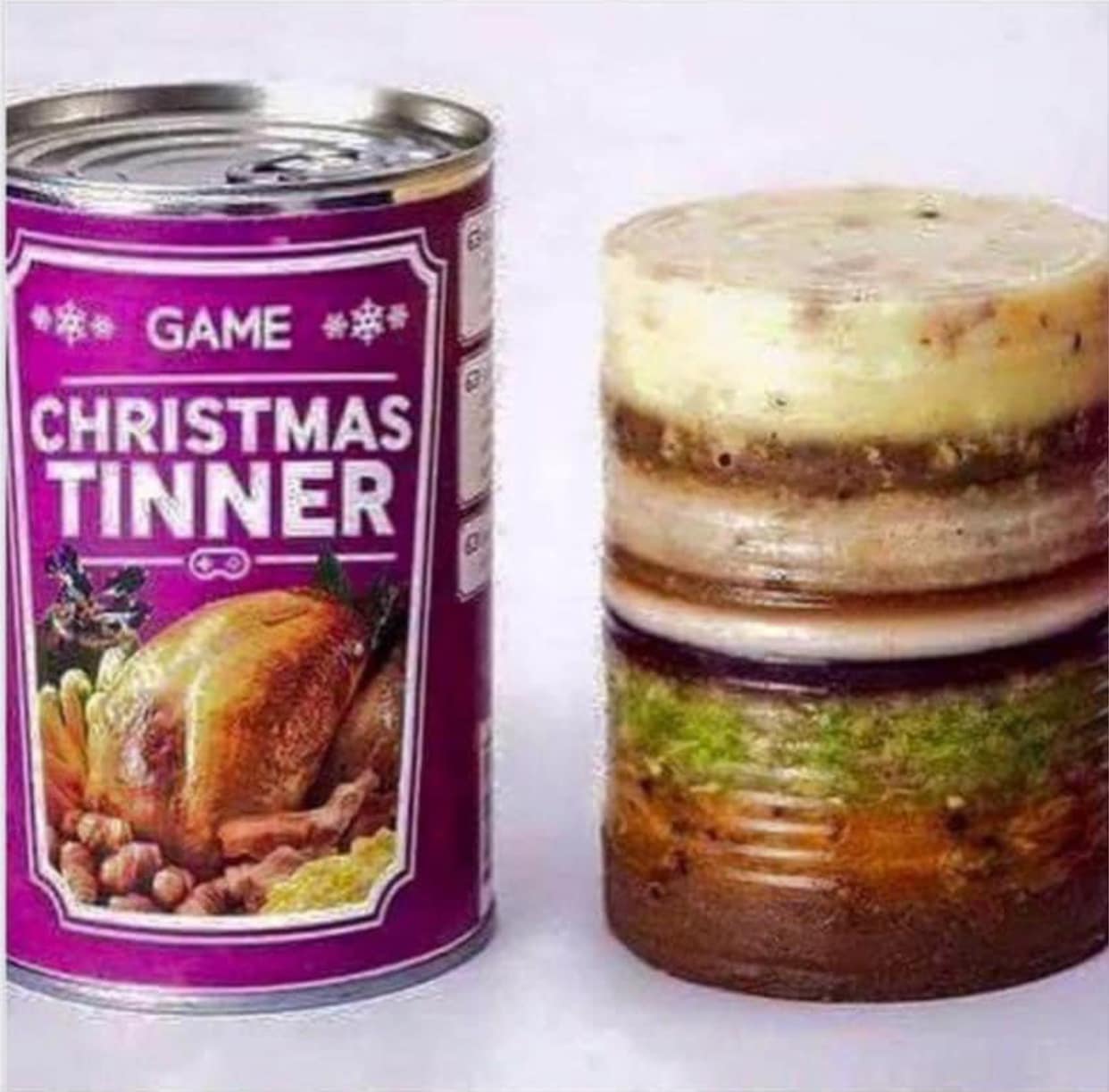
The left object represents the perfect, structured holiday meal: a crisp, intact can labeled "Christmas Tinner." The crumpled cylinder on the right represents the food being broken open or "played with," creating an in-between state where the neat, layered contents (greens, sauce, and meat) are mixed together. This humorously illustrates the transition from a festive, whole dinner to a messy, leftover pile.
simple-description (llama3.2-vision_11b)
The meme is a play on words, combining the phrase "tin can" with "tinder" to create a pun. The image likely shows a can of "tinder" (a dating app) with a label that says "tinder" but is actually a can of "tin can" food, with the words "tinder" and "tin can" being similar but with different meanings.
detailed-analysis (gemma3-27b-vision)
Okay, let's break down this image of the "Christmas Tinner" using the frameworks you requested. It's a truly bizarre and thought-provoking image, ripe for analysis!
Visual Description
The image depicts a canned food product labeled “Christmas Tinner.” The can is a classic cylindrical shape, with a purple label featuring a picture of a beautifully roasted turkey, potatoes, and other Christmas dinner accoutrements. Next to the can, stands a “stack” of the canned food, with each layer visually representing a component of a traditional Christmas dinner. Starting from the bottom, we see a layer resembling gravy, then roast potatoes, a layer of what looks like turkey or meat, and culminating in a layer of mashed potato on top. The 'stack' is somewhat crudely formed, giving the impression of the meal being compressed into a cylindrical form. The overall color scheme is dominated by purple, brown, and beige tones. It's a very unnatural representation of a celebratory meal, emphasizing artificiality and industrial processing.
Foucauldian Genealogical Discourse Analysis
This image is potent when analyzed through a Foucauldian lens. The "Christmas Tinner" embodies the discourse of convenience and the increasing need for efficient consumption that has become prevalent in late modernity. A genealogy of this product would trace the historical shifts in food production and consumption.
- Power/Knowledge: The “Tinner” demonstrates how power operates through knowledge by presenting a simplified, controlled version of a complex social ritual (Christmas dinner). The food industry gains power by defining what constitutes “Christmas” through this product, standardizing and streamlining a traditionally handmade experience. It embodies the normalization of processed food and the decline of culinary skills.
- Discipline & Control: This product disciplines bodies by offering a predictable, easily-consumed meal that requires no preparation. It’s a form of biopower—control over life through control over sustenance.
- Discontinuity & Rupture: The "Tinner" represents a rupture from traditional Christmas dinner practices. The genealogy would show the historical transition from preparing a feast (demanding time, labor, and skill) to purchasing a pre-formed, processed product. It’s a break from ancestral traditions.
- Archaeology: The history of pre-packaged meals demonstrates the normalization of standardized food, the decline of culinary skills, and the increasing demand for convenience.
Critical Theory
From a critical theory perspective, the "Christmas Tinner" is symptomatic of the alienation and reification characteristic of late capitalist society.
- Commodification: The Tinner represents the complete commodification of a social ritual – Christmas dinner. It reduces a meaningful cultural practice to a marketable product. The experience of togetherness, family, and culinary skill is replaced by a standardized, easily-consumed item.
- False Consciousness: The Tinner may promote a “false consciousness” by obscuring the labor and resources required to produce it. Consumers are detached from the origins of their food, furthering their alienation. The product promises “Christmas” without requiring actual engagement with the holiday's values.
- Culture Industry: This product is a manifestation of the “culture industry” (as described by Adorno and Horkheimer). It provides a standardized, mass-produced version of culture that stifles individuality and critical thought. It’s a pre-packaged, homogenized experience of Christmas.
- Loss of Authenticity: The "Tinner" signifies a loss of authenticity. The 'real' experience of preparing a holiday meal and the social connections that come with it are replaced by a manufactured experience.
Marxist Conflict Theory
A Marxist analysis would focus on the class relations inherent in the production and consumption of the "Christmas Tinner."
- Exploitation of Labor: The product represents the exploitation of labor involved in food production, processing, and packaging. The cheap price of the Tinner is achieved through the underpaid labor of agricultural workers and factory employees.
- Alienation: The product further alienates the consumer from the means of production and the labor that created the food. The consumer is simply purchasing a finished product, divorced from the entire process.
- Commodification of Tradition: Like the Critical Theory analysis, the Tinner exemplifies the commodification of a cultural tradition. This is done in service of generating profit for the owning class.
- Class-Based Consumption: The Tinner may be marketed towards those who lack the time, resources, or skills to prepare a traditional Christmas dinner – often those in lower socioeconomic classes. It can be seen as a way of 'selling' a compromised version of a celebration to a specific class.
Postmodernism
From a postmodern perspective, the “Christmas Tinner” is an example of simulacra and simulation.
- Hyperreality: The Tinner is not really a Christmas dinner; it’s a representation of a representation. It’s a simulation of a meal, divorced from the authentic experience of cooking and sharing. The image itself is a step removed from the 'reality' of a Christmas meal, making it a hyperreal experience.
- Loss of Meaning: The product highlights the loss of meaning in contemporary culture. Traditional rituals and values are stripped of their original significance and reduced to commodities.
- Irony & Parody: The image is inherently ironic and parodic. It mocks the idea of a traditional Christmas dinner by presenting it in such an absurd and artificial form.
- Deconstruction of Tradition: The Tinner deconstructs the idea of “Christmas” by presenting a fragmented, processed version of the traditional meal. It challenges the notion of authenticity and cultural heritage.
- Pastiche: The Tinner can be seen as a pastiche of the elements of Christmas dinner - a bizarre blending of layers.
Queer Feminist Intersectional Analysis
While seemingly less directly applicable, a Queer Feminist Intersectional analysis can be applied:
- Disruption of Norms: The absurdity of the "Christmas Tinner" disrupts traditional notions of domesticity, cooking, and family. Traditionally, cooking a Christmas dinner has been heavily gendered as 'women's work.' This canned version subverts that expectation by removing the labor and skill traditionally associated with that role.
- Commodification of Care: Cooking for others is often a form of care work. The Tinner commodifies this care work, replacing genuine connection with a purchased product. This highlights the broader societal tendency to undervalue emotional and physical labor.
- Intersectionality: The convenience of the Tinner might appeal particularly to those juggling multiple responsibilities (work, caregiving, etc.). However, its affordability and accessibility could be limited for those facing economic hardship or living in food deserts.
- Rejection of Idealized Domesticity: The image challenges the idealized vision of a perfect, home-cooked Christmas dinner often presented in media. It acknowledges the realities of modern life—time constraints, economic pressures, and the challenges of balancing work and family.
I hope this in-depth analysis, using the frameworks you provided, is helpful and insightful. This image really does lend itself to a lot of layers of interpretation! Let me know if you'd like me to expand on any specific point or apply a different theoretical lens.
simple-description (llama3.2-vision)
This meme is a play on the idea of a "Christmas dinner" being a traditional British meal, but in this case, it's a canned product called "Christmas Dinner in a Tin" (or "Christmas Tinner" in some versions). The image likely shows a can with this label, and the joke is that the contents of the can are a messy, unappetizing mixture of food, rather than a traditional, well-cooked meal. The text on the can is likely "Game Christmas Tinner" or something similar, with a picture of a cooked chicken or other festive food.
tesseract-ocr
ies = : -_ % Dc er — — ue e ; , 5 | ay | —= i “ a iso 9 a ——— , Ae yg ~~ . AT P : —_— — ee Na a ‘ . eee 7 a Ay ee SS!