First Seen
2023-11-16T20:57:44+00:00
simple-description (qwen3.5_2b-q8_0)
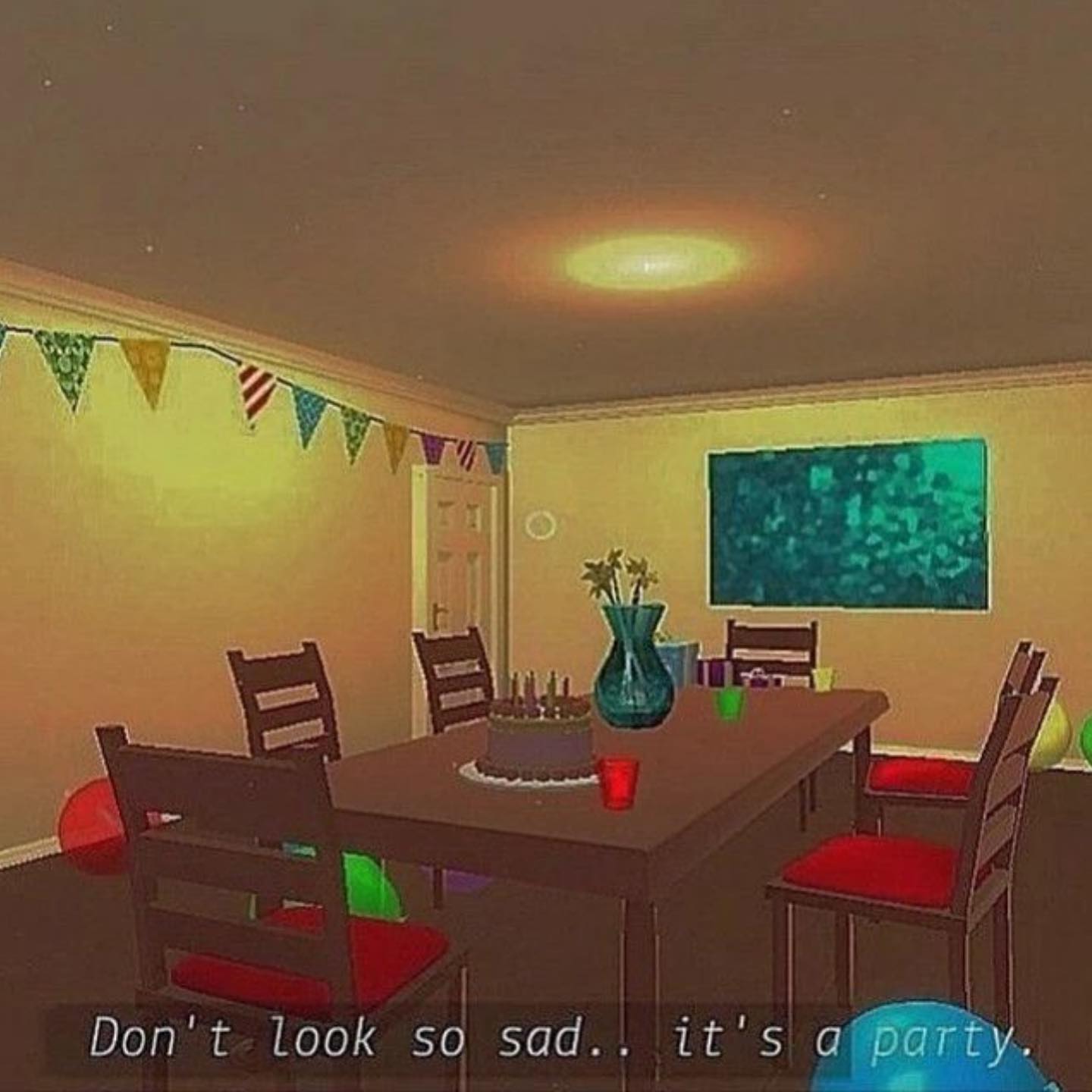
This image illustrates the concept of liminality by depicting an empty dining room set up for a celebration, but left entirely devoid of guests or interaction. The dim, warm lighting and presence of decorations like bunting suggest a transition between a normal day and an unexpected event, creating an eerie atmosphere. This "pre-party" emptiness is played out at maximum volume, highlighting the melancholic nature of the space that exists only to be filled, which perfectly captures the feeling of being stuck in a liminal space.
simple-description (llama3.2-vision_11b)
The meme is a screenshot from the video game "My Time at Portia" where the character Emily says "Don't look so sad... it's a party" while standing next to a dead body. The image is a representation of liminality, a state of being in between two stages, in this case, a funeral and a party.
detailed-analysis (gemma3-27b-vision)
Okay, let's break down this image through several theoretical lenses.
Visual Description
The image depicts a seemingly domestic interior, specifically a dining room set for a party, but with a peculiar, unsettling quality. The color palette is dominated by a warm, artificial yellow/orange, bordering on sickly. A long dining table is central, surrounded by chairs. On the table, there are signs of a celebration – a cake, a vase with plants, and several glasses (some appear empty). A string of decorative flags hangs along one wall. However, the room feels eerily empty and static. There's a notable lack of human presence. The overall aesthetic leans towards the uncanny valley, with a slightly distorted, digital, or dreamlike feel. The text overlay “Don’t look so sad… it’s a party” directly contrasts the apparent mood. A pink balloon on the left and green object on the right provide stark color contrast against the warm yellows of the room.
Postmodernism
The image embodies several key tenets of postmodernism.
- Simulacra & Simulation: The "party" depicted feels detached from any genuine experience. The celebratory elements (cake, decorations) are present, but the absence of people creates a sense of artificiality. It is a representation of a party, rather than an actual party happening. It points to the idea that our experiences are increasingly mediated by representations.
- Irony & Pastiche: The contrast between the text ("Don’t look so sad… it’s a party") and the desolate scene creates a strong sense of irony. The image is a pastiche, a collage of elements (party decorations, a dining room) that are juxtaposed in a way that undermines any clear or stable meaning.
- Deconstruction of Grand Narratives: The image questions the traditional "grand narrative" of celebration. It suggests that happiness or joy is not always authentic or straightforward, and that societal expectations (to be happy at a party) can be performative or even oppressive.
- Subjectivity & Fragmentation: The image's uncanny quality and lack of clear narrative encourage subjective interpretation. It doesn't offer a single, coherent meaning, but rather fragments of emotion and sensation.
Critical Theory
This image lends itself well to analysis through the lens of Critical Theory, particularly around the idea of alienation and the manufactured nature of experience.
- Alienation: The emptiness of the room suggests a form of social alienation. While the staging implies an attempt at connection through celebration, the absence of people underscores a disconnect. The festive elements become almost mocking, highlighting the lack of genuine social engagement.
- Commodification of Experience: The staging of the “party” can be interpreted as a reflection of the commodification of experience in late capitalism. Celebration itself has become a marketable product, divorced from its original social and emotional roots. The "party" is not about genuine connection but about fulfilling an expected performance or consumerist practice.
- Critique of Conformity: The text “Don’t look so sad…it’s a party” suggests a social pressure to conform to an expected emotional display. It subtly critiques the expectation that we should always be happy or cheerful, particularly in social settings.
Foucauldian Genealogical Discourse Analysis
A Foucauldian reading focuses on the power dynamics embedded in the very idea of a “party” and how it functions as a disciplinary practice.
- Discourse of Celebration: We need to analyze the discourse surrounding parties. What does it mean to have a party? What behaviors are expected? The image subtly disrupts this discourse. The missing people indicate a failure of this expected performance.
- Power/Knowledge: The expectation to be happy at a party is not neutral; it’s a form of power/knowledge. It’s an implicit rule that reinforces social norms. The image, by showcasing sadness within the party context, challenges this power dynamic.
- Genealogy of Happiness: A genealogical approach would trace the historical development of the concept of "happiness" as a social imperative. How has happiness been constructed as something we should feel, and how does this construction serve particular power structures? The image presents a disruption to the expectation of happiness, suggesting that it is not always naturally or effortlessly achieved.
Queer Feminist Intersectional Analysis
While the image is subtle, a Queer Feminist Intersectional lens can reveal underlying themes of constraint and emotional labor.
- Performance of Happiness: The expectation to ‘look happy’ (as per the text) often disproportionately affects marginalized groups, particularly women and LGBTQ+ individuals, who are frequently socialized to prioritize the emotional needs of others. This pressure to perform happiness can be exhausting and silencing.
- Emotional Labor: The image hints at the emotional labor required to maintain a cheerful facade, even when feeling otherwise. This labor is often unpaid and invisible, and it can be particularly burdensome for those who do not conform to traditional gender roles.
- Subversion of Norms: The image's melancholy can be read as a subtle act of resistance. By refusing to fully conform to the expectation of happiness, it challenges the norms that seek to control and regulate emotions.
Marxist Conflict Theory
This is the least directly applicable lens, but we can still connect it.
- Alienation & Consumerism: In a capitalist society, even moments of celebration can be shaped by consumerism and alienation. The party itself might be seen as a form of consumption, a way to alleviate the pressures of capitalist life through material goods and fleeting experiences.
- False Consciousness: The expectation to be happy at a party, even when feeling down, can be seen as a form of “false consciousness” - a state of being unaware of one’s true social and economic conditions. The image subverts this expectation, highlighting the possibility of genuine emotion breaking through the surface of a manufactured experience.
Let me know if you'd like me to elaborate on any of these analyses!
simple-description (llama3.2-vision)
The meme is a screenshot from a video game, specifically a scene from the 2011 game "The Last Story". The image shows a deserted and abandoned party room, with a table still set with a birthday cake, but no one is present. The text overlayed on the image reads: "Don't look so sad. It's a party."
tesseract-ocr
eer on : tH Wao oa piss “estas ws woe odie), | wel K > cs c ~<aill ant \ iS h 5 Wom aj cee i : h hy ne ; y/ a =, : ei cl cot Wee y frail Pi gli i 2 Don't- look so sad.. it's Tae