First Seen
2025-05-06T21:13:52.498516+00:00
simple-description (qwen3.5_2b-q8_0)
This meme captures the feeling of being "stuck" in a transition zone, like an abandoned school at night. Standing in this space represents a liminal state—a threshold area where you feel transient, empty, and waiting. You are effectively between the school and the outside world, feeling small and helpless in a place that no longer functions as a home. The text "Liminality" appears in the top left corner, referencing the specific concept of these eerie, transitional spaces where time seems to hang suspended.
detailed-analysis (gemma3_27b-it-q8_0)
Okay, let's analyze this image through the lens of "Liminality," with sections addressing relevant theoretical perspectives.
Image Description
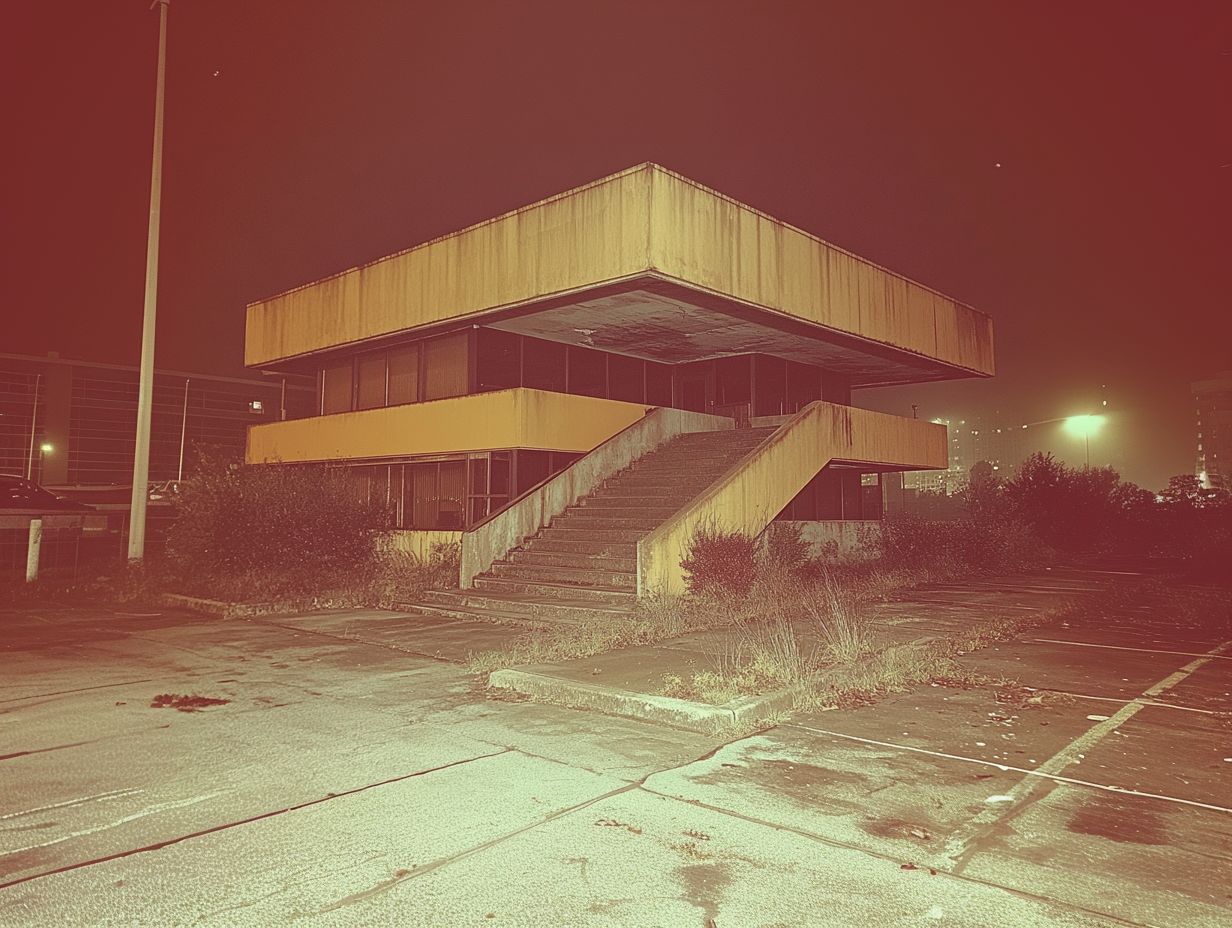
The image depicts a two-story, mid-century modern style building at night. It is clearly abandoned or at least heavily disused. The architecture is starkly geometric—boxes and straight lines, emphasized by the prominent staircase leading to a door that seems to lead nowhere. The building is surrounded by a cracked and empty parking lot, with sparse, overgrown vegetation encroaching on the concrete. The lighting is particularly evocative; a reddish, almost washed-out hue dominates the scene, creating an unsettling, dreamlike atmosphere. There are a few distant streetlights, but they do little to dispel the sense of isolation. The overall composition feels balanced yet unsettling, like a stage set waiting for a play that will never begin. The emptiness and stillness are pronounced.
Liminality: The Core Concept
This image strongly evokes liminality, which, in anthropology and increasingly in popular culture (as embodied in the "Liminal Space" aesthetic) refers to the transitional period or phase between one state and another. It's the "in-between" space. Key characteristics of liminal spaces include:
- Ambiguity: The purpose of the building is unclear. Was it an office? A store? What happened to it? This uncertainty is central to the liminal experience.
- Absence of People: The lack of human presence heightens the sense of transition. The space is meant to be used, but it’s not currently being used. It's the echo of human activity, not the activity itself.
- Temporality: The building’s state suggests a past and a potential future, but exists only in a present suspension. It’s caught between what was and what could be.
- Unsettling Familiarity: The architectural style is recognizable (mid-century modern), making the state of abandonment even more jarring. We know what this type of building is for, but this one isn't doing that.
This image taps into a profound sense of disorientation. Liminal spaces often evoke feelings of nostalgia, anxiety, and a strange sense of anticipation, as if something is about to happen, but never does. It's about a threshold crossed, but not quite reached.
Foucauldian Genealogical Discourse Analysis
Michel Foucault’s work can help us understand the history that created this liminal state. Foucauldian genealogy examines how power structures and discourses shape our understanding of space, institutions, and even time.
- Discipline and Panopticism: The building’s structure itself (especially the staircase and seemingly visible interior spaces) suggests a panoptic design— a design which enables surveillance. The building was likely designed to be a site of control and efficiency (an office, perhaps). Its abandonment signifies a breakdown of that disciplinary power. The "gaze" no longer operates here.
- Shifting Discourses of Progress and Decay: The architectural style speaks to a particular moment in history, a belief in progress, modernization, and the "future." Its current state is a visible negation of that discourse. It's a material manifestation of a failed promise. The image suggests how discourses about economic growth, urbanization, and ultimately obsolescence work.
- The Archive and Erasure: The building, as a physical object, is a part of the "archive"—a repository of history. Its abandonment implies a deliberate or accidental erasure from that archive, a silencing of its function and purpose.
Postmodernism
Postmodern thought is intimately connected to the experience of liminality.
- Deconstruction of Grand Narratives: The building's state represents the unraveling of "grand narratives"—the overarching stories that gave meaning to modern life (e.g., progress, capitalism, the nuclear family). This building doesn’t participate in those narratives anymore. It’s a relic of a belief system that has lost its authority.
- Simulacra and Simulation: Jean Baudrillard’s concept of simulacra is relevant. The building is a representation of a function (office, shop, etc.), but now that function is gone. It's a "copy" without an original, a simulation of purpose. It evokes a sense of hyperreality – a world where the representation precedes and defines the real.
- Fragmentation and Loss of Meaning: Postmodernism emphasizes the fragmentation of experience and the loss of inherent meaning. The building embodies this – it’s a fragment of a past, disconnected from a coherent present.
Critical Theory
Critical Theory asks us to examine the power structures embedded within the image.
- Alienation: The abandoned building can be seen as a symbol of alienation, a condition where individuals are separated from the means of production, from their labor, and from each other. The emptiness of the space reflects the emotional and social isolation that can result from capitalist structures.
- Commodification and Disposable Spaces: The building was once a commodity—a place of economic activity. Its abandonment suggests the disposability of spaces within a capitalist system. Once it's no longer profitable, it's left to decay.
- The Built Environment and Power: The built environment is not neutral; it's shaped by power relations. The building's architecture reflects specific values and ideologies. Its current state exposes the fragility of those ideologies.
In conclusion: This image is a powerful embodiment of liminality. It's not merely an aesthetically pleasing photograph; it's a visual representation of transition, loss, and the unsettling feeling of being "in-between." By applying these theoretical lenses, we can see how the image resonates with broader cultural and philosophical anxieties about modernity, power, and the search for meaning in a fragmented world.
simple-description (llama3.2-vision_11b)
The meme is a photograph of a decaying, abandoned building, often referred to as an "abandoned building" or "urban decay" image. The image is typically used to convey a sense of desolation, neglect, or the passing of time. The meme often includes a caption or text, such as "I'm not lazy, I'm just on liminal time" or "I'm not procrastinating, I'm just on liminal time", referencing the concept of liminality, a state of being between two states of being, often used to describe a sense of being stuck or in a state of transition.
detailed-analysis (gemma3-27b-vision)
Okay, let's break down this image through the lenses you've requested. It's a compelling image that lends itself to several theoretical approaches.
Visual Description
The image depicts a two-story, modernist building, likely a former commercial structure, in a state of disrepair and abandonment. It's characterized by sharp angles, flat planes, and a strong emphasis on geometric form. A prominent set of stairs lead up to the entrance, but the entrance appears inaccessible or boarded up. The surrounding area is a large, cracked asphalt parking lot with patches of weeds and overgrown vegetation. The color palette is heavily filtered with a strong yellow/orange hue, creating a slightly unsettling and desaturated atmosphere. The lighting is flat and almost unnatural, with a few sparse streetlights visible in the background. The overall impression is one of decay, neglect, and a haunting stillness. There's a sense of past functionality now eroded by time and lack of use.
Foucauldian Genealogical Discourse Analysis
This image is ripe for a Foucauldian analysis. The building itself can be seen as a site of power/knowledge, a physical manifestation of a specific discourse surrounding commerce, urban planning, and social organization.
- Discipline & Panopticism: The building’s architectural design, with its clear lines and structured layout, evokes a disciplinary logic. The staircase and its relationship to the entrance suggest controlled access and surveillance. While not a literal Panopticon, the building's form implies a space designed to regulate behavior through visibility and control.
- Genealogy of Abandonment: A genealogical approach would investigate the historical shifts that led to the building's abandonment. What discourses—economic decline, changing consumer habits, suburban sprawl, deindustrialization—converged to render this structure obsolete? It wasn’t an inevitable outcome, but a product of specific historical forces.
- Power Relations: The building’s decay signifies a shift in power relations. The former authority and control it represented have eroded. The weeds reclaiming the parking lot are a visual metaphor for the forces that challenge established power structures.
- The Archive: The building becomes an “archive” – not of documents, but of the lost practices, hopes, and assumptions of a particular era. Its very existence (and decay) speaks volumes about how the social landscape has transformed.
Critical Theory
Through the lens of Critical Theory, this image is far more than just a decaying building.
- Alienation: The building embodies alienation, a core concept in Critical Theory. It represents a space designed for human activity now devoid of it, suggesting a disconnect between individuals and the structures built to serve them. The lack of vitality speaks to a broader societal malaise.
- Commodification: The building was likely a site of economic exchange, a place where goods or services were commodified. Its abandonment points to the inherent instability and ephemerality of capitalist production. Everything is subject to obsolescence.
- Rationalization & Bureaucracy: The building’s modernist design reflects the principles of rationalization and bureaucratic organization. Its now-empty state suggests the limitations of this approach to social organization. Rationalization, when divorced from human needs, can lead to dehumanization and decay.
- Reification: The building, once a dynamic space, has become reified—an object removed from its original purpose and treated as a thing in itself. This highlights a broader tendency in modern society to prioritize objects over human relationships.
Marxist Conflict Theory
Applying a Marxist perspective reveals class tensions and economic contradictions embedded in the image.
- Capitalist Crisis: The building's abandonment is symptomatic of a crisis of capital accumulation. It suggests that the economic forces that once sustained this structure have faltered, leading to job losses, declining investment, and ultimately, dereliction.
- Spatial Fixes: The image can be seen as an example of a “spatial fix” – an attempt to resolve the contradictions of capitalism by relocating economic activity. The building may have been left behind as capital moved to newer, more profitable locations.
- Class Struggle: The decay of the building can be interpreted as a silent representation of class struggle. The building likely once provided employment and served a community. Its abandonment signifies the loss of livelihoods and the widening gap between the wealthy and the working class.
- Surplus Value: The building's prior function was likely to generate surplus value for its owners. Its abandonment represents a loss of that value and the failure of the capitalist system to sustain itself in this location.
Postmodernism
From a Postmodern perspective, the image embodies several key themes.
- Deconstruction of Grand Narratives: The building's decay challenges the modernist "grand narratives" of progress, rationality, and utopian urban planning. It suggests that these narratives are flawed and unsustainable.
- Simulacra & Simulation: The building, once a functional space, now exists as a simulation of its former self. It's a hollow shell, a signifier without a clear signified.
- Fragmentation & Loss of Meaning: The image reflects a broader fragmentation of meaning in postmodern society. The building’s decay suggests a loss of coherence and a sense of disillusionment.
- Pastische & Intertextuality: The building’s modernist architecture can be seen as a pastiche of earlier styles. The image invites us to read it in relation to other representations of urban decay and abandoned spaces.
Important Note: These analyses are not mutually exclusive. The image is complex enough to support multiple interpretations. I’ve tried to highlight the most relevant themes for each theoretical framework. Let me know if you’d like me to elaborate on any particular aspect!
simple-description (llama3.2-vision)
The meme is a photo of a dark, abandoned, and decaying building at night. The image is captioned "I'm not lazy, I'm just on energy-saving mode". The tone is humorous and ironic, implying that the building's state of disrepair is similar to the meme's speaker feeling like they're conserving energy rather than being lazy.