First Seen
2025-05-04T06:02:33.048357+00:00
simple-description (qwen3.5_2b-q8_0)
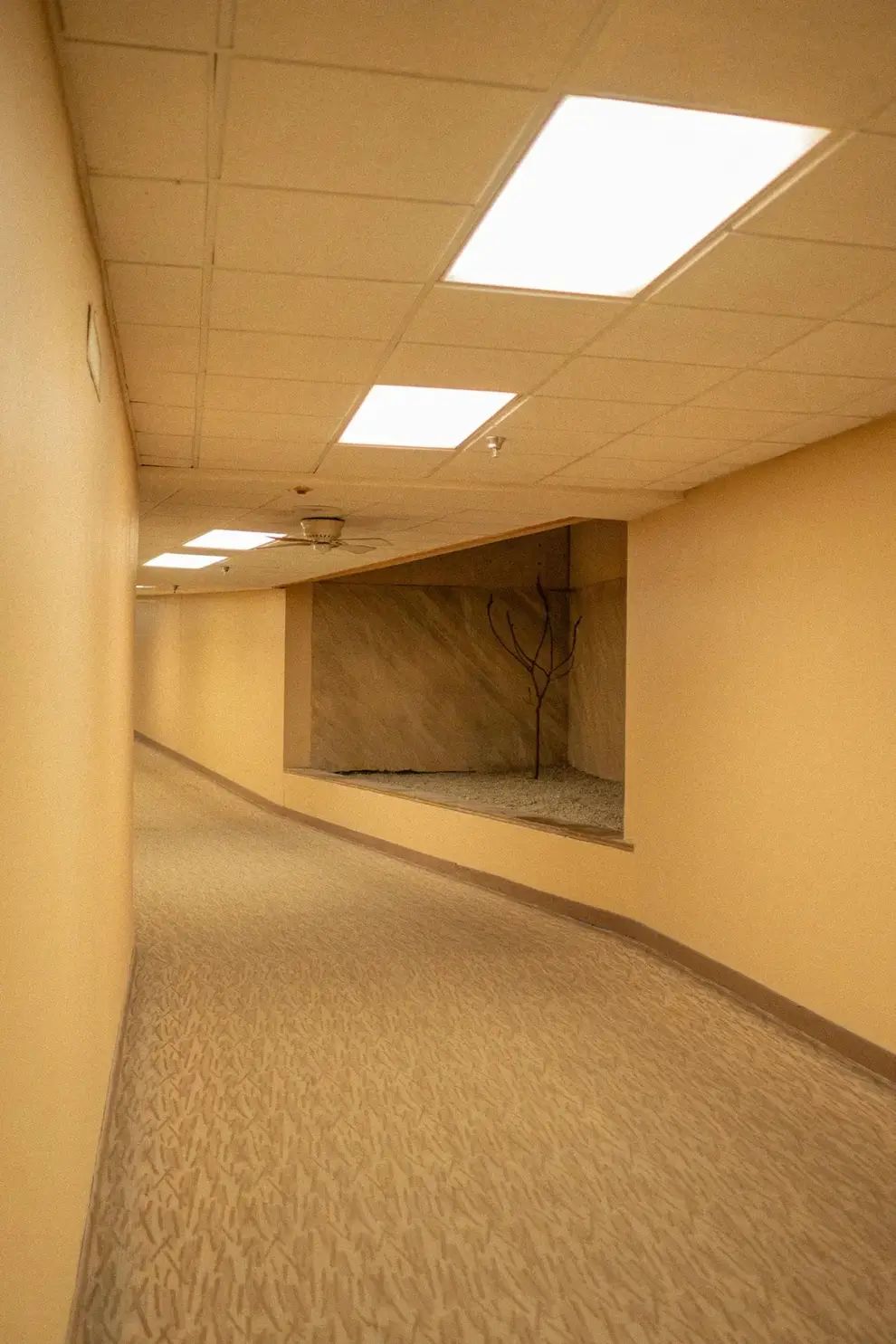
This image evokes the feeling of a "liminal space"—a place that feels empty, deserted, and slightly uncanny, like wandering into a forgotten hallway where no one is expected. The quiet, yellow lighting and the solitary tree growing out of gravel in the corner create a sense of being lost in a silent, abandoned transit area. There is no text visible in the image to accompany this mood.
detailed-analysis (gemma3_27b-it-q8_0)
Okay, let's break down this image through the lens of “Liminality” and relevant theoretical frameworks. This image has become a common "liminal space" aesthetic on platforms like Reddit and Tumblr, evoking strong feelings of unease and nostalgia.
Visual Description
The image depicts a long, beige-toned hallway with a repeating carpet pattern. It's likely a corridor within an institutional building – a hospital, school, or office – judging by the fluorescent lights embedded in the ceiling and the functional design. The most striking element is a recessed alcove (or indentation) along one wall. This alcove is filled with sand and features a single, bare, branch-like tree. The lack of people, and the artificial lighting, contribute to a sterile, almost dreamlike quality. The perspective emphasizes the length of the corridor, drawing the eye further into the space, creating a sense of vastness. The hallway seems to extend indefinitely.
Liminality & The Core Experience
At its heart, this image is powerfully liminal. “Liminality,” stemming from the Latin word limen meaning “threshold,” refers to the transitional period between one state of being and another. It’s the “in-between” space, the waiting room, the doorway, the hallway. This isn’t about a place to be but a place to pass through. The image captures the feeling of being suspended – not quite here, not quite there.
Several characteristics contribute to this feeling:
- Transitional Space: Hallways are inherently transitional. They connect spaces, but are rarely destinations in themselves.
- Absence of Human Activity: The emptiness amplifies the liminal quality. Without people, the space feels devoid of purpose, as if frozen in time.
- Artificiality & Depersonalization: The institutional aesthetic (beige walls, fluorescent lights, carpet) feels deliberately impersonal, stripping away any sense of warmth or individuality. This contributes to a feeling of disconnection.
- The Anomaly of the Alcove: The recessed alcove with the bare tree is a disruption of the expected. It introduces an element of the natural world into a thoroughly artificial environment, but it's a contained nature, a still life rather than a living ecosystem. It feels symbolic, and invites interpretation (see below under Postmodernism).
Foucauldian Genealogical Discourse Analysis
Michel Foucault's work on power, discourse, and institutions is highly relevant here. The hallway, as an architectural feature of institutions (schools, hospitals, prisons, offices), is itself a tool of power and control. The long, straight lines and the visibility it affords are features designed to facilitate surveillance.
- Panopticism: The hallway suggests the possibility of observation. Even if no one is visible, the structure evokes the idea of being watched. It’s a subtle form of disciplinary power.
- Normalization: The standardized design of the hallway (beige walls, identical lights) promotes a sense of normalization, reinforcing expected behaviours and suppressing individuality.
- Discourse of Institutional Space: This image represents the discourse of the sterile, controlled environment. It says "order," "efficiency," and "regulation". The alcove, while seemingly counter to this, might be interpreted as a managed expression of nature, further reinforcing control. The institution allows for a limited glimpse of the natural world, but within its own framework.
Critical Theory (Frankfurt School)
The image can be viewed through the lens of Critical Theory’s critique of modernity and instrumental reason. The sterile, repetitive nature of the hallway represents the alienating effects of industrialized, rationalized society.
- Dehumanization: The lack of warmth and individuality suggests a process of dehumanization. The space feels designed for function, not for human comfort or well-being.
- Loss of Authenticity: The artificiality of the environment points to a loss of authenticity and connection to the natural world. This resonates with Adorno and Horkheimer's critique of the "culture industry."
- Reification: The hallway itself becomes a reified object – a symbol of the rationalized, bureaucratic structures that dominate modern life.
Postmodernism
Postmodernism excels at deconstructing meaning and challenging grand narratives. The image is ripe for postmodern interpretation:
- Simulacra and Simulation: (Baudrillard) – The hallway simulates a space of transition, but it’s a hollow simulation. It lacks genuine purpose or meaning. The tree in the alcove could be considered a simulacrum of nature, a copy without an original.
- Ambiguity and Open Interpretation: The alcove with the tree invites a multitude of interpretations. Is it a symbol of hope? A representation of isolation? A failed attempt to bring nature into an artificial world? The ambiguity is deliberate.
- Loss of the Real: The overall feeling of unreality challenges the idea of a stable, objective "real." The image feels like a fragment of a dream, or a memory distorted by time.
Why It Resonates (the 'Meme' Aspect)
This image’s popularity as a “liminal space” meme taps into a collective cultural anxiety. It resonates because:
- Nostalgia for a Vague Past: Many people report feeling a strange nostalgia when viewing these images, even if they don’t have specific memories attached to them. This is likely linked to shared experiences of institutional spaces (schools, hospitals) and a yearning for a simpler, less chaotic time.
- Existential Discomfort: The image evokes a subtle sense of existential discomfort – a feeling of being lost, adrift, or uncertain about one’s place in the world.
- Reflection of Contemporary Anxiety: In an age of rapid change and uncertainty, the liminal space can be seen as a metaphor for the anxieties of modern life – the feeling of being stuck in a state of transition, without a clear sense of direction or purpose.
In essence, this image isn’t simply of a hallway; it is a feeling. It's a visual representation of the human experience of being "in-between," and its power lies in its ability to tap into deeply held anxieties and nostalgic yearnings.
simple-description (llama3.2-vision_11b)
The meme is a photograph of a long, empty corridor with beige walls and a carpeted floor. The image is captioned "liminal space" and features a small, dimly lit room in the distance, with a single chair and a small, bare tree. The image is a representation of a liminal space, a transitional or intermediate state between two phases or states.
detailed-analysis (gemma3-27b-vision)
Okay, here's an analysis of the image broken down into the requested sections, based on how well each theoretical framework applies. Some sections will be more robust than others, as not all lenses are equally relevant.
Visual Description
The image depicts a long, curved hallway with a distinctly institutional aesthetic. The walls are a pale yellow, and the floor is covered in a patterned beige carpet. The lighting is fluorescent, provided by rectangular fixtures in a drop ceiling. The hallway is relatively bare, lacking any clear signage or decoration, apart from a recessed niche in the wall.
This niche is the focal point – it's a shadowed alcove filled with pebbles and a single, bare tree branch, resembling a miniature zen garden. The curve of the hallway and the receding perspective create a strong sense of depth and isolation. The color palette is muted and somewhat oppressive, contributing to a sterile and perhaps unsettling atmosphere. The overall impression is one of institutional anonymity, punctuated by a contrived natural element.
Foucauldian Genealogical Discourse Analysis
This image is particularly well-suited to a Foucauldian reading. The hallway is a space of power/knowledge. It's a corridor designed for surveillance and control – a structure directing movement and defining access. Foucault argued that institutions like schools, hospitals, and prisons don’t just repress but produce certain subjects. This hallway seems specifically designed to create a feeling of being "processed" or guided, and the muted, uniform design contributes to a feeling of being stripped of individuality.
The recessed niche/zen garden is interesting in this context. It feels like an attempt to humanize the space, to introduce a sense of calm and natural beauty. However, it's a controlled nature, a miniaturized and contained landscape, mirroring the control exerted by the institution itself. It could be seen as a panoptic technique, a gesture towards well-being used to further discipline and normalize the occupants. The garden serves not as a source of genuine escape but as a representation of tranquility, reinforcing the institutional power structure.
A genealogical inquiry might trace the historical development of this type of institutional architecture. Why these colors? Why this type of carpet? What discourses (e.g., efficiency, hygiene, order) informed these design choices? How do they shape the bodies and behaviours of those who move through this space?
Critical Theory
The image aligns with critical theory's concerns with power structures and ideological control. The corridor represents a system – an institutional structure – that operates to maintain a certain order. The lack of individuality in the design – the bland colors, the repetitive patterns – suggest a suppression of individual expression.
The zen garden, while seemingly benign, can be viewed as a form of aesthetic pacification. By presenting a stylized version of nature, the institution can create the illusion of a harmonious environment, masking underlying power dynamics. It's a form of symbolic domination: the imposition of an idealized aesthetic to maintain control over the perception of space and experience.
The question of who benefits from this design is central. Is it to create a more efficient work environment? To discourage loitering? To maintain a sense of order? The image prompts a critical examination of the intended effects of this space and who is ultimately served by its design.
Marxist Conflict Theory
While not as overtly applicable, a Marxist reading can still be attempted. The hallway represents a space of labour and/or the control of labour. It connects areas of work or service within an institution (e.g., hospital, office building). The uniformity and blandness can be seen as symbolic of the alienation of workers – a lack of individual expression or ownership over their environment.
The institution, through its design, reinforces the class structure by establishing a clear distinction between those who control the space (management, authority figures) and those who are subject to its rules (employees, clients). The zen garden, while aesthetically pleasing, could be seen as a way to distract from the underlying economic inequalities inherent in the institution. It's a surface-level attempt to create a more pleasant atmosphere, but it doesn't address the structural problems that lead to exploitation and alienation.
Postmodernism
The image touches upon postmodern themes of simulation and the loss of authenticity. The zen garden feels like a hyperreality – a copy of nature that has been stripped of its original context and meaning. It’s a representation of tranquility, not the real thing. This reflects the postmodern notion that we live in a world saturated with signs and symbols, where it's increasingly difficult to distinguish between the real and the simulated.
The image's blandness and lack of clear meaning can also be interpreted as a reflection of the postmodern condition of fragmentation and uncertainty. The hallway seems to lead nowhere in particular, and its purpose is unclear. This ambiguity can be seen as a rejection of grand narratives and a celebration of the multiplicity of perspectives.
Queer Feminist Intersectional Analysis
This is the least directly applicable framework, but some readings are possible. The stark, sterile environment can be seen as a space that reinforces heteronormative and patriarchal structures. Spaces of institutional control often historically exclude or marginalize queer and feminist bodies, and the lack of warmth or individual expression in the hallway could be seen as reflecting this exclusion.
The attempt to "humanize" the space with the zen garden can be read as a superficial gesture that ignores the deeper systemic issues of inequality and discrimination. The garden, while aesthetically pleasing, doesn’t address the specific needs and experiences of marginalized groups.
Additionally, the controlled nature of the space – the strict adherence to order and uniformity – can be seen as a metaphor for the ways in which dominant power structures attempt to regulate and control bodies and identities that deviate from the norm. The image prompts questions about who is allowed to feel comfortable and safe in this space, and who is excluded or marginalized by its design.
Hopefully, this detailed analysis, organized by theoretical framework, provides a comprehensive understanding of the image. Let me know if you'd like me to expand on any particular aspect!
simple-description (llama3.2-vision)
The meme is an image of a long, empty hallway with a small, dimly lit room at the far end. The room appears to be a small, bare space with a single, dead tree in the center. The text "I have 1000 sqft of empty space" appears above the image, implying that the room is a large, empty space that is not being used.