First Seen
2023-05-10T21:03:35+00:00
simple-description (llama3.2-vision_11b)
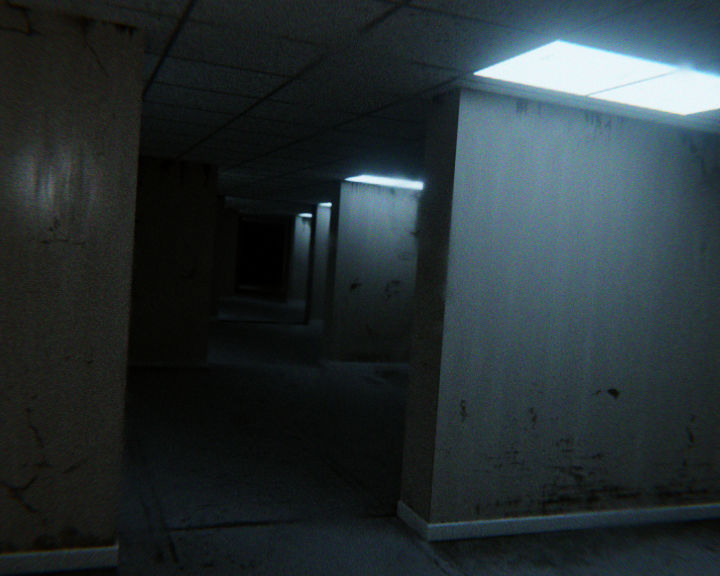
The meme is an image of a dark and eerie hallway, with a faint glow emanating from the ceiling. The image is captioned "I can see you" and is often used to express a sense of unease or being watched.
detailed-analysis (gemma3-27b-vision)
Okay, let's break down this image using the requested theoretical frameworks.
Visual Description
The photograph depicts a narrow, institutional hallway bathed in harsh fluorescent light. The space appears to be an interior corner of a larger building, likely an office or older public space. One wall is brightly illuminated by a rectangular fluorescent light fixture. The other wall recedes into deep shadow, making it difficult to discern much detail beyond the suggestion of further corridors or doorways. The walls are a faded, off-white or beige, with some visible marks and blemishes, suggesting wear and tear, or a lack of upkeep. The ceiling appears to be a typical drop ceiling with a grid pattern. The overall feeling is one of starkness, isolation, and perhaps even a degree of claustrophobia. The lighting creates a strong contrast between the illuminated and shadowed areas, intensifying the sense of depth and contributing to a somewhat unsettling atmosphere.
Foucauldian Genealogical Discourse Analysis
This image is incredibly potent when viewed through a Foucauldian lens. The hallway embodies a heterotopia – a space that is simultaneously real and unreal, existing outside the normative order. It's a liminal space, a passage between spaces, where power dynamics are visually inscribed.
- Discipline and Panopticism: The long, shadowed corridor evokes the idea of a panoptic gaze, even if not literally present. The implied surveillance through the layout (the potential for someone to be watching from the shadows) constructs a form of self-regulation. The space is designed to instill a sense of being observed.
- Genealogy of Control: Tracing the "genealogy" of this space, we might ask: What institutional logic produced this hallway? What practices, discourses, and forms of knowledge are embedded in its design? This likely points towards late 20th century office design or a building constructed for bureaucratic processes.
- Power/Knowledge: The fluorescent lighting is not merely a functional element; it is power. The bright illumination is a means of visibility, control, and normalization. The shadows, conversely, represent the areas where power isn't directly exercised, but still potential power, or where resistance might begin.
- Normalisation: The standardized design is aimed at normalising behaviors. It aims to impose an order on bodies and behaviours.
Critical Theory
This image lends itself to analysis through the lens of Critical Theory, particularly the Frankfurt School tradition.
- Alienation & Reification: The sterile, repetitive architecture and harsh lighting can be seen as contributing to the alienation of the individual within modern bureaucratic structures. The space becomes a symbol of reified (thingified) power and control.
- The Culture Industry: The uniformity of the space reflects the homogenizing effects of the "culture industry." It’s a space that doesn’t encourage individuality or creativity; it prioritizes function and efficiency.
- Domination & Control: The image exemplifies how built environments can be designed to reinforce systems of domination. The hallway isn’t neutral; it’s actively producing a particular subject, one who is compliant, manageable, and subject to surveillance.
- Loss of Authenticity: The standardized and utilitarian design contributes to a sense of a loss of authenticity and the erosion of individual expression.
Marxist Conflict Theory
From a Marxist perspective, the photograph can be interpreted as reflecting the material conditions of labor and class relations.
- Alienated Labor: The space suggests the impersonal nature of work in a capitalist system. The starkness and lack of humanizing elements underscore the dehumanizing aspects of alienated labor.
- Infrastructure of Control: The hallway represents the infrastructure used to maintain control over the working class. It’s a space designed to facilitate surveillance and regulate movement.
- Capital and Space: The built environment, including the hallway, is a manifestation of capital. The design decisions are driven by economic considerations, prioritizing efficiency and profit over the well-being of those who occupy the space.
- Power Dynamics: The harsh lighting and sterile environment can be seen as a visual representation of the power imbalance between employers and employees. The space reinforces the employer's control over the work environment.
Postmodernism
While the hallway appears quite austere, a postmodern reading can find interesting points.
- Simulacra and Simulation: The space isn’t “real” in the sense of being authentically lived in; it’s a simulation of a hallway, designed for a specific purpose. It’s a signifier without a clear signified, a pastiche of functional architecture.
- Deconstruction of Meaning: The image challenges traditional notions of space and purpose. The hallway is not simply a means of getting from one place to another; it’s a space that is saturated with meaning and power.
- Fragmentation and Loss of Grand Narratives: The repetition and uniformity of the space can be seen as reflecting the fragmentation and loss of grand narratives in postmodern society. There is no overarching meaning or purpose to the space; it is simply a functional element of a larger system.
- Empty Signifier: The hallway, as a space, is a relatively empty signifier. It doesn't necessarily evoke any strong emotions or associations; it is simply a functional space.
Queer Feminist Intersectional Analysis
This analysis requires a bit more interpretive work, as the image doesn't immediately reveal gender or sexuality. However, we can consider how this space might impact bodies and experiences differently based on identity.
- Spatial Control and Gendered Bodies: Spaces like this are often designed with an assumed "universal" body in mind – typically a heterosexual, able-bodied man. This can create challenges and feelings of exclusion for individuals who don't fit that norm. The harsh lighting and lack of personal touches can feel particularly isolating for marginalized bodies.
- Panoptic Surveillance & Vulnerability: The potential for surveillance within the hallway can be especially threatening for individuals who are already vulnerable to harassment or violence (e.g., women, LGBTQ+ individuals, people of color).
- Intersectionality of Power: The space is not simply about gender or sexuality; it's about the intersection of multiple forms of power and oppression. The design of the space reinforces existing power structures and can contribute to the marginalization of individuals who hold multiple marginalized identities.
- Controlling Bodies: The space can be interpreted as being designed to control and contain bodies, reinforcing societal norms and expectations. This can be particularly oppressive for individuals who challenge those norms.
I hope this detailed breakdown is helpful! Let me know if you'd like me to elaborate on any of these points.
simple-description (llama3.2-vision)
The meme is a picture of a dark, abandoned hallway with a faint glow emanating from the lights in the distance. The image is captioned "I'm not scared of the dark...".
tesseract-ocr
Pf if |Z J q ri = , ' zx cere ies b sii oe he ita le