First Seen
2023-05-10T21:03:35+00:00
simple-description (llama3.2-vision_11b)
The meme is a picture of a dimly lit, narrow corridor with a faint glow emanating from the end. The image is captioned "I've been walking for 10 minutes". From the perspective of liminality, this meme represents a state of being in between two places, physically and emotionally, with a sense of disorientation and confusion.
detailed-analysis (gemma3-27b-vision)
Okay, here's an analysis of the image, broken down into the requested sections. I will only include sections where the themes are reasonably applicable given the visual content.
Visual Description
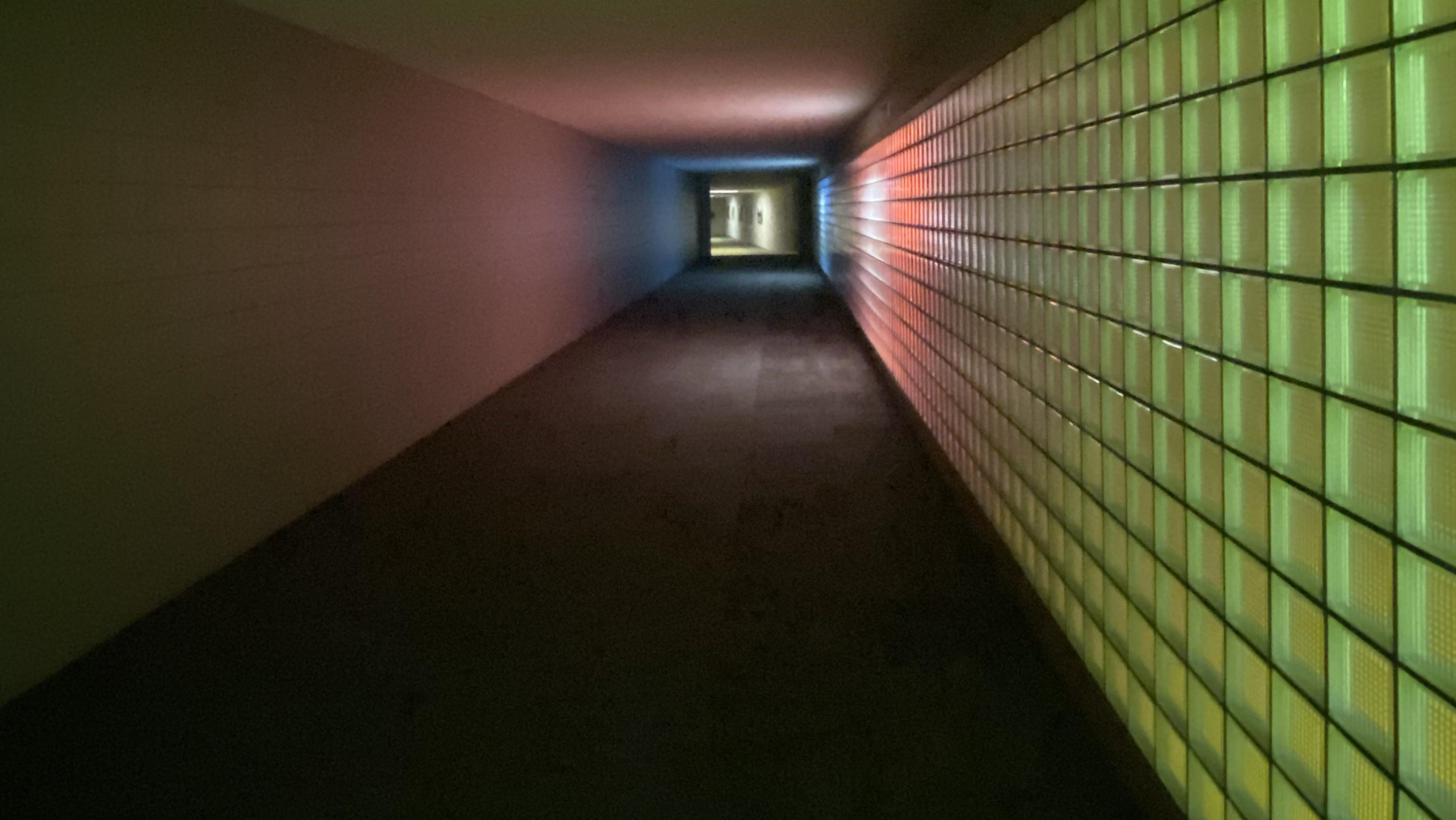
The image presents a long, narrow corridor or tunnel. The perspective is strongly one-point, drawing the viewer's eye down a central vanishing point. One wall is constructed of illuminated glass blocks, creating a patterned, textured surface with a yellow-green glow. The opposite wall is dark, a solid plane of a muted reddish-purple hue. The floor is dark, reflecting some light, and appears to be smooth. At the far end of the tunnel, there is a door, framed in a brighter, blue-toned light, which appears as a distant, perhaps unattainable, goal. The overall effect is one of depth, repetition, and a slightly unsettling, almost claustrophobic, quality. The lighting emphasizes contrast between the illuminated glass blocks and the dark wall, creating a dramatic and slightly surreal atmosphere.
Foucauldian Genealogical Discourse Analysis
This image powerfully evokes themes central to Michel Foucault’s work, particularly his concepts of power, surveillance, and normalization.
- Panopticism: The tunnel itself can be read as a metaphorical Panopticon. Though we cannot see the gaze, the long, linear structure implies observation. The corridor forces a directed movement, potentially creating a sense of being watched. The glass block wall, while visually intriguing, is also a porous structure. It allows light, and potentially visibility, in both directions. It doesn't offer solid concealment. This subtly reinforces the idea of an ever-present (though unseen) power structure.
- Discipline and Normalization: The tunnel enforces a linear trajectory. This is suggestive of disciplined movement and expectation. The repetition of the glass blocks implies a system, a grid, a structure that attempts to regulate and normalize space. Deviation from the central path is potentially punished (by darkness).
- Genealogical Investigation: The image doesn’t show the history that created the tunnel, but implies it. The tunnel is a product of a power dynamic that determined this linear structure, a purpose, a destination. A genealogical approach would ask how this space came to be, and what historical forces shaped its design and function. What practices does it encourage? What bodies does it control?
Postmodernism
The image also aligns with several tenets of postmodern thought:
- Deconstruction of Space: The tunnel, as a deliberately constructed space, questions traditional notions of space. It is not 'natural' but a product of human intervention, with a defined purpose and direction. This challenges the idea of neutral or objective space.
- Simulacra and Simulation: The illuminated glass blocks, while real materials, create a patterned surface that borders on artificial. They function as a representation of light and form, rather than direct illumination. This contributes to the idea of a simulated reality where the distinction between the ‘real’ and the ‘representation’ is blurred.
- Loss of Grand Narratives: The tunnel’s direction implies a destination, but the image does not reveal what that destination is. The lack of a clear, defined purpose challenges the idea of linear progress or overarching narratives. It suggests a fragmented, open-ended experience.
Queer Feminist Intersectional Analysis
While less immediately obvious, a queer feminist intersectional lens can be applied to the image:
- Linearity & Heteronormativity: The straight, narrow tunnel can be seen as a metaphor for heteronormative expectations—a pre-determined path with limited deviation. The pressure to move forward along this path mirrors societal pressures to conform to certain norms (gender, sexuality, etc.).
- Visibility & Surveillance: The glass wall, offering both visibility and potential exposure, can be connected to the experience of marginalized bodies, who are often subject to heightened surveillance and scrutiny. The need to navigate this space, constantly potentially visible, can be linked to the experience of being ‘under the gaze’.
- Claustrophobia & Control: The narrowness of the corridor can evoke feelings of claustrophobia and a lack of agency. This may be connected to systemic constraints and limitations experienced by marginalized groups. The image evokes a sense of being confined within structures of power.
I hope this comprehensive analysis is helpful! Let me know if you’d like any aspect of it expanded or clarified.
simple-description (llama3.2-vision)
The meme is an image of a long, dark tunnel with a faint glow at the end. The text "I can see for miles and miles and miles and miles" is written in a childlike, scribbled font at the top of the image, referencing the classic song "I Can See for Miles" by The Who. The image is meant to be humorous and ironic, as the speaker is claiming to have a long-range vision, but is actually stuck in a narrow, dark tunnel.
tesseract-ocr
vical f . mu = : , ) = Y % WN ee 4