First Seen
2024-11-18T19:35:47.409301+00:00
simple-description (qwen3.5_2b-q8_0)
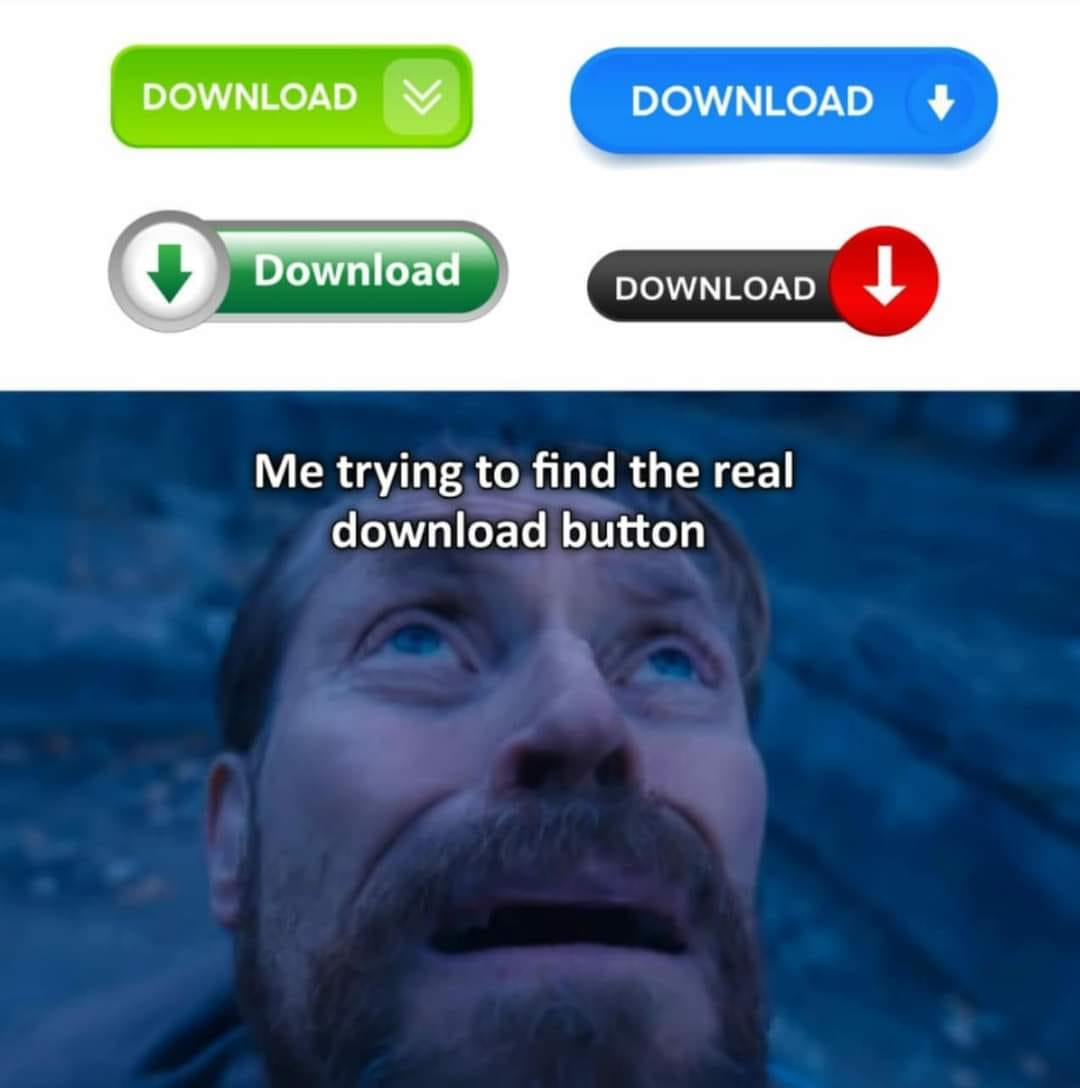
For someone familiar with the Linux operating system (specifically GNOME), this meme humorously explains the confusing interface created by a mix of the standard system menu and browser download managers.
It depicts the visual chaos of four conflicting "Download" buttons—representing the standard system menu, Firefox, Thunderbird, and other plugins—that make finding the actual system shortcut (usually just an icon or a keyboard shortcut) difficult. The text overlay, "Me trying to find the real download button," captures the frustration of trying to figure out which interface to use when you need to save a file.
detailed-analysis (gemma3_27b-it-q8_0)
Okay, let's break down this meme from a Linux-centric perspective, applying various theoretical frameworks where appropriate.
Visual Description
The meme features a grid of buttons all labelled "DOWNLOAD", but each with different styling (color, direction of arrow, case, etc.). Below that is an image of Willem Dafoe in The Lighthouse, looking upward with an expression of utter confusion and desperation. The text overlaid reads: "Me trying to find the real download button."
In the context of Linux, this highlights a frequently frustrating experience. Unlike the typically standardized interfaces of Windows or macOS, Linux often presents users with a wide range of graphical environments (Desktop Environments or DEs) and applications, each with its own style and quirks. This leads to inconsistent button designs, UI elements, and overall aesthetics, making even simple tasks like downloading something a surprisingly challenging hunt.
Foucauldian Genealogical Discourse Analysis
Michel Foucault's work focuses on how power operates through discourse—the ways we talk and think about things. In this meme, the "DOWNLOAD" button has become a site of power negotiation. The standardization of a "DOWNLOAD" button in mainstream operating systems (Windows, macOS) constructs a dominant discourse around what a download should look like.
Linux, by embracing customization and diversity, challenges that discourse. It fragments it, creating a multiplicity of “DOWNLOAD” buttons. The meme's image of Dafoe embodies the disorientation resulting from this break in the assumed naturalness of a UI element.
- Genealogy: We can trace the history of the "DOWNLOAD" button. It wasn't always as it is today. Early internet interfaces were very different. The current form is a product of interface design choices influenced by commercial operating systems. Linux intentionally resists being fully drawn into that history.
- Power/Knowledge: The meme reveals how knowledge of a “correct” download button comes from a pre-established interface paradigm. Users coming from other operating systems are 'subjected' to the power of Linux’s non-standardization, forcing them to learn a new way of interacting with the system.
Critical Theory
From a Critical Theory perspective, particularly that of the Frankfurt School, the meme points to the alienation inherent in technology. The "DOWNLOAD" button, a fundamentally utilitarian object meant to facilitate access, becomes an obstacle due to the proliferation of choice and inconsistencies. This is a subtle form of technological control.
The meme could be read as a critique of the fragmented and often user-hostile design choices driven by a desire for customization at the expense of usability. The user isn’t empowered by choice; they’re disoriented by it. This illustrates the tension between technological progress and human well-being. The seemingly trivial act of downloading becomes a symbol of the larger anxieties around navigating a complex technological landscape.
Postmodernism
The meme is deeply postmodern. Postmodernism rejects grand narratives and embraces fragmentation, pastiche, and the instability of meaning.
- Simulacra & Simulation: The multiple "DOWNLOAD" buttons aren't representing a download; they are simulations of a download, potentially without a clear original. The "real" download button is elusive, becoming a hyperreality where the signifier (the button) has become detached from the signified (the actual act of downloading).
- Deconstruction: The meme "deconstructs" the notion of a universal "DOWNLOAD" button. It exposes the arbitrary nature of its design and the underlying assumptions that govern our expectations.
- Irony & Playfulness: The meme’s humor derives from the ironic gap between what should be a simple action and the frustrating reality of finding the correct button.
Why these theories fit the Linux context:
Linux, at its core, is a philosophical project as much as it is an operating system. It challenges dominant technological paradigms, embraces decentralization, and encourages customization. This makes it fertile ground for these theoretical analyses. The meme doesn't just reflect a usability issue; it reflects the fundamental ethos of Linux – a rejection of imposed standardization and a celebration of diversity, even if it leads to occasional user frustration.
Let me know if you'd like a more in-depth exploration of any of these theoretical frameworks within the context of the meme!
simple-description (llama3.2-vision_11b)
The meme is a screenshot of a Linux terminal with a prompt to enter a password, but instead of a password, it says "Linux is fun". The image is humorous because it's a common joke that Linux is not user-friendly, and this is a tongue-in-cheek example of that. The text "Linux is fun" is a sarcastic comment on the complexity of Linux, implying that it's not as intuitive as other operating systems.
detailed-analysis (gemma3-27b-vision)
Okay, here's an analysis of the meme image, broken down into the requested sections. Not every section will apply – I'll only include those where the image lends itself to those theoretical frameworks.
Visual Description
The image is a meme comprised of two parts. The top portion shows a grid of four brightly colored buttons labeled "DOWNLOAD," each with a different directional arrow indicating where the download file will be located. The bottom portion features a close-up, heavily-filtered photograph of a man (appearing to be Ryan Reynolds) with a strained and exasperated expression. The text "Me trying to find the real download button" is overlaid on the image. The overall effect is humorous and relatable, playing on the common frustration of navigating websites with deceptive or misleading download buttons. The color palette is vibrant and slightly jarring, contributing to a sense of visual overload.
Foucauldian Genealogical Discourse Analysis
This meme is ripe for a Foucauldian reading. The "real" download button is not an intrinsic truth, but a construct of discourse. The proliferation of fake or misleading download buttons (and the meme’s depiction of this) signifies a shift in power dynamics within digital spaces.
- Power/Knowledge: The creators of websites (and those who design deceptive buttons) exercise power by controlling access to information/downloads. They dictate the terms of engagement. Knowledge of how to navigate these traps (recognizing deceptive buttons) becomes a form of resistance, but one that is constantly challenged by evolving techniques of deception.
- Genealogy: A genealogical approach would trace the history of deceptive online practices. Starting with early banner ads, then “fake” downloads that lead to adware/malware, this meme represents a continuation of that history. It demonstrates how strategies of manipulation evolve and are normalized within the digital landscape.
- Discipline: The meme implies a disciplinary mechanism: we are constantly subjected to online interfaces that attempt to shape our behavior (in this case, to click on the desired, often advertising-linked, button). The frustration of the man reflects a resistance to this form of control.
- Surveillance: The proliferation of tracking cookies and data collection tied to clicks and downloads further exacerbates this dynamic, turning the simple act of downloading into a form of being monitored.
Critical Theory
The meme also lends itself to a reading through Critical Theory, particularly around the concept of commodification and alienation in the digital realm.
- Commodification of Attention: The many buttons that look like downloads are, in essence, commodifying our attention. They are designed to capture our clicks, even if those clicks don't lead to what we actually want. This is a key feature of the attention economy.
- Alienation: The frustrated expression of the man speaks to a sense of alienation – a disconnect between his intended action (downloading) and the reality of the frustrating, manipulative digital environment. He is alienated from the "simple" task of downloading because it is now entangled with deceptive practices.
- Ideology: The meme exposes a hidden ideology embedded in website design. The underlying message is that user experience is secondary to profit generation, and that manipulation is an acceptable tactic.
Postmodernism
The meme reflects core tenets of postmodernism:
- Simulation and Hyperreality: The image shows multiple, nearly identical buttons, creating a sense of simulation—a copy without an original. The “real” download button is obscured amidst the simulacra, contributing to a hyperreality where the distinction between reality and representation becomes blurred.
- Deconstruction: The meme can be seen as a deconstruction of the concept of a "download button." It reveals the constructed and arbitrary nature of this supposedly straightforward function, highlighting the layers of manipulation that often lie beneath the surface.
- Irony and Parody: The image's humor is based on irony—the contrast between the expected simplicity of downloading and the frustrating reality. It's a parody of the design trends that prioritize monetization over user experience.
Let me know if you’d like any of these points elaborated on, or if you'd like me to focus on a different theoretical angle.
simple-description (llama3.2-vision)
This meme is a humorous commentary on the frustration of trying to find a "real" or "true" download button on a website. The image features a screenshot of a website with multiple "download" buttons, but none of them are actually working. The text above the image reads, "Me trying to find the real download button."