First Seen
2025-01-07T04:49:48.439067+00:00
simple-description (qwen3.5_2b-q8_0)
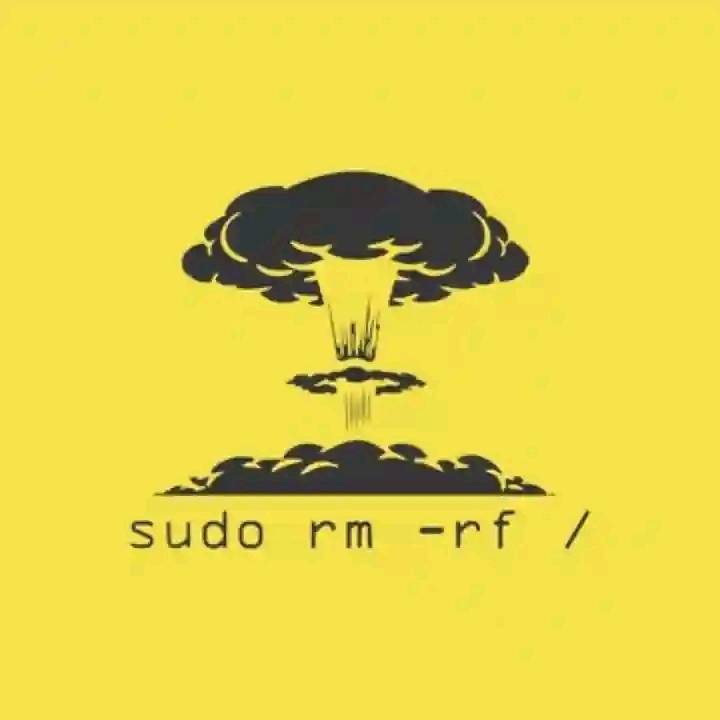
This meme uses a nuclear explosion to represent the catastrophic, self-destructive power of the Linux command sudo rm -rf /. By literally deleting everything in your computer recursively, it acts as a humorous visual for a command that is arguably the most dangerous to run without a backup. Users use this image to jokingly express "delete me" or to warn others that this command is so destructive that it might explode the machine.
detailed-analysis (gemma3_27b-it-q8_0)
Okay, let's break down this meme from a Linux/systems administration perspective, then layer in the requested theoretical frameworks where appropriate.
Visual Description
The image features a stylized black and white illustration of a nuclear explosion, resembling the iconic mushroom cloud. Below the explosion graphic is the command line text: sudo rm -rf /. The background is a bright yellow.
Linux Context & Explanation
This meme speaks directly to a very potent, very dangerous command within the Linux/Unix operating system environment. Here's a breakdown:
sudo: This stands for "superuser do." It allows a user to execute a command with the privileges of the root user – essentially, god-mode access. This is a security mechanism designed to prevent accidental or malicious system-level damage.rm: This is the "remove" command. It’s used to delete files and directories.-r: This flag stands for "recursive." When used withrm, it means the command will delete a directory and all of its contents, including subdirectories and files within those subdirectories.-f: This flag stands for "force." It suppresses any prompts or warnings. Usually, the system would ask for confirmation before deleting things, but-fbypasses that./: This is the root directory. It's the very top-level directory of the entire file system. Everything on the system is contained within it.
Therefore, sudo rm -rf / is a command that, if executed, will attempt to completely erase the entire file system on a Linux/Unix system. It’s the equivalent of hitting a self-destruct button. It's frequently used as a cautionary tale among system administrators. It's the kind of command you absolutely, positively do not run unless you have a very specific (and likely disastrous) reason to do so. The visual of a nuclear explosion aptly reflects the extent of the devastation this command can inflict.
Foucauldian Genealogical Discourse Analysis
Michel Foucault's work focuses on power, knowledge, and discourse. In this context, the meme unveils a discourse of control and potential disruption.
- Power/Knowledge: The command encapsulates a very specific kind of power. It's power held by those with administrative access ("sudo" being the key to that access). The knowledge to understand the command's effects is also a form of power. The meme reveals this power, but also highlights the danger of its misuse.
- Genealogy: Tracing the historical development of this command shows a move towards greater automation and control. Early systems were far more cumbersome to manage.
rm -rfbecame possible with more sophisticated file systems and a need to quickly manage large amounts of data. However, this increased power also introduces a greater potential for catastrophic error. - Discipline & Punish: The meme subtly references disciplinary power. The command is a tool of absolute control – the power to erase existence. It’s a dramatic example of the kind of totalizing control that Foucault explores. The potential for it to be run accidentally acts as a form of self-discipline for system administrators.
Critical Theory
From a critical theory perspective, this meme can be seen as a critique of the illusion of control offered by technology.
- Instrumental Reason: The command embodies "instrumental reason" – the idea that technology is neutral and simply a tool to achieve ends. However, the meme demonstrates that the "tool" can have profoundly destructive consequences, questioning the neutrality of technology itself.
- Domination of Nature: The complete obliteration of the filesystem can be viewed as a technological equivalent to the domination of nature. The user, wielding the command, seeks to exert absolute control over the digital "environment".
- Alienation: The ease with which one can potentially destroy a system highlights the alienation of the user from the underlying complexities of the technology they're wielding. The abstract nature of the command hides the profound impact it has on the system.
Postmodernism
The meme reflects aspects of postmodern thought:
- Deconstruction: The command deconstructs the entire file system, reducing it to nothing. This act of "deconstruction" is a key concept in postmodernism.
- Simulacra and Simulation: The system after the command is executed is a simulation of nothingness. The file system, once real, has been replaced by a void, arguably a "hyperreality" where meaning is lost.
- Rejection of Grand Narratives: The meme implicitly mocks the grand narrative of technological progress and control. It shows how quickly things can fall apart, challenging the idea that technology inherently leads to improvement.
Marxist Conflict Theory
A Marxist interpretation could focus on the power dynamics inherent in the command:
- Class Struggle: The "sudo" component signifies the power held by the administrative class (those with root access) over the rest of the system/users.
- Means of Production: The file system represents the "means of production" in a digital sense. The command allows the administrative class to completely destroy the means of production, highlighting their control.
- Alienation: As mentioned earlier, the abstraction of the command alienates the user from the complexities of the system. The user has power but may not fully understand the consequences of its use, leading to a detachment from the fruits of their labor (in this case, the functioning of the system).
In Summary
The sudo rm -rf / meme is a potent symbol within the Linux community. Beyond its technical meaning, it’s a darkly humorous reflection on the awesome power – and inherent risks – of modern technology. The theoretical frameworks above reveal deeper layers of meaning, connecting it to broader themes of power, control, destruction, and the illusion of mastery.
simple-description (llama3.2-vision_11b)
The meme is a play on the "sudo" command in Linux, which is used to execute a command with superuser privileges. The image shows a mushroom cloud with the text "sudo rm -rf /" which is a command that can delete an entire file system. The meme is a joke about the dangers of using this command without careful consideration.
detailed-analysis (gemma3-27b-vision)
Okay, let's break down the image through those lenses.
Visual Description
The image features a stark and minimalist design against a bright yellow background. At the top is a silhouetted mushroom cloud, a universally recognized symbol of nuclear explosion and devastation. Beneath the cloud, stylized waves suggest water or perhaps earth being disrupted. Below this imagery is the text "sudo rm -rf /" in a monospace font, resembling code or a command-line prompt. This text is central to understanding the complex meaning of the image. The combination is visually impactful, creating a sense of immediate, catastrophic destruction.
Foucauldian Genealogical Discourse Analysis
This image operates powerfully within a Foucauldian framework. The mushroom cloud itself represents a discourse of power – the history of nuclear weaponry, the Cold War, and the threat of annihilation. However, the text underneath is where the more subtle power dynamics emerge.
“sudo rm -rf /” is a Linux command that, when executed, recursively and forcefully deletes everything on a system. It's an absolute deletion, a complete reset. In a genealogical analysis, we're not interested in a cause of this imagery, but rather the historical conditions that allow these concepts (destruction, reset, absolute power) to be connected.
- Power/Knowledge: The command requires ‘sudo’ (super user do), suggesting a need for authority to enact such destruction. This highlights how power is mediated through systems and access, and the creation of 'expert' knowledge required to wield such tools.
- Disciplinary Power: The command implies total control over a system, a panoptic view. It suggests a desire to completely control and erase information, to discipline a system into non-existence.
- Genealogy of Destruction: We could trace a historical genealogy linking the creation of weapons of mass destruction to the development of increasingly sophisticated command systems (like Linux). This isn’t about a direct line of causality, but rather how the conditions of possibility for such extreme acts have developed over time.
Critical Theory
The image embodies the core tenets of Critical Theory, particularly in its questioning of power structures and the potential for catastrophic technological advancement. The image can be seen as a critique of:
- Instrumental Reason: The command-line interface represents the epitome of rational, efficient, and supposedly neutral technology. However, the result is complete destruction. This speaks to the inherent dangers of instrumental reason divorced from ethical considerations.
- Technological Determinism: The image challenges the idea that technology is inherently neutral or progressive. It demonstrates how technology can become a tool of radical destruction, driven by systems of control.
- The Culture Industry: The seemingly innocuous command-line text becomes a terrifying symbol, appropriated into a form of visual commentary. This highlights how cultural symbols can be repurposed to reflect anxieties about technology and power.
- Domination: The act of deleting everything (/), signifies the ultimate form of domination – the erasure of existence itself.
Marxist Conflict Theory
From a Marxist perspective, the image points to fundamental class conflicts and the instrumentalization of technology to serve the interests of dominant classes.
- Means of Destruction: Nuclear weapons and the technology that controls them represent the ultimate expression of the “means of production” applied to destruction, concentrated in the hands of state and military elites.
- Ideological Control: The use of a command-line interface, a symbol of technological prowess, can be seen as a form of ideological control—suggesting a rational, technical basis for the use of force.
- Alienation: The image hints at the alienation of humanity from its own creations. The command, executed by a single individual, has the power to unleash unimaginable destruction.
- Class Warfare: The potential for catastrophic destruction is seen as a reflection of inherent conflict within capitalist systems, where the drive for power and profit can lead to existential threats.
Postmodernism
The image fits well within postmodern aesthetics and concepts:
- Simulation & Hyperreality: The command-line text, a representation of code, becomes a symbol of destruction, blurring the lines between reality and representation. It's a simulation of annihilation.
- Deconstruction: The image can be seen as a deconstruction of the myth of technological progress. The supposedly neutral tool of coding becomes a force of ultimate destruction.
- Loss of Grand Narratives: The image challenges grand narratives of progress, rationality, and control. It suggests that even the most rational systems can lead to catastrophic outcomes.
- Fragmentation: The minimalist design and combination of seemingly disparate elements (mushroom cloud, code) reflect the fragmentation and loss of meaning characteristic of postmodern art.
Queer Feminist Intersectional Analysis
This is the most complex lens to apply, but some interpretations can be made.
- Systems of Control & Erasure: The act of deleting everything resonates with the historical erasure of marginalized communities, particularly queer and feminist voices. The “sudo rm -rf /” command can be seen as a metaphor for systemic oppression and attempts to erase identities and experiences.
- Patriarchal Control of Technology: The history of technology is often dominated by patriarchal structures. The image can be seen as a critique of the male-dominated field of technology and its potential for destructive outcomes.
- Intersectional Vulnerability: Marginalized communities are often disproportionately vulnerable to the effects of violence and destruction, whether physical or systemic. The image can be seen as a reminder of this vulnerability.
- Reclaiming Power: While the image depicts an act of erasure, a queer/feminist reading could also see the act of writing the command – and thus, sharing the image – as a form of reclaiming power and drawing attention to systems of control.
In conclusion, the image is a powerful and multilayered piece that operates on several levels. It’s a visually striking critique of power, technology, and the potential for catastrophic destruction, and invites a variety of critical interpretations.
simple-description (llama3.2-vision)
The meme is a humorous illustration of a nuclear explosion, but instead of a mushroom cloud, a giant "sudo" (short for "super user do") command is erupting. The text "sudo rm -rf /" appears in the image, which is a command that, if executed, would delete all files on a Linux system, effectively causing a digital "nuclear explosion".