First Seen
2023-05-10T21:03:35+00:00
simple-description (llama3.2-vision_11b)
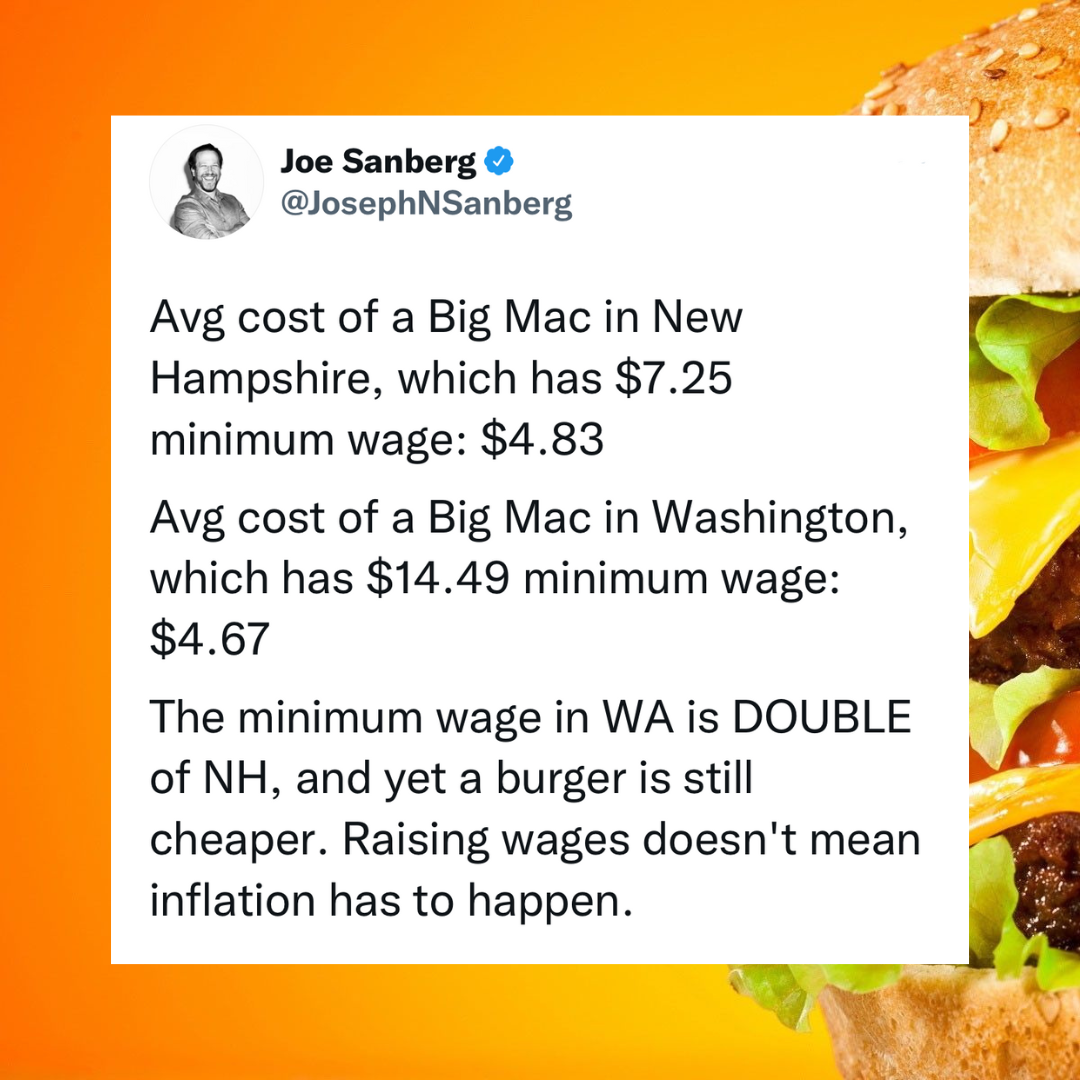
The meme is a humorous comparison between the minimum wage in the US states of New Hampshire and Washington. The image shows a text overlay that says "New Hampshire has a minimum wage of $7.25, while Washington has a minimum wage of $13.69".
detailed-analysis (gemma3-27b-vision)
Okay, let's break down this image of a tweet by Joe Sanberg through various theoretical lenses.
Visual Description
The image is a screenshot of a Twitter (now X) post. The post is overlaid on a close-up image of a McDonald’s Big Mac. The text is white and prominent over a blurred, warm-toned background of the burger. The visual connection to a fast-food item immediately frames the discussion around consumer goods, everyday costs, and perhaps, accessibility. The choice of a Big Mac as the example is significant—a universally recognizable, relatively inexpensive item meant to symbolize affordability.
Foucauldian Genealogical Discourse Analysis
This tweet is a small node within a larger discourse surrounding wages, economic policy, and the relationship between labor and consumerism. A Foucauldian genealogy would examine how the very concepts of "minimum wage," "inflation," and "affordability" have been constructed through historical power dynamics.
- Power/Knowledge: The tweet seeks to challenge a dominant narrative—that raising minimum wages necessarily leads to inflation. It attempts to create a counter-discourse based on the empirical evidence of Big Mac prices. This highlights how "truth" isn't objective, but rather a product of power relations.
- Discipline: The fear of inflation often functions as a disciplinary mechanism, discouraging minimum wage increases and reinforcing existing power structures. This tweet attempts to disrupt this disciplinary logic.
- Genealogy of “Inflation”: How did "inflation" become a feared term? What historical events, political strategies, and economic theories contributed to its construction as a threat? A genealogical approach would trace the evolving meaning of "inflation" and its use as a tool of social control.
Critical Theory
From a critical theory perspective, the tweet exposes how seemingly "neutral" economic principles (like supply and demand, inflation) often mask underlying ideological interests.
- Ideology: The dominant narrative that wage increases cause inflation functions as an ideology—a system of beliefs that justifies and maintains the status quo (in this case, lower wages for workers).
- Emancipation: The tweet strives for emancipation by challenging this ideological hold. It's a small step towards questioning the "naturalness" of economic inequalities.
- Commodification: The Big Mac is a symbol of commodification, the process of turning labor and resources into exchangeable goods. The tweet subtly critiques the prioritization of profit and economic growth over worker wellbeing.
Marxist Conflict Theory
From a Marxist perspective, the tweet is evidence of the inherent conflict between the bourgeoisie (capital owners) and the proletariat (workers).
- Exploitation: Low wages are seen as a form of exploitation, where workers are not compensated fairly for the value they create.
- Class Struggle: The debate about minimum wage is a manifestation of class struggle, a conflict over the distribution of wealth and power.
- False Consciousness: The acceptance of the idea that raising wages causes inflation can be seen as a form of "false consciousness," where workers internalize beliefs that serve the interests of the ruling class.
Postmodernism
A postmodern reading might focus on the construction of meaning itself.
- Grand Narratives: The tweet implicitly challenges the "grand narrative" that economic growth is the ultimate goal. It suggests that there are alternative metrics of success (like worker wellbeing) that should be considered.
- Deconstruction: The comparison between New Hampshire and Washington deconstructs the simple equation of "higher wages = higher prices." It demonstrates that reality is more complex and contingent.
- Relativism: It implies a rejection of universal economic "truths," suggesting that policies must be adapted to specific contexts.
Queer Feminist Intersectional Analysis
While this tweet doesn't explicitly address issues of gender or sexuality, an intersectional lens can still be applied to understand its broader implications.
- Labor Segmentation: The minimum wage disproportionately affects marginalized workers, including women, people of color, and LGBTQ+ individuals, who are often overrepresented in low-wage jobs.
- Care Work: Minimum wage jobs are often filled by those performing essential, yet undervalued, care work (e.g., in childcare, elder care, food service). The tweet implicitly highlights the need to compensate care workers fairly.
- Economic Justice: An intersectional perspective frames the debate about minimum wage as a matter of economic justice—ensuring that everyone has the resources to live a dignified life.
In summary, this seemingly simple tweet about a Big Mac can be analyzed through multiple theoretical lenses, revealing its complex implications for power, ideology, and social justice.
simple-description (llama3.2-vision)
The meme is a humorous comparison of the cost of a Big Mac in two different states, using the prices as a way to poke fun at the idea that raising wages doesn't mean inflation has to happen. The text reads: "The average cost of a Big Mac in New Hampshire is $7.25 with a $4.83 minimum wage, and in Washington it's $14.49 with a $4.67 minimum wage." The meme is meant to be humorous and satirical, rather than a serious comparison of the two states' minimum wages.
tesseract-ocr
Joe Sanberg @ - @JosephNSanberg Avg cost of a Big Mac in New —y Hampshire, which has $7.25 minimum wage: $4.83 Avg cost of a Big Mac in Washington, which has $14.49 minimum wage: $4.67 The minimum wage in WA is DOUBLE | of NH, and yet a burger is still cheaper. Raising wages doesn't mean | q inflation has to happen.