First Seen
2023-05-10T21:03:35+00:00
simple-description (llama3.2-vision_11b)
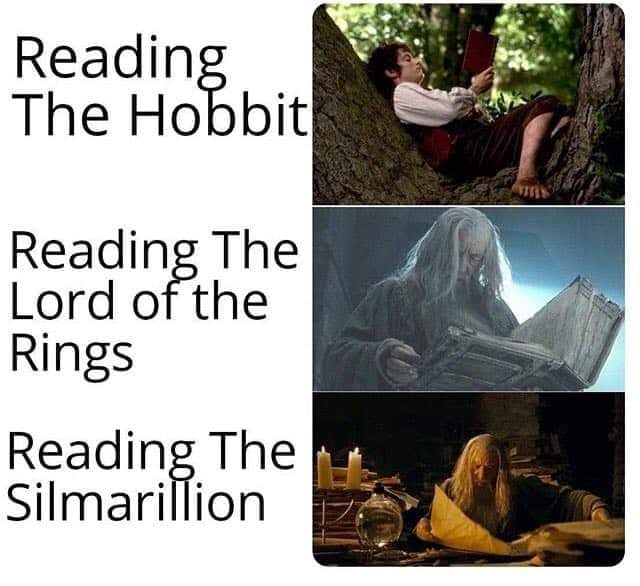
This meme is a play on the idea that the Lord of the Rings (LoTR) trilogy is a long and complex series of books, and that reading them is a daunting task. The meme shows a character from LoTR (Gandalf) reading a book, but the text above the image says "Reading" and below it says "The Lord of the Rings" and then "The Hobbit" and "The Silmarillion". The meme is implying that even a wise and powerful wizard like Gandalf finds the LoTR books to be a challenge to read.
detailed-analysis (gemma3-27b-vision)
Okay, let's break down this image and explore it through the lenses of several critical theories.
Visual Description
The image is a vertically arranged triptych, or three-panel composition, with text labeling each panel. Each panel appears to be a still or promotional image from adaptations of J.R.R. Tolkien’s works.
- Top Panel (The Hobbit): A person with reddish-brown hair is sitting on a tree with a book in their lap. The background is blurry foliage.
- Middle Panel (The Lord of the Rings): A grey-bearded individual, likely representing Gandalf, appears to be holding an ornate box. The background is dark, suggesting a cavern or underground setting.
- Bottom Panel (The Silmarillion): A light-haired, fair-skinned figure is lying on a dark-colored, cushioned surface. The image features ornate fabrics and golden jewelry.
The overall effect is a visual representation of progressively more complex and potentially demanding texts. The postures of the figures also suggest increasing levels of engagement—from relaxed reading to intense contemplation, perhaps even physical strain.
Critical Theory
The structure of the image lends itself well to interpretation through Critical Theory. The progression from The Hobbit to The Lord of the Rings to The Silmarillion can be seen as a metaphor for increasing levels of theoretical complexity.
- The Hobbit represents a comparatively straightforward entry point into Tolkien’s world, embodying a nostalgic focus on adventure and heroism.
- The Lord of the Rings introduces more complex moral ambiguities, the burden of responsibility, and the cost of power.
- The Silmarillion, with its mythic scope and genealogical history, demands a greater degree of intellectual engagement—a willingness to grapple with intricate histories, cosmological narratives, and difficult ethical questions.
The image suggests that the journey of reading Tolkien is a process of increasingly sophisticated engagement with systems of power, morality, and historical narrative.
Foucauldian Genealogical Discourse Analysis
This image strongly suggests the possibilities of Foucauldian genealogical analysis.
- Genealogy: The Silmarillion particularly embodies this. The book is fundamentally about tracing the lineage of power, the origin of institutions, and the evolution of social structures within Tolkien’s mythos. The image’s depiction of a seemingly exhausted or burdened figure could represent the arduous task of unearthing and reconstructing this complex history.
- Discourse: The images could represent the shifting “discourses” within Tolkien’s work. The Hobbit offers a relatively simple narrative of good versus evil. The Lord of the Rings introduces a more nuanced discourse of resistance and sacrifice. The Silmarillion challenges the very foundations of these narratives, revealing the messy, contingent, and often violent origins of the “truths” they take for granted.
- Power/Knowledge: The act of "reading" these texts—especially The Silmarillion—can be seen as an attempt to access and understand the "power/knowledge" that shapes Tolkien’s world.
Marxist Conflict Theory
We can see elements of Marxist Conflict Theory, although it's somewhat more subtle.
- Hierarchy and Power: All three texts inherently feature hierarchies of power. The imagery could represent the increasing burden of understanding these systems. The Hobbit depicts a simpler world with clear antagonists. The Lord of the Rings reveals the complexities of resisting a dominant power structure. The Silmarillion unveils the origins of this power—the conflicts that gave rise to the hierarchies we see in the later works.
- Struggle and Exploitation: Within Tolkien’s world, there's a constant struggle for resources, territory, and control. The Silmarillion is filled with conflicts and betrayals, potentially representing the exploitative nature of power.
- Class and Status: While not explicitly "class"-based in a modern sense, Tolkien’s world has clearly defined social hierarchies and status distinctions, and these themes are more pronounced in the deeper genealogies revealed in The Silmarillion.
Postmodernism
The image does hint at a postmodern reading. The layering of texts, and the implication that each successive work complicates the understanding of the previous one, can be interpreted through a postmodern lens.
- Meta-Narratives: The Silmarillion dismantles the simple, heroic narratives of The Hobbit. It reveals the foundations of these narratives to be complex, contingent, and often marred by violence. This can be seen as a rejection of grand, overarching meta-narratives in favor of fragmented, localized stories.
- Deconstruction: The image suggests that the meaning of Tolkien’s world is not fixed but constantly shifting. Each reading—each step into a more complex text—deconstructs the assumptions of the previous one.
- Subjectivity: The varying postures of the readers could reflect the subjective experience of interpretation. The act of reading itself becomes a constructed experience.
Queer Feminist Intersectional Analysis
While this might be stretching, we could consider intersections of power and marginalized voices.
- Limited Representation: Traditionally, Tolkien's work has been criticized for the limited role of women and the lack of queer representation. The image could be interpreted as visually representing this issue—the increasingly complex narratives failing to address these marginalized perspectives.
- Patriarchal Structures: The Silmarillion reveals the deep-rooted patriarchal structures within Tolkien’s world, where power is predominantly held by men and women are often relegated to passive roles. This could be symbolically represented by the burdened posture of the reader.
- Intersectionality: The increasing complexity of the texts could be seen as an opportunity to explore the intersections of power and oppression, but only if one actively reads against the grain and seeks out marginalized voices within the narrative.
Let me know if you'd like me to elaborate on any of these points or explore additional interpretations!
simple-description (llama3.2-vision)
The meme is a humorous comparison of the reading habits of three fictional characters from the "Lord of the Rings" and "Hobbit" book series. The text "Reading The Hobbit, Reading The Lord of the Rings, Reading The Silmarillion" is written on the left side of the image, while three images of the characters from the books are on the right. The images show the characters from the books in various states of reading, with the first image showing a hobbit sitting in a tree, the second image showing an old wizard reading a book, and the third image showing an old wizard reading a book in a dark, candle-lit room.
tesseract-ocr
Beading: ba ee The Hobbit Riise” Beading The [an eee Lord of the Me 4% Rings ac. Y a The i i Silmarillion =}