First Seen
2024-05-21T17:48:01.473603+00:00
simple-description (qwen3.5_2b-q8_0)
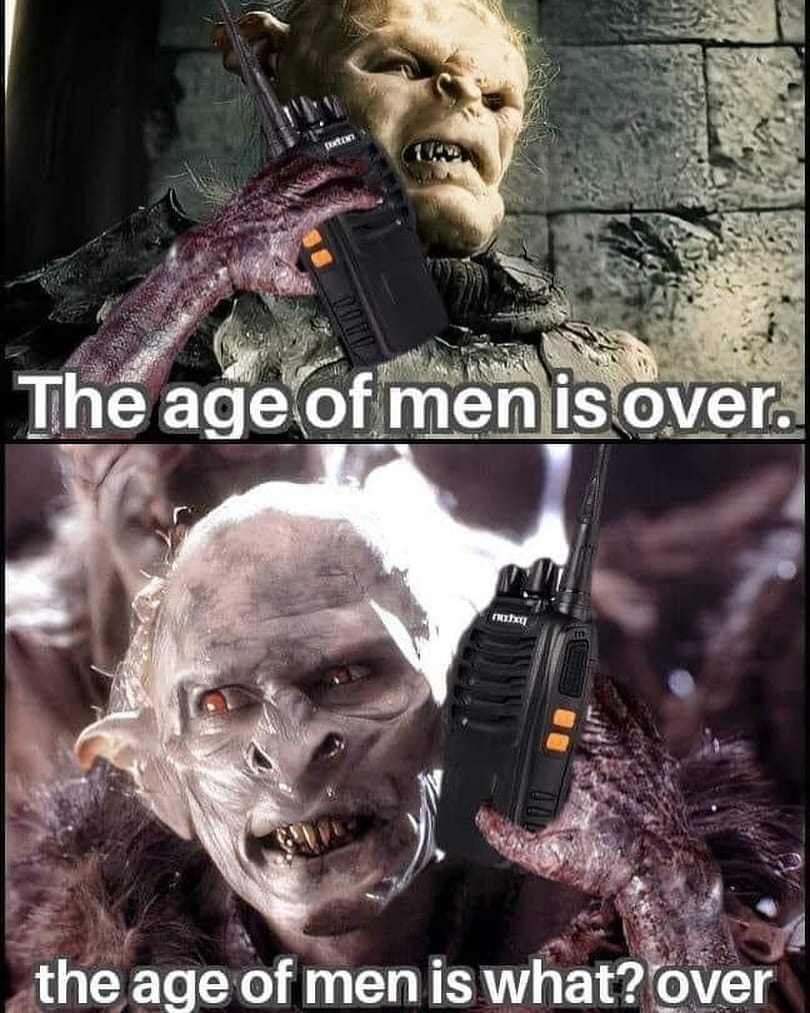
This meme references the hit song "The Age of Men Is Over" by The Black Eyed Peas and the character Doomguy (Tholgyr) from The Lord of the Rings. In the top panel, the wise wizard Gandalf speaks to Doomguy with the lines "The age of men is over." In the bottom panel, Doomguy delivers the song's famous line "the age of men is what? over," playing on the iconic lyric and the character's dark persona.
simple-description (llama3.2-vision_11b)
The meme is a humorous comparison between the character Gollum from J.R.R. Tolkien's "The Lord of the Rings" and a modern-day person's experience of aging. The image shows Gollum holding a phone and saying "I mean, you're not going to die until you're like, 100 or something." The text at the top of the image reads "The age of men is over" and at the bottom "The age of men is what?"
detailed-analysis (gemma3-27b-vision)
Okay, let's break down this meme image through the lens of the theoretical frameworks you've requested. It's a provocative image, and the analysis will be layered.
Visual Description
The meme consists of two panels. Both panels depict Gollum (from The Lord of the Rings) in a close-up shot, holding a modern walkie-talkie (branded “Retevis”). In the first panel, Gollum looks up, the walkie-talkie being held to his ear with a somewhat triumphant/ominous expression. Text overlaid reads "The age of men is over". In the second panel, Gollum maintains the same posture and expression, but the text at the bottom reads "The age of men is what? Over?". The lighting and color palette are dark and dramatic, accentuating Gollum's grotesque features. The contrast between the medieval/fantasy setting of Lord of the Rings and the modern technology creates a jarring and deliberate juxtaposition.
Foucauldian Genealogical Discourse Analysis
The meme taps into and subverts the discourse of masculinity and power. Michel Foucault's genealogical method encourages us to trace the historical conditions that shaped how we understand concepts like “men,” "masculinity," and "power." This meme doesn't present masculinity as a natural or inherent state, but as a constructed one. The image implies a "death of man," or a shift in dominant power structures.
- Power/Knowledge: The juxtaposition of Gollum, a creature often seen as "Other" and "subhuman" in the context of the Lord of the Rings narrative, with modern communication technology is critical. Communication is a key source of power/knowledge, and Gollum’s possession of it subverts traditional hierarchies.
- Discontinuity: The image creates a rupture in our expectations. Traditionally, power in LOTR is associated with nobility, warriors, and magic. To see Gollum, an outcast, wielding modern communication technology signals a disruption of this established order.
- Genealogy of Masculinity: By presenting a creature often defined in opposition to traditional masculine ideals as the one announcing the end of the “age of men”, the meme challenges the very foundations of what "man" and "masculinity" have historically signified.
Critical Theory
From a Critical Theory perspective (rooted in the Frankfurt School), the meme reveals and critiques the power dynamics embedded within social structures.
- Dominant Ideology: The meme potentially exposes the fragility of traditional, patriarchal ideologies. By suggesting that the "age of men" is over, it challenges the notion that masculinity is inherently superior or natural.
- Culture Industry: The meme itself is a product of the "culture industry" (Adorno & Horkheimer) – it’s a mass-produced, readily shareable image that circulates within contemporary digital spaces. It functions as a form of cultural commentary.
- Emancipation & Negativity: The meme’s negative assertion (“The age of men is over”) can be interpreted as a call for emancipation from oppressive patriarchal structures, suggesting a need for new social order.
Marxist Conflict Theory
The meme can be analyzed as representing a shift in the means of power and, therefore, class conflict, albeit symbolically.
- Power Dynamics: Traditionally, in the context of Lord of the Rings and broader historical narratives, power is often associated with physical strength, military prowess, and social status, all of which are primarily (though not exclusively) associated with men. The introduction of communication technology in the hands of an “othered” creature like Gollum re-configures these power dynamics.
- Subaltern Agency: Gollum, a character often marginalized and exploited, is gaining access to the means of communication, potentially enabling him to exert agency and challenge established power structures.
- Material Conditions: The walkie-talkie, as a material object, is a symbol of modernity and technological advancement. It shifts the basis of power away from traditional markers (strength, lineage) and towards access to information and the ability to communicate.
Postmodernism
The meme exhibits key postmodern characteristics:
- Pastiche/Intertextuality: The meme blends elements from two distinct cultural realms: the high fantasy world of Lord of the Rings and the mundane reality of modern technology. This juxtaposition creates a sense of irony and playfulness.
- Deconstruction of Grand Narratives: The claim “The age of men is over” challenges the grand narrative of patriarchal dominance. It deconstructs the idea of a fixed, linear progression of history with men as the central actors.
- Simulacra and Simulation: The image is a simulation of a statement within the context of the LOTR narrative. It’s a representation of a power shift, rather than an actual one.
Queer Feminist Intersectional Analysis
This is where the analysis gets particularly rich.
- Deconstructing Gender Binaries: The meme implicitly challenges traditional gender roles and the binary opposition of male/female. By suggesting the end of the “age of men,” it opens up space for alternative understandings of gender and power.
- Othering and Marginalization: Gollum is a creature who exists outside the normal parameters of the LOTR world. His possession of the walkie-talkie challenges the hierarchy.
- Intersectionality: While the meme doesn't explicitly address intersectionality, it hints at the complex interplay of power dynamics. It suggests that power isn’t solely about gender, but also about species, social status, and access to resources (in this case, technology).
- Challenge to Hegemonic Masculinity: The meme represents a challenge to the ideal of hegemonic masculinity, a type of masculinity that is considered dominant, normative, and often associated with power and control. Gollum's presence challenges the idea that masculinity is the only path to power.
In Conclusion
This seemingly simple meme is a surprisingly complex cultural artifact. It leverages the power of visual juxtaposition and a provocative statement to critique and deconstruct various forms of power dynamics, challenge dominant ideologies, and open up space for alternative understandings of gender, masculinity, and social order. Each theoretical framework provides a unique lens for understanding the meme’s significance.
tesseract-ocr
\yws 4 . a za : ‘Si VY ae? To iq . ay bs NY i i ad ae rh ¢ ae » & Bee Re \ etic it os a 7 aoe p, ; Pi ar S ; Re: fo8 ‘ Be } Po, A) Behar ; “me ee an at ee > are EF Pit 4 \e5 en y eat, &* | The age.of menijis‘over: HP aN OLLI OVET.: — | od Ne ‘ ‘* bai , pe t ~ ? l , a Ti) F p oe 5 A & b ‘ c b , . “ Jeu ti} sare Pies rs ‘ina co ae F 2 5 ¥ ‘ i a ria mr irl Si : A 2 vi _the age of men is what?over
simple-description (llama3.2-vision)
This meme is a humorous take on the concept of aging and the passage of time. It features a screenshot of a character from the "Lord of the Rings" series, specifically Gollum, holding a radio and saying "The age of men is over. The age of men is what? Over." The text is a play on the phrase "the age of men is over" and the character's mispronunciation of it, implying that the age of men is not over, but rather what?