First Seen
2024-08-05T21:20:41.112032+00:00
simple-description (qwen3.5_2b-q8_0)
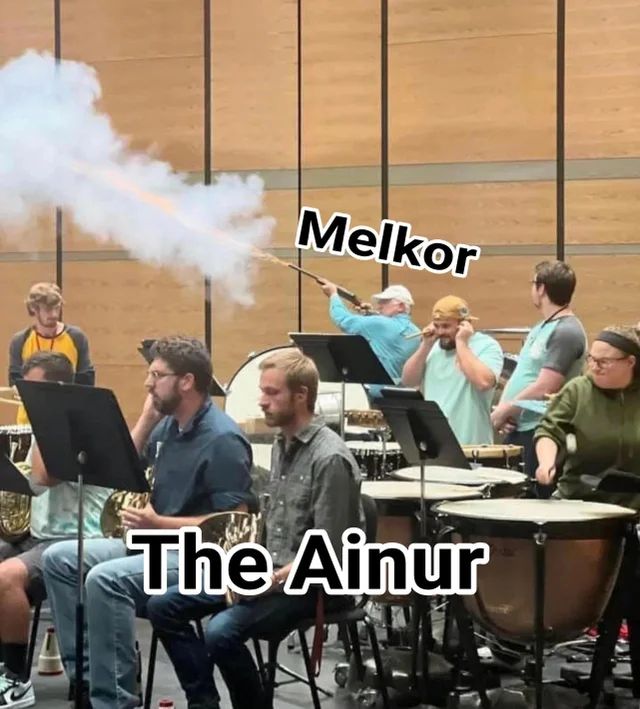
This meme plays on characters from J.R.R. Tolkien's The Lord of the Rings. The image features musicians, while the text overlays identify two specific figures: "Melkor," who is a high-ranking Elfi often associated with the Dark Lord Sauron, and "The Ainur," who are the divine spirit beings of Valinor. The humor comes from juxtaposing the spiritual, creative nature of the "Ainur" against a chaotic, destructive event, like the flare being lit, created by the darker figure labeled "Melkor."
simple-description (llama3.2-vision_11b)
This meme is from the context of the Lord of the Rings (LoTR) series. It shows a group of people playing instruments in a band, with one person holding a large, puffed-up instrument that looks like a giant horn. The text "They shall not pass... the air" is written above the image, referencing a famous quote from the LoTR series.
detailed-analysis (gemma3-27b-vision)
Okay, let's break down this image through various theoretical lenses. I'll only address the topics that seem relevant to the content of the picture, given that not every theory will necessarily apply.
Visual Description
The image depicts a group of people playing musical instruments—primarily brass and percussion—in what appears to be a modern, airy concert hall or auditorium. The background is largely characterized by glass windows and a light-colored wood paneling. Several musicians are actively playing, focusing on their instruments and music stands. Prominent text overlays the image: "Melkor" is labelled on a musician playing a trumpet with vapor or smoke coming out of the instrument, and “The Ainur” is labelled across the bottom, referencing the angelic beings in J.R.R. Tolkien’s cosmology. The scene feels candid, like a snapshot taken during a rehearsal or performance. There’s a general sense of effort and concentration, but the informal setting and the vapor-producing trumpet add a slightly playful or ironic dimension.
Foucauldian Genealogical Discourse Analysis
This image lends itself well to a Foucauldian reading, specifically by focusing on power relations as they manifest through discourse and representation.
- Discourse of Power & the Tolkien Universe: The labeling of “Melkor” and “The Ainur” isn’t merely about a musical ensemble. It constructs a power dynamic, drawing on Tolkien’s mythology. Melkor, the original Dark Lord, is positioned as the source of the musical “noise” (the smoke emanating from his instrument), while the Ainur, the angelic beings that created the world through music, are represented by the rest of the ensemble. This isn’t a neutral labeling; it performs a hierarchy.
- Knowledge/Power: The image implies a certain 'knowledge' about Tolkien's world is required to understand the labelling and the implied power relations. Those unfamiliar with Tolkien's mythology are excluded from fully understanding the message. This demonstrates how knowledge can be used to reinforce power dynamics and create inclusion/exclusion.
- Genealogy of the Image: Tracing the origins of the image—the practice of bands using mythological references, the popularity of Tolkien, the aesthetic choices in the photograph—reveals a chain of historical and cultural influences shaping its meaning. We can trace how the concepts of "good" vs. "evil" from the mythology get projected onto the musical performance.
Critical Theory
From a critical theory perspective, we can examine how the image perpetuates or challenges dominant ideologies.
- Myth and Ideology: By referencing Tolkien's mythology, the image taps into a pre-existing narrative structure. Tolkien, while fantasy, often deals with themes of power, good vs. evil, and creation. The image appropriates these themes, potentially reinforcing existing ideologies about hierarchical structures and the conflict between order and chaos.
- Cultural Appropriation: The use of Tolkien's mythology, created by a specific cultural context, can be considered cultural appropriation. However, within certain fan communities, such references are often accepted as homage or reinterpretation.
- Spectacle and Representation: The image itself is a spectacle. By presenting the musicians labelled with characters from a mythology, it frames the performance in a specific way, potentially influencing the audience's perception of the music and the musicians.
Marxist Conflict Theory
While not the most overt, a Marxist reading can be applied, although a bit subtly.
- Power Dynamics & Control: The labeling of “Melkor” (the originator/powerful figure) and “The Ainur” immediately implies a hierarchy. Marxist theory looks at how power and control are exerted in society. Here, the implied power structure within the mythological context is mirrored by the labeling in the image.
- The Role of Culture/Art: Art (in this case, the musical performance represented in the image) can be seen as a site of ideological struggle. The image, by presenting the musicians through the lens of Tolkien’s mythology, implicitly reinforces or challenges existing power structures and social norms.
Postmodernism
The image exhibits several traits commonly associated with postmodernism:
- Intertextuality: The image is deeply reliant on intertextuality – it depends on the viewer’s pre-existing knowledge of Tolkien's work to be fully understood. It's a remix of mythology and contemporary performance.
- Playfulness and Irony: The vapor-producing trumpet adds a layer of irony and playfulness to the scene. It subverts the seriousness often associated with classical music and epic fantasy.
- Deconstruction of Grand Narratives: By juxtaposing a musical ensemble with mythological figures, the image subtly challenges the grand narratives of good vs. evil and creation. It suggests that these concepts are fluid and open to interpretation.
- Blurring of Boundaries: The image blurs the boundaries between mythology, performance, and reality. It creates a hybrid space where different worlds collide.
I hope this provides a thorough analysis of the image through these various theoretical lenses. Let me know if you'd like me to elaborate on any specific aspect.
simple-description (llama3.2-vision)
This meme features a group of people playing a musical instrument in a band, but they're all holding cannons instead of instruments. The text "The Ainur" appears in the image, and the word "Melkor" is written above the person in the back holding a cannon, who is also blowing a horn-like instrument.