First Seen
2023-06-09T21:47:39+00:00
simple-description (qwen3.5_2b-q8_0)
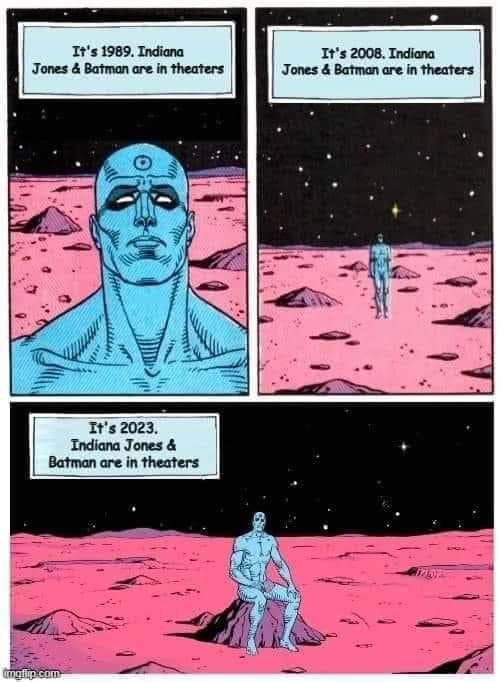
The meme illustrates Marx's concept of commodity fetishism by treating the release of the Indiana Jones film as a magical, objective force rather than a human-made product. The text shows that the movie is framed as a concrete "thing" that appears to happen "on" the moon in 2008 and even in 1989, effectively ignoring that it was actually created by human labor. The final panel clarifies that it happens "in theaters" in 2023, satirizing the idea that a movie release is a physical object that manifests everywhere without explaining its creation.
simple-description (llama3.2-vision_11b)
The meme is a humorous commentary on the increasing commercialization of superheroes. It shows a comic book character, Dr. Manhattan, from the series "Watchmen," looking out at a desolate landscape, with a caption that reads: "It's 1989, and I can see the entire history of humanity unfolding before me. It's 2008, and I can see the entire history of humanity unfolding before me. It's 2023, and I can see the entire history of humanity unfolding before me... and I see a never-ending stream of Marvel and DC movies." The meme is poking fun at the over-saturation of superhero movies and the lack of originality in the industry.
detailed-analysis (gemma3-27b-vision)
Okay, let's break down this intriguing comic panel sequence through various theoretical lenses.
Visual Description
The image is a three-panel comic strip presented in a style reminiscent of Frank Miller's work (particularly The Dark Knight Returns). The overall color palette is dominated by shades of red and gray, lending a somewhat bleak and otherworldly atmosphere. The background is a lunar-like landscape, appearing barren and cratered.
The central figure is a tall, powerfully built, metallic being with a smooth, featureless face save for a central, glowing eye. The figure is depicted in increasing detail across the panels. In the first panel, it is largely a looming silhouette. In the second, a figure standing upright in the distance. And finally, in the third, the figure is clearly visible, standing in a relaxed, almost contemplative pose.
Above each panel is a text bubble with the same phrase: “Indiana Jones & Batman are in theaters.” The dates change across the panels: 1989, 2008, and 2023.
Foucauldian Genealogical Discourse Analysis
This image powerfully evokes a genealogical analysis, specifically regarding the "discourse" surrounding heroism, masculinity, and entertainment. Foucault would be interested in how the idea of "hero" has evolved over time, and how this evolution is linked to power structures.
- Archaeology of Knowledge: The recurring phrase "Indiana Jones & Batman are in theaters" acts as a marker of cultural moments. It represents a specific type of cultural product—action-adventure blockbusters—that was prevalent during those years. This phrase isn’t just about the movies; it’s a signifier of a cultural landscape.
- Genealogy of Power: The metallic figure is crucial. It represents a transformation of the heroic ideal. It's an evolution from the pulpy adventurers (like Indiana Jones) and masked vigilantes (like Batman) to something altogether different. The figure's cold, metallic form suggests a shift towards a less human, more technological, and potentially less romanticized form of heroism. The figure displaces the human heroes. It's a change in the rules of how we define “hero,” and those rules are entangled with societal power dynamics—specifically, the growing role of technology and militarization in our understanding of protection and strength.
- Discursive Formation: The sequence implies that the figure emerged as a result of the cultural and technological landscape surrounding those years. The dates signify how it transitioned from being a vague possibility in 1989 to a fully realized presence in 2023.
Critical Theory
Through the lens of Critical Theory, we can interpret the image as a commentary on the commodification of culture and the evolution of the “heroic” archetype.
- Culture Industry: The repeated phrase about the films highlights the cyclical and predictable nature of the "culture industry" (Adorno and Horkheimer). The focus on blockbuster entertainment suggests a system that prioritizes profit and formulaic narratives over genuine artistic expression.
- Loss of Aura: The transition of the heroic figure from human-based to metallic could be seen as a reflection of the “loss of aura” (Benjamin). The metallic figure lacks the individuality and authenticity associated with traditional heroes. It's a mass-produced image, reflecting the standardization and dehumanization of contemporary culture.
- Reification: The figure itself, and the emphasis on spectacle, can be viewed as "reification," a process where social relations are replaced by thing-like representations. The heroic ideal, once embodied by complex human characters, is reduced to a powerful, metallic form – a commodity, divorced from its human origins.
Marxist Conflict Theory
From a Marxist perspective, this image can be interpreted as a reflection of societal tensions between the ruling class and the oppressed.
- Ideology & Superstructure: The recurring phrase about Indiana Jones and Batman, as entertainment products, serves as part of the “superstructure” in Marxist terms. They are a means to reinforce dominant ideologies about power, heroism, and justice. The films provide narratives that obscure the underlying class conflicts and power imbalances in society.
- Alienation: The metallic figure can be seen as a symbol of the alienation of labor and the dehumanization of workers under capitalism. The figure is a product of technological advancement, representing a shift from human craftsmanship to mass production. This process dispossesses workers of their skills and creativity.
- Power Dynamics: The figure’s imposing form suggests a concentration of power and control. It could represent the militarized forces that maintain the status quo and suppress dissent.
Postmodernism
The image embodies several key themes of Postmodernism:
- Simulacra and Simulation: The metallic figure can be seen as a “simulacrum” (Baudrillard). It is a copy without an original, an image that has become detached from reality. The figure embodies a hyperreality where the distinction between representation and reality has collapsed.
- Fragmentation and Deconstruction: The sequence deconstructs the traditional notion of the hero. The figure’s metallic form is a departure from the flesh-and-blood heroes of the past. This fragmentation challenges the idea of a stable, unified identity.
- Meta-narratives and their decline: The comic implicitly questions the grand narratives of heroism and adventure. The repetition of the movie titles and the emergence of the metallic figure suggest a rejection of traditional storytelling and a embrace of irony and self-reflexivity.
Queer Feminist Intersectional Analysis
This analysis is a bit more challenging, as the image doesn’t immediately present overt gender or sexual dynamics. However, a queer feminist intersectional reading can be applied:
- Deconstruction of Masculinity: The metallic figure challenges traditional notions of masculinity. The figure's lack of facial features and cold, emotionless form dismantles the archetype of the strong, virile hero. This deconstruction opens up space for alternative expressions of strength and power that are not tied to traditional gender norms.
- Power & The Body: The figure's metallic body represents an erasure of vulnerability and embodiment. The focus on a hardened, impenetrable exterior could be seen as a metaphor for the patriarchal tendency to suppress emotions and embrace aggression.
- Disruption of the Gaze: The figure's lack of expressive features and its imposing stature challenge the traditional male gaze. It disrupts the objectification of the body and creates a sense of ambiguity and uncertainty.
- Intersection with Technocracy: The technological aspect of the figure’s construction intersects with the historical marginalization of certain groups. Technological advancement, while seemingly neutral, often reinforces existing power structures and exacerbates inequalities.
Let me know if you'd like me to elaborate on any of these analyses, or explore different theoretical frameworks!
simple-description (llama3.2-vision)
This meme is a humorous commentary on the passage of time. It features a panel from a comic book or graphic novel, where the character of Dr. Manhattan from the series "The Watchmen" is shown to be observing the passage of time. The text in the panel reads, "It's 1989. The United States is in the midst of a cold war, and the world is on the brink of nuclear war. It's 2008. The world is in a state of war, and the world is on the brink of a global war. It's 2023. The world is in a state of war, and the world is on the brink of a global war."
tesseract-ocr
ne : 2 Tt's 1989. Indiana | It's 2008, Indiana | Jones & Batman are in theaters Jones & Batman are in theaters = L _ _| Berane —-—| i -— (|= eas od me} _ 5 r Se 2) Oo —_——_ a BY > f= sPivie - I Ne <> a ae 3 _— - 7 -| [ae TH : " a: ( —__ = Bs <= aii i | It's 2023. 5 Indiana Jones & M4 | Batman are in theaters aa, 1 ee a PN ————— pea eee SA ee oo. - weal T i > = 5a ee ht es- : | ee eS a