First Seen
2024-06-12T00:10:55.318431+00:00
simple-description (qwen3.5_2b-q8_0)
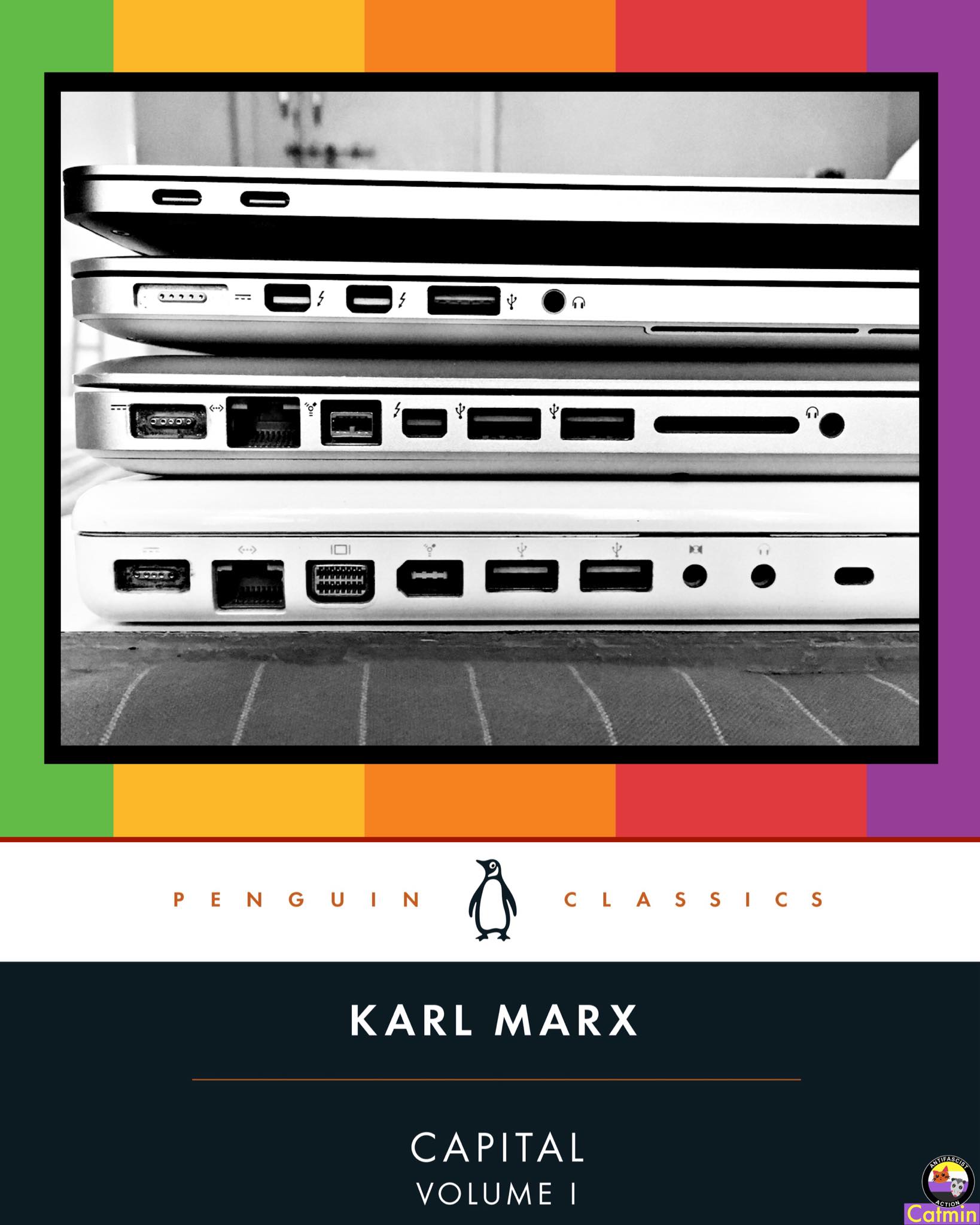
This meme is a visual reference to the concept of Commodity Fetishism from Karl Marx's Capital, Volume 1.
Here is an explanation of the concept as depicted in the image:
- The Source: The text at the bottom confirms the image references Marx's Capital, Volume 1. Marx is the philosopher who coined the term "Commodity Fetishism."
- The Definition: "Commodity Fetishism" is the idea that the social relationships between people (who produces what) are perceived as if they are relationships between things (the goods themselves). In this context, the 'fetish' refers to the 'object' or the 'commodity' itself. We treat the laptop as having value and function independent of the human labor that created it.
- The Image's Meaning: The stack of laptops represents a collection of "things" or "commodities." By stacking these objects, the meme illustrates how we often treat these items as distinct, self-contained entities with their own "power" or social standing, rather than seeing the complex human labor and production systems behind them.
- The Ports: The ports and the "Stack" symbolize the circulation and connection of these goods. It suggests that we are interacting with these "things" as if they are independent of their human creators.
In short, the meme uses the visual of a stack of "Commodities" to illustrate the idea that in capitalist society, we are often reduced to our role as workers (laborers) who sell our time and labor power for the market, treating our products as isolated objects.
simple-description (llama3.2-vision_11b)
The meme is a humorous illustration of the concept of commodity fetishism, a Marxist idea that people's values and desires are shaped by the products they buy and use. The image shows a person holding a smartphone, with the words "I love my iPhone" written above it, but the text is actually a quote from Karl Marx's book "Das Kapital". The meme is poking fun at the idea that people's values are influenced by the products they buy, and that they are willing to pay a high price for them.
detailed-analysis (gemma3-27b-vision)
Okay, here's a breakdown of the image, with analysis tailored to the requested theoretical frameworks where applicable.
Visual Description
The image is a book cover for the Penguin Classics edition of Karl Marx’s Capital, Volume I. The top 2/3 of the cover features a black and white photographic stack of the back ports of several Apple Macbooks. The ports are facing upward, creating a repetitive pattern of rectangles, circles, and various connection points. The lighting is direct, creating strong highlights and shadows. The lower 1/3 of the image is a solid black background featuring the "Penguin Classics" logo (a stylized penguin), the author's name ("Karl Marx"), and the title ("CAPITAL VOLUME I"). A multicolored stripe is at the very top of the cover.
Marxist Conflict Theory
This cover immediately evokes themes of capital and technology in a visually arresting way. The choice of Apple Macbooks, as symbols of contemporary technological capitalism, is significant.
- Alienation: The sheer number of ports – the interfaces through which information and value flow – could be interpreted as representing the increasingly complex and alienating nature of capitalist production. Ports represent access points, but also boundaries and controls. The stack emphasizes a sense of relentless accumulation and connectivity.
- Commodification: The Macbooks themselves are commodities, and the ports are essential to their function in the system of exchange. The image visualizes how technology has become central to the accumulation of capital.
- Technology and Class: The Macbooks are status symbols, often associated with creative or professional classes, representing a specific segment of the capitalist landscape. This also can be viewed as an example of how technology contributes to the stratification within capitalist systems.
- The Materiality of Abstract Labor: While Capital deals with abstract economic concepts, the image grounds the discourse in a material reality of circuits, cables, and physical infrastructure. It suggests that even the most ethereal concepts of capital rely on very concrete, physical foundations.
Foucauldian Genealogical Discourse Analysis
The image can be analyzed through a Foucauldian lens by examining the “discourse” of technology and power.
- Panopticism & Surveillance: The ports – the "interfaces" – can be seen as analogous to the panoptic gaze. They are connection points, but also points of potential control and monitoring. Each port is a potential gateway for data collection and circulation, even if not immediately apparent.
- Power/Knowledge: The Macbooks are objects of knowledge and expertise. Accessing, understanding, and utilizing the technology embodied in the ports requires specialized knowledge. This knowledge, in turn, confers power.
- Disciplinary Technologies: The repetitive, ordered arrangement of the ports evokes the image of a regulated, disciplined system. The ports themselves represent the "technologies" that enable the management and control of information, resources, and individuals within a capitalist system.
- Genealogy of the Interface: The image prompts a consideration of the historical development of the interface – how we have moved from more direct modes of interaction to increasingly mediated ones.
Critical Theory
The image resonates with themes explored within Critical Theory, particularly the critique of instrumental reason and the commodification of life.
- Instrumental Reason: The ports and their function embody a logic of efficiency and optimization. They are designed solely to achieve specific ends – the transmission of data, the connection of peripherals – without regard for broader social or ethical consequences.
- Commodification of Experience: By associating technology with the text of Capital, the image suggests that even our relationships with technology – with information, communication, creativity – are increasingly mediated by capitalist logic. The ports represent a system of exchange that permeates all aspects of modern life.
- Reification: The ports are physical representations of abstract economic relationships. The image visually embodies the concept of reification—the treatment of abstract concepts as concrete realities.
Note: Postmodernism and Queer Feminist Intersectional Analysis aren't as directly applicable to this image. While postmodern critique might challenge the notion of a singular, coherent "capital," and a queer-feminist reading could explore how gendered and marginalized bodies are impacted by the technologies depicted, these frameworks wouldn't be the primary lens through which to interpret the image.
tesseract-ocr
"YT i : ™ alll ener _=-e oo =e. a=) J-CY Te GlGiwGwee ee ee hc KARL MARX CAPITAL ~*~ VOLUME | A)
simple-description (llama3.2-vision)
The meme is a humorous image of a stack of MacBooks with multiple USB ports, implying that the devices are so old that they have a USB port for every year of the Mac's existence. The image is captioned "MacBook" with a "2006-2015" label below it, implying that the devices are so old that they have a USB port for every year of the Mac's existence.