First Seen
2023-08-26T16:50:34+00:00
simple-description (qwen3.5_2b-q8_0)
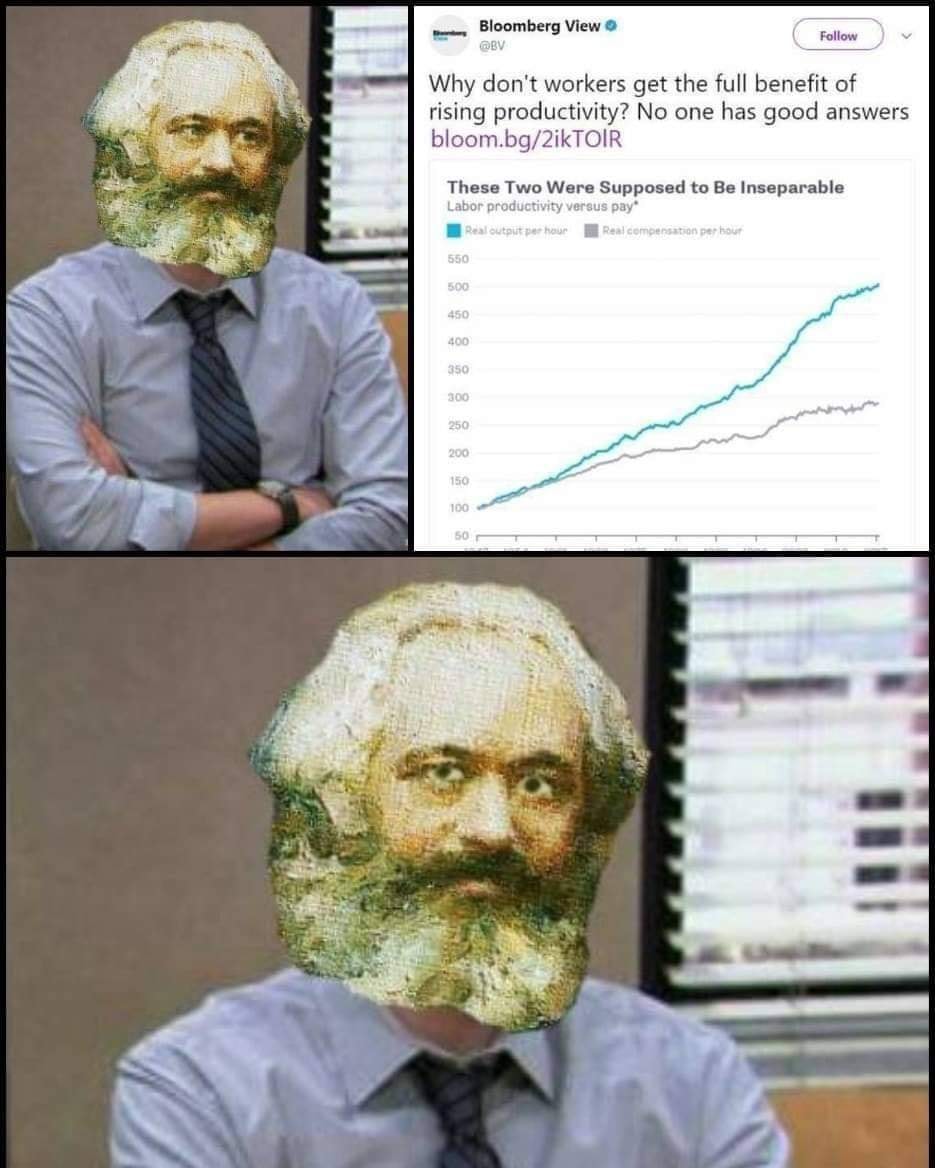
This meme plays on the visual contrast between the image of Karl Marx and a screenshot from Bloomberg View, highlighting the Marxist idea that "relations of production" often fail to keep pace with "forces of production" like rising productivity. The tweet includes a graph showing that while "Real output per hour" (productivity) is rising, "Real compensation per hour" (pay) is lagging behind, suggesting that even when workers add more value, the capitalist wage system does not share that gain. The bottom panel of the meme, showing the same person looking bored, reinforces a cynical interpretation that despite advancements in technology, the fundamental power dynamics between labor and capital remain unchangeable and oppressive.
simple-description (llama3.2-vision_11b)
This meme is a play on the common phrase "I can see you're reading" from the TV show The Office, but with a Marxist twist. The image shows a photo of Karl Marx, the father of Marxism, with a caption that reads "I can see you're reading Das Kapital" - a reference to Marx's influential book on economics. The meme is a humorous way of poking fun at the idea that Marx's work is so widely read that even the most mundane situations can be seen as a commentary on Marxist theory.
detailed-analysis (gemma3-27b-vision)
Okay, let's break down this image/meme with analyses as requested. It’s a dense image with multiple layers, lending itself to several theoretical approaches.
Visual Description
The image presents a two-panel meme. The top panel shows a professional headshot of a man in a button-down shirt, seated in an office setting. However, the man's face has been digitally altered to resemble a lion's head, creating a humorous and unsettling juxtaposition. Overlaid on the image is a Twitter post from "Bloomberg View" asking "Why don't workers get the full benefit of rising productivity? No one has good answers." A graph is displayed next to the tweet with two lines – one blue indicating “real output per hour” and the other turquoise indicating "real compensation per hour". The graph demonstrates that while output has steadily increased, compensation has remained largely stagnant.
The bottom panel is the same man with the same lion-like visage.
The overall effect is comedic, but also deliberately thought-provoking, setting up a connection between the image of predatory capitalism and the question of wage stagnation.
Marxist Conflict Theory
This image is strongly rooted in Marxist analysis. The graph explicitly highlights the contradiction between increased productivity (the worker creating more value) and stagnant wages. This is a central tenet of Marxist thought – the exploitation of labor. The owner/capitalist class appropriates the surplus value created by the workers, increasing their profits while workers do not see a corresponding increase in their wages.
- Class Struggle: The image implicitly demonstrates the inherent class struggle. The lion head (a symbol of predatory strength and control) is superimposed on the figure representing (potentially) the capitalist class.
- Surplus Value: The widening gap between the lines on the graph visually represents the extraction of surplus value from labor.
- Alienation: While not explicit, the image hints at alienation. Workers contribute to increased production, but do not benefit from the results, creating a sense of disconnection and powerlessness.
- Critique of Capitalism: The image’s question and the accompanying graph are a direct critique of the capitalist system’s tendency to concentrate wealth in the hands of a few, even as the workforce becomes more productive. The meme implicitly blames the capitalist class for the inability of workers to realize the benefit of their increased productivity.
Foucauldian Genealogical Discourse Analysis
A Foucauldian lens can unpack how power operates in shaping the discourse around productivity and compensation.
- Power/Knowledge: The Bloomberg View tweet constructs a particular narrative. It presents a question, seemingly open-ended, but the framing implies a problem with the workers themselves (or perhaps a complex system that no one understands), rather than directly attributing blame to systemic inequalities. The power lies in framing the conversation. The graph is presented as neutral data, but it's carefully selected to support the implied argument.
- Genealogy of the Concept: Examining the "history" of concepts like 'productivity' and 'compensation' reveals they are not neutral technical terms. These terms are historically shaped by power relations—what constitutes 'productive' labor, who determines 'fair' compensation, and how these are measured. The discourse around "productivity" has become central to justifying inequality and enforcing disciplinary power in the workplace.
- Disciplinary Power: The implied demand for workers to be more “productive” functions as a form of disciplinary power, shaping behavior and enforcing conformity.
- The Lion as a Symbol: The lion head is interesting here. It signifies the raw, predatory aspect of power. It’s not a benevolent leader, but a hunter. The image subverts the normal image of the business professional to demonstrate the predatory nature of capitalism.
Critical Theory
Drawing on the broader tradition of Critical Theory (especially the Frankfurt School), this image can be seen as a critique of the instrumental reason that dominates modern society.
- Commodification: The image highlights the commodification of labor – reducing human effort to a quantifiable metric (output per hour). This ignores the human experience, well-being, and inherent dignity of work.
- The Enlightenment Critique: Critical Theorists questioned the uncritical embrace of Enlightenment rationality. This image points to how the pursuit of efficiency and productivity (rational goals) can have deeply unequal and exploitative consequences. The 'rational' pursuit of profit leads to stagnation of wages.
- The Culture Industry: The image can also be seen in relation to the "culture industry" – the mass production of ideas and narratives that reinforce the status quo. The Bloomberg View tweet and graph, as seemingly objective sources of information, contribute to the normalization of economic inequality.
Postmodernism
A postmodern analysis could focus on the image’s deconstruction of meaning and the fragmentation of truth.
- Simulacra and Simulation: The image is a simulation of a debate. It presents a question and a graph, but it doesn’t offer genuine solutions. It’s a superficial representation of a complex issue. The lion head is also a simulacrum.
- Deconstruction of Authority: The incongruous combination of the headshot and the lion image deconstructs the authority normally associated with the professional and/or financial sectors. It challenges the idea of neutral, objective expertise.
- Irony and Parody: The image is ironic – it presents a serious question with a ridiculous visual element. This suggests a skepticism towards grand narratives and a distrust of institutions.
Note:
It's worth noting that these theoretical lenses aren't mutually exclusive. They can be used in combination to provide a richer and more nuanced understanding of the image. The strength of this image is that it is layered, allowing for a range of interpretations.
Let me know if you’d like me to expand on any of these analyses or apply other theoretical frameworks!
tesseract-ocr
“ rad se Bloomberg View @ = 5 RSS ev — aie. 3 Why don't workers get the full benefit of > ee rising productivity? No one has good answers a a 4 bloom.bg/2ikTOIR ee These Two Were Supposed to Be Inseparable s Labor productivity versus pay* Bar 2" a ta KN 'RVUN NS A iS | Ss A) aw * A ae ca " ~ —— Bia ee a oa oo fe 7 inn See gy 5 * cia ya i ee a Sue As ° ™ us a —— & ia ' A aes he "
simple-description (llama3.2-vision)
The meme is a screenshot of a Bloomberg article with a caption that reads "Why don't workers get the full benefit of rising productivity? No one has good answers." The image is a photo of a character from the TV show "The Office" (Jim Halpem) with a photo of Karl Marx's face Photoshopped onto his head, making a sarcastic expression. The image is meant to be humorous and ironic, poking fun at the idea that workers are not benefiting from rising productivity.