First Seen
2023-05-10T21:03:36+00:00
simple-description (llama3.2-vision_11b)
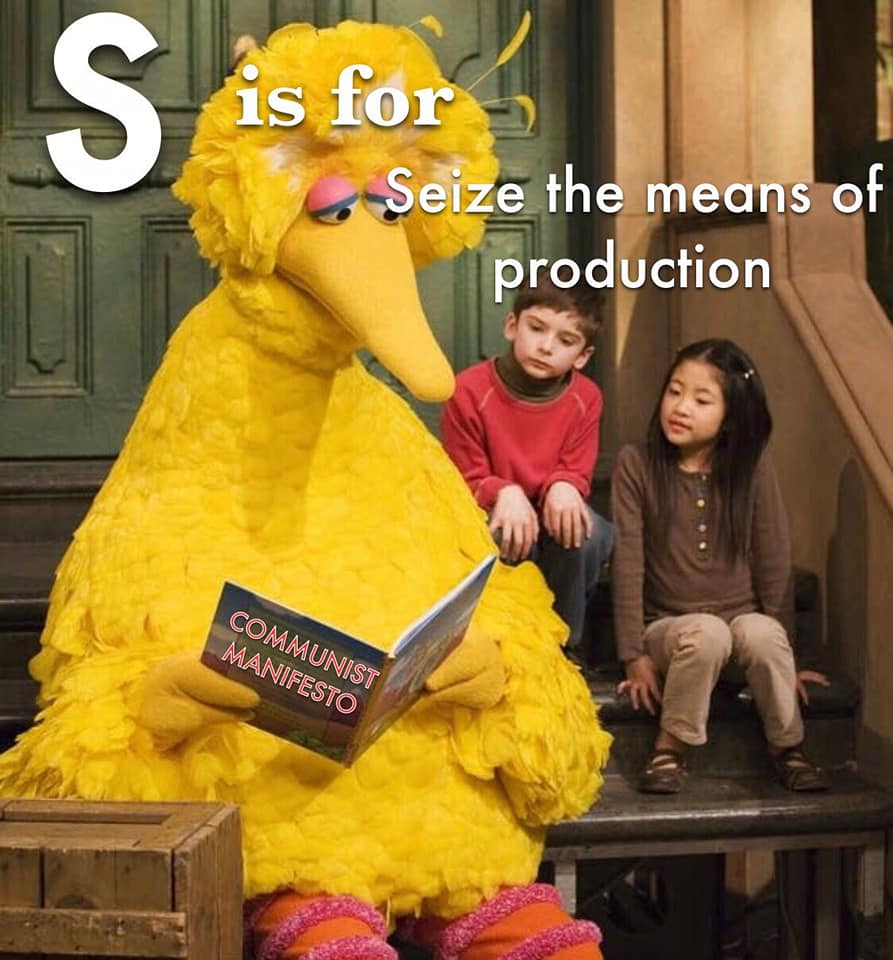
The meme is a play on the phrase "I can read you like a book" and is used to describe someone who is extremely knowledgeable about a particular topic, in this case, Marxism. The image is of Big Bird from Sesame Street holding a book with the title "Das Kapital" and the text "I can read you like a book" is replaced with "I can read Marx like a book".
detailed-analysis (gemma3-27b-vision)
Okay, let's break down this image through several theoretical lenses, as requested. It's a fascinatingly layered image, making for rich analysis.
Visual Description
The image depicts Big Bird, the iconic Sesame Street character, seated on a stairwell landing within what appears to be the interior of a brownstone or similar building. He is positioned prominently in the foreground, reading a book with a clear title: “Communist Manifesto.” Two young children, a boy in a burnt orange sweater and a girl in a brown jacket, are seated on the stairs behind him, observing him. Above Big Bird’s head is a large letter ‘S’ and the text “Seize the means of production.” The backdrop is a warm, slightly faded interior, adding a sense of domesticity. The framing and lighting make Big Bird the clear focal point, while the children appear as slightly passive observers. The scene’s setting and characters are instantly recognizable, immediately invoking childhood nostalgia and a sense of education/learning.
Marxist Conflict Theory
This image is explicitly geared toward Marxist thought. The most obvious element is Big Bird reading the Communist Manifesto and the accompanying text “Seize the means of production.” This directly references central tenets of Marxist theory, particularly the idea that the proletariat (the working class) should overthrow the bourgeoisie (the owning class) and take control of the resources used to create wealth – the “means of production.”
- Symbolism: Big Bird, a character historically associated with childhood innocence, education, and inclusivity, is now positioned as a reader of Marxist theory. This creates a deliberate juxtaposition. The idea is to present complex socio-political ideas in a way that is accessible to children.
- Socialization & Ideology: The children, as viewers, are presented with the concept of class struggle and revolutionary ideology. This is a visual assertion that even at a young age, individuals are subjected to ideological forces.
- Class Conflict: The image hints at a subversion of the traditional educational landscape. Instead of being taught dominant capitalist narratives, the children are being introduced to critiques of that system.
- Critique of Childhood: It can also be seen as a critique of how childhood is often constructed as apolitical, obscuring the realities of class and power.
Foucauldian Genealogical Discourse Analysis
Using a Foucaultian lens, we can examine the discourse surrounding this image, and how it constructs meaning.
- Power/Knowledge: Foucault argues that power and knowledge are inextricably linked. This image attempts to disseminate knowledge – specifically, Marxist thought – within a particular framework. The act of associating a beloved children’s character with revolutionary theory is a power move, aiming to shift perceptions and potentially influence beliefs.
- Genealogy of "Seize the means of production”: The phrase itself has a specific historical lineage and meaning rooted in the 19th-century labor movement. The image attempts to re-contextualize this phrase by placing it within the seemingly innocent realm of Sesame Street.
- Discursive Formation: The image participates in a discursive formation surrounding political ideology and education. It challenges the assumption that certain concepts are too complex for children and suggests that political consciousness can be cultivated from a young age.
- Normalizing Revolutionary Thought: By placing revolutionary thought (represented by the "Communist Manifesto") within the context of a familiar childhood setting, the image could be seen as attempting to normalize or de-stigmatize radical ideologies.
Critical Theory
From a Critical Theory perspective (drawing on thinkers like Adorno and Horkheimer), we can examine the image as a cultural product that reinforces or challenges existing power structures.
- Culture Industry: The image can be seen as a satirical commentary on the “culture industry.” It takes a well-established symbol of childhood (Big Bird) and uses it to convey a message that is critical of the dominant capitalist system.
- Ideology Critique: The image performs an ideology critique by suggesting that the seemingly neutral realm of childhood education is, in fact, a site of ideological struggle.
- Commodification of Radicalism: A cynical reading might suggest that the image commodifies radical thought. By packaging Marxism within a playful and familiar framework, it potentially dilutes its revolutionary potential.
Postmodernism
A postmodern interpretation would focus on the image’s playful subversion of meaning and its rejection of grand narratives.
- Intertextuality: The image relies heavily on intertextuality – the relationship between the image and the cultural history of Sesame Street and Marxist thought. The juxtaposition creates a new meaning that is more complex than the sum of its parts.
- Irony & Parody: There’s a clear element of irony and parody. The image intentionally clashes two disparate worlds – childhood innocence and revolutionary politics. This creates a sense of playfulness and challenges conventional expectations.
- Deconstruction: The image can be seen as a deconstruction of traditional educational norms. It challenges the assumption that certain concepts are too complex for children and suggests that political consciousness can be cultivated from a young age.
Note: Some of these interpretations may overlap or be seen as contradictory. The richness of this image is that it invites multiple readings and allows for a variety of theoretical approaches. It's a potent visual statement that successfully combines nostalgia, political commentary, and theoretical complexity.
I hope this thorough analysis is helpful! Let me know if you would like me to elaborate on any specific aspect or theoretical lens.
simple-description (llama3.2-vision)
The meme features Big Bird from Sesame Street, but instead of reading a book, he's holding a book with the title "Communist Manifesto" and a sarcastic expression. The text above him reads "S is for Seize the means of production" and "Seize the means of production" is written above him in a smaller font. The meme is a play on the classic Sesame Street alphabet song, but with a communist twist.
tesseract-ocr
2 , a i y rf 1 ° ” | | S 1s toy e - \ L bd = i eS ER ence . production Y 3) Re : AE % i = | see , Sera es a ED