First Seen
2023-05-10T21:03:36+00:00
simple-description (llama3.2-vision_11b)
The meme is a play on the concept of "Marx's labour theory of value" and the idea of automation in a Marxist context. The image likely features a robotic figure with the phrase "Commodify the means of production!" or a similar Marxist slogan.
detailed-analysis (gemma3-27b-vision)
Okay, here’s an analysis of the image, broken down into sections as requested. It's a complex image, so multiple perspectives are relevant.
Visual Description
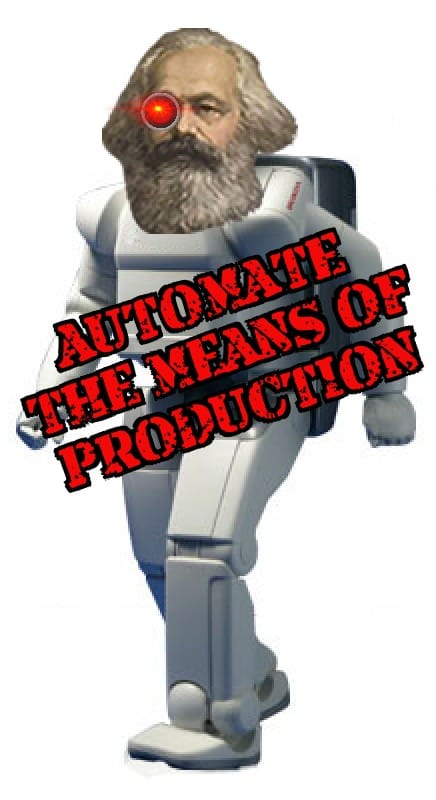
The image depicts a robotic or cyborg figure with the head of Karl Marx superimposed onto a white, metallic body. The body appears to be a simple, stylized robot design. Marx’s head is rendered realistically, with a long beard and serious expression. His eye has been digitally replaced with a glowing red robotic eye. Bold red text reading "AUTOMATE THE MEANS OF PRODUCTION" is dramatically overlaid across the figure. The background is plain white, isolating the figure and emphasizing the message. The overall effect is jarring and aims to combine a historical figure with futuristic technological imagery.
Marxist Conflict Theory
This image is deeply rooted in Marxist thought. The slogan "Automate the Means of Production" is a direct, updated riff on Marx’s famous call to revolutionize the forces of production. In Das Kapital and The Communist Manifesto, Marx argued that history is defined by class struggle, driven by the tension between those who own the means of production (the bourgeoisie) and those who labor (the proletariat).
This image suggests a futuristic extension of that struggle. The robotic body can be interpreted in several ways:
- Technological Liberation: Automation, in a Marxist framing, could liberate workers from repetitive, alienating labor, potentially creating a society of abundance where needs are met without exploitative toil.
- Exacerbation of Class Conflict: Alternatively, it could represent the further displacement of human labor by machines, concentrating wealth and power in the hands of those who own the robots, leading to increased unemployment and a more extreme form of class disparity.
- The robot body of Marx itself is the metaphorical means of production - a re-imagining of the intellectual production of ideas.
- The image attempts to fuse the past and future. The roboticized body hints at a future where Marxist ideals could be carried out, or a future dystopia where labor is fully replaced by machines.
The image is not a simple endorsement of automation. It's a provocation, raising questions about how technology will shape the future of labor, class, and social power.
Foucauldian Genealogical Discourse Analysis
Using a Foucauldian lens, the image can be examined as a construction of power/knowledge. The image doesn’t present a neutral depiction of automation. It actively constructs a specific discourse about it through the association with Marx and the forceful slogan.
- Discipline and Control: The robotic body, while potentially liberating, can also represent a new form of discipline and control. Robots are programmed; they function according to pre-set rules. This can be seen as a metaphor for the increasing control exerted by technology over our lives.
- Genealogy of Automation: A genealogical approach would examine the historical development of automation and the changing discourses around it. How has the idea of automation been linked to progress, efficiency, and control? How has it been used to justify social inequalities? The image can be seen as a point in that ongoing historical and discursive process.
- The Red Eye: The robotic red eye can be seen as a symbol of surveillance, a panoptic gaze that monitors and controls the means of production.
Critical Theory
From a broader Critical Theory perspective (drawing from the Frankfurt School and beyond), the image critiques the ideological foundations of technological progress. It challenges the assumption that technology is inherently neutral or benevolent.
- Technological Rationality: Critical theorists like Herbert Marcuse argued that technological rationality can become a form of social control, suppressing critical thinking and reinforcing existing power structures. The image suggests that automation, if not carefully managed, could be another tool for domination.
- Commodification of Ideas: The image itself is a commodified representation of a political ideology. It can be easily circulated and consumed as a meme or a piece of digital art, potentially obscuring the complex theoretical underpinnings of Marxist thought.
- The Image's Function: Critical Theory would ask, what is the function of this image? Is it to raise awareness, to inspire action, or simply to generate clicks and engagement? What is the underlying power dynamic that produced this image and is driving its circulation?
Postmodernism
Postmodernist analysis could focus on the image's playful blending of historical and futuristic elements.
- Pastiche and Irony: The image is a form of pastiche, combining elements from different historical periods and cultural contexts. This can be seen as a characteristic of postmodern art, which often rejects grand narratives and embraces fragmentation and irony.
- Deconstruction of Ideology: The image can be interpreted as a deconstruction of Marxist ideology. By juxtaposing Marx with a robotic body, it challenges the traditional, "humanistic" understanding of Marxism and raises questions about the role of technology in shaping the future.
- Simulacra and Simulation: The image is itself a simulacrum—a copy of a copy—that bears little relation to reality. The robotic Marx is a hyperreal representation of a historical figure, divorced from his original context.
Queer Feminist Intersectional Analysis
While not immediately apparent, a Queer Feminist Intersectional lens can still be applied, but requires a bit more nuance.
- Alienation and Bodily Autonomy: Marxist thought often touches upon alienation, and this can be linked to queer feminist concerns about bodily autonomy and control. The robotic body can be seen as a symbol of the commodification and control of bodies, both human and machine.
- The Absence of Diverse Representation: The image presents a singular, (white, male) vision of the future. It doesn't address the ways in which automation might disproportionately impact marginalized communities, or how it could reinforce existing forms of oppression.
- Deconstructing the 'Worker': Queer and feminist critiques of work often challenge the traditional, idealized image of the "worker" as a productive, masculine subject. Automation raises questions about the very definition of work and the role of labor in shaping identity.
Hopefully, this multi-faceted analysis provides a comprehensive understanding of the image and its potential meanings. Let me know if you'd like me to delve deeper into any specific aspect!
simple-description (llama3.2-vision)
This meme is a humorous image of Karl Marx, the founder of Marxism, with a robotic body and a red laser eye. The text "Automate the Means of Production" is overlaid on the image, referencing a key concept in Marxist theory. The image is likely intended to be ironic or satirical, poking fun at the idea of Marx's theories being applied in a futuristic, high-tech context.
tesseract-ocr
‘Oe \ on a). Ohne OLAS SS aS Spy V_/ a