First Seen
2023-05-10T21:03:35+00:00
simple-description (llama3.2-vision_11b)
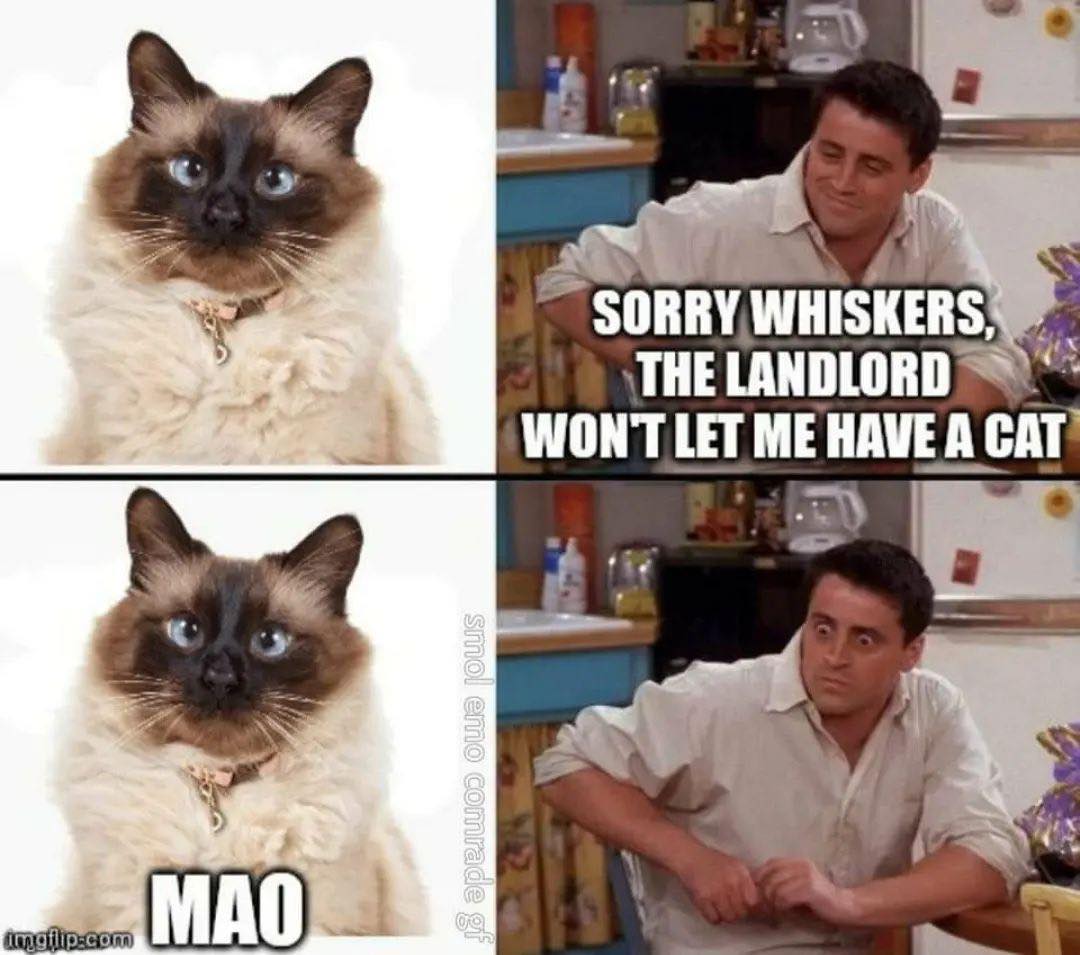
The meme is a humorous example of Marxist theory applied to everyday life, specifically the concept of "class struggle" in the context of pet ownership. The image features a cat sitting at a table with a human, with the cat speaking in a sarcastic tone, "I don't think I'm the one who's oppressed by my owner's lack of cat food, I think that's you."
detailed-analysis (gemma3-27b-vision)
Okay, let's break down this meme using the theoretical frameworks you've requested. It's a surprisingly rich image for analysis, given its initial simplicity.
Visual Description
The meme is a four-panel image, formatted in a classic "Drake meme" style.
- Top Left: A fluffy, blue-eyed ragdoll cat with a slightly grumpy expression.
- Top Right: A screenshot of actor Matthew Perry (as Chandler Bing from Friends) looking pleading and regretful. Text overlaid reads: "Sorry Whiskers, the landlord won't let me have a cat".
- Bottom Left: The same ragdoll cat, looking somewhat imposing.
- Bottom Right: The same screenshot of Matthew Perry, but now looking more sullen and defeated. The word "MAO" is overlaid.
- A small watermark is visible on the bottom left of the image, "imgflip.com"
The meme sets up a humorous juxtaposition: the cat seems to represent a revolutionary figure (indicated by the "MAO" caption), while the character in the screenshot conveys a sense of powerlessness against external constraints.
Marxist Conflict Theory
This is perhaps the most immediately evident theoretical lens through which to read the meme.
- Class Conflict: The "landlord" represents the owning class, exercising power over the "tenant" (represented by Chandler/Matthew Perry). The landlord's restriction on pet ownership is a seemingly minor example of the larger power dynamic between those who own property and those who rent it.
- Alienation: Perry’s character is alienated from the ability to express a simple desire (owning a cat) due to the restrictions imposed by the owning class. This echoes the broader Marxist concept of alienation – the separation of workers from the products of their labor, from each other, and from their own potential.
- Symbolism of the Cat (MAO): The association of the cat with Mao Zedong (a key figure in the Chinese Communist Revolution) is crucial. This subtly equates the desire for pet ownership with a political struggle. It positions the cat (representing revolutionary potential) as being suppressed by the owning class. The meme suggests that even seemingly trivial desires can be framed as a form of resistance against oppressive systems.
- False Consciousness: Perry/Chandler's immediate acceptance of the landlord's rule represents a state of "false consciousness" (according to Marx). He doesn't question the legitimacy of the landlord's authority, but rather simply accepts it.
Foucauldian Genealogical Discourse Analysis
A Foucauldian reading focuses on the power dynamics enacted through discourse and the construction of knowledge.
- Power/Knowledge: The landlord’s restriction on pets isn’t just about animals. It’s an assertion of power and the creation of a "norm" – a set of rules defining acceptable behavior within the rented space. This is an example of how knowledge (the "rules" of tenancy) is used to exercise power.
- Discipline and Normalization: The landlord’s rule is a form of "discipline"—a way of controlling behavior and ensuring conformity. By restricting pet ownership, the landlord is enforcing a certain "normal" way of life for tenants.
- Genealogy: A genealogical approach would investigate how this rule (no pets) came to be. What historical, social, and economic factors led to its establishment? It would question the “naturalness” of this rule, revealing it as a historically contingent construct.
- Biopower: The restriction could be seen as a form of biopower, managing aspects of life (animal companionship) to exert control.
Postmodernism
A postmodern reading will emphasize the destabilization of meaning and the rejection of grand narratives.
- Irony & Parody: The meme uses irony by connecting a seemingly trivial issue (pet ownership) with a major historical figure (Mao). This undermines the seriousness of both the issue and the figure.
- Playfulness with Signs: The meme plays with the connection between signifiers (“cat”, “MAO”, “landlord”) and their signified meanings. It doesn’t offer a clear, definitive interpretation but rather presents a fractured, ambiguous image.
- Deconstruction of Authority: By juxtaposing the authority of the landlord with the revolutionary symbolism of Mao, the meme challenges the idea of absolute authority.
- Simulation & Hyperreality: The meme is a simulation of a situation, a digital construct that draws on cultural references. It contributes to a hyperreal environment where images and representations become more “real” than reality itself.
Critical Theory
This offers a broad framework for examining power structures and social inequalities.
- Dominant Ideology: The meme subtly criticizes the dominant ideology that prioritizes property rights over individual desires or basic companionship. The landlord's rule reinforces a system that values ownership above other values.
- Hegemony: The landlord’s unchallenged authority represents a form of “hegemony” – the dominance of one group (the owning class) over others through consent rather than coercion.
- Emancipation: By associating the cat with Mao, the meme hints at a desire for emancipation from oppressive systems.
Queer Feminist Intersectional Analysis
While not the most prominent lens, there are still some nuances to consider.
- Challenging Normative Spaces: The restriction on pets could be seen as regulating domestic space and limiting expressions of care and companionship, which can disproportionately affect marginalized groups. The home should be a space of comfort and safety, and restrictions limit that.
- Power Dynamics: The power imbalance between landlord and tenant highlights broader power dynamics that intersect with gender, race, and class. These intersections can exacerbate the impact of such restrictions on vulnerable groups.
- Care as Resistance: The desire for a pet (and the associated caretaking) can be a form of resistance against a dehumanizing system that prioritizes profit over well-being. However, the meme does not delve deeply into these nuanced issues.
I hope this breakdown is thorough and helpful! Let me know if you'd like me to elaborate on any of these points.
simple-description (llama3.2-vision)
This meme is a humorous exchange between a cat and its owner. The cat says "Sorry whiskers, the landlord won't let me have a cat" in response to the owner's request to get a cat. The cat's response is sarcastic and playful, using the Chinese Communist Party's abbreviation "MAO" to imply that the cat is a communist revolutionary.
tesseract-ocr
— 60lU® R a f hi ~ . * * ' [ s — a ~Sae =} ih al STA LIES (ats fa UC ie See WONT LET ME HAVE A CAT : im" : e > a om ab Ca” oe a. . Ay — #8 _~ Bh S al > , ' if j . & ) ~ . 5 / _—* i