First Seen
2024-01-11T20:24:07+00:00
simple-description (qwen3.5_2b-q8_0)
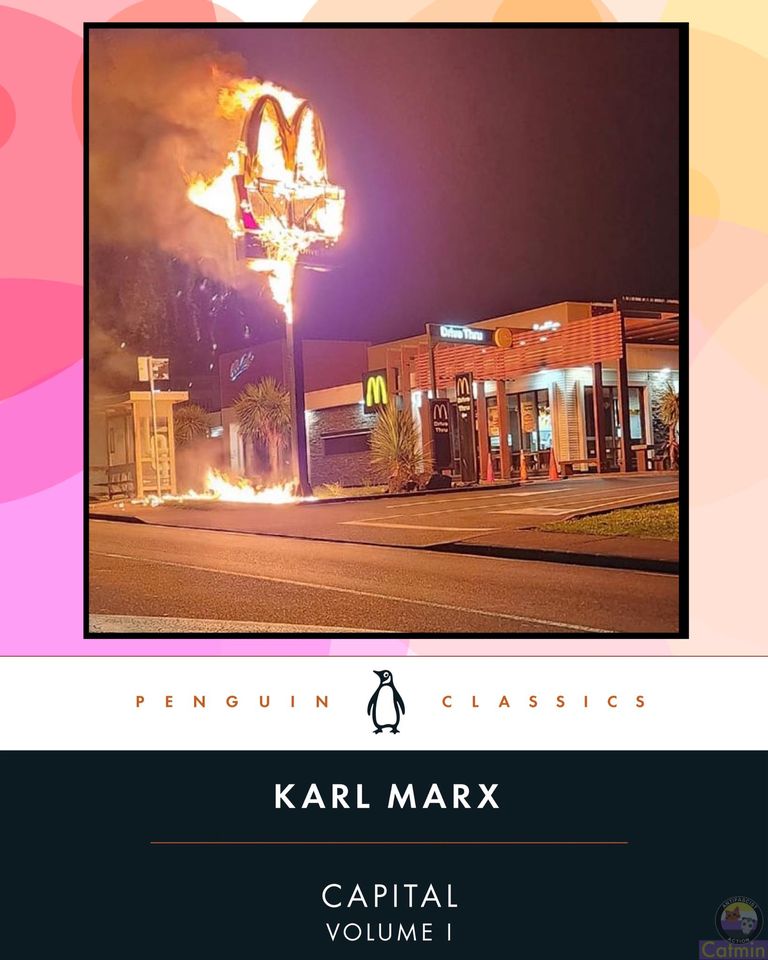
This meme combines a chaotic image of a McDonald's sign burning in the night with the title "Capital Volume I" from Karl Marx's book. In Marxist theory, "Capital" refers to the specific concept of money and capital, while "Volume I" represents the book's analysis of the inevitable crises within the capitalist system. The fire serves as a visual metaphor for the violent destruction of the old order, symbolizing the systemic contradictions that the text aims to explain.
simple-description (llama3.2-vision_11b)
The meme depicts a photo of a McDonald's restaurant engulfed in flames, with a caption referencing the Marxist critique of capitalism. The image implies that the capitalist system is inherently unstable and prone to collapse, much like the burning restaurant.
detailed-analysis (gemma3-27b-vision)
Okay, let's break down this image of a fast-food restaurant engulfed in flames within the context of the requested theoretical frameworks.
Visual Description
The image depicts a fast-food complex – recognizable by the McDonald's and Burger King signage – set ablaze. The fire appears to be concentrated around a large, decorative, vaguely Western-themed pole/tower structure in the center of the parking lot. Flames are visibly licking up the structure, and smoke billows upwards. The image is taken at night, with the fast-food buildings illuminated, creating a stark contrast between the bright, clean branding and the destructive fire. The parking lot is empty. The overall impression is one of chaos and destruction juxtaposed with the ubiquitous familiarity of American fast food. The angle suggests a direct confrontation or witness account.
Marxist Conflict Theory
This image is inherently fertile ground for Marxist analysis. It visually embodies the core tenets of conflict theory.
- Class Struggle: The fast-food industry is famously built on the exploitation of labor – low wages, precarious employment conditions, and limited opportunities for advancement. The fire could be interpreted as a symbolic representation of the simmering resentment and potential for revolt against the capitalist system that fuels these conditions.
- Commodity Fetishism: The bright, clean branding of McDonald's and Burger King stands in sharp contrast to the destruction. It highlights how capitalism encourages us to focus on the commodities themselves (the food) while obscuring the often-exploitative conditions of production and the people involved. The fire potentially exposes the inherent instability of the entire system built on these commodified products.
- Alienation: Workers within these systems are alienated from the fruits of their labor and from each other. The fire, while destructive, could be seen as an attempt to reclaim something, to disrupt the status quo of commodification and control.
- Revolution: While not definitively revolutionary, the image evokes the possibility of societal upheaval, mirroring the historical connection between social unrest and economic disparities. The fire is a visually potent symbol of resistance.
Foucauldian Genealogical Discourse Analysis
From a Foucauldian perspective, this image provides a starting point for analyzing the discourse surrounding fast food, consumerism, and power.
- Power/Knowledge: The fast-food complex represents a carefully constructed system of power/knowledge. The branding, the menu, the store layout, and the marketing all work together to produce a certain way of understanding food, convenience, and value. The fire disrupts this established order, challenging the very narratives that uphold the system.
- Disciplinary Power: Fast-food restaurants operate as spaces of normalization. They dictate consumption patterns, enforce rules of order, and create a standardized experience. The fire disrupts this panoptic control, momentarily shattering the illusion of order.
- Genealogy of Control: Analyzing the history of the fast-food industry would reveal how it emerged as a means of controlling labor, resources, and consumption. The fire could be seen as a response to the accumulated effects of this history.
- Disruption of Discourses: The act of setting fire to the establishment is a performative act that challenges the dominant discourse surrounding the industry. It sends a clear message that the status quo is not acceptable.
Critical Theory
The image resonates with many tenets of Critical Theory, particularly those concerned with cultural domination and the critique of instrumental reason.
- Culture Industry: The fast-food complex embodies the "culture industry" – a system that produces standardized cultural products for mass consumption. The fire can be seen as a resistance against this homogenization of culture, a rejection of the pre-packaged experiences offered by the industry.
- Instrumental Reason: The pursuit of efficiency and profit in the fast-food industry has led to the dehumanization of both workers and consumers. The fire can be seen as a rejection of this purely instrumental approach to food and value.
- Emancipation: Critical Theory aims to expose systems of domination and to create conditions for human emancipation. The image, depending on the context, could be interpreted as a symbolic act of rebellion against a system that limits human potential.
Postmodernism
A postmodern reading might focus on the image as a deconstruction of meaning and the blurring of boundaries.
- Simulacra and Simulation: The fast-food complex, with its carefully constructed branding and artificial atmosphere, can be seen as a prime example of Baudrillard's concept of simulacra – copies without originals. The fire, in a way, exposes the artificiality of this system, revealing the underlying emptiness.
- Fragmentation and Disruption: The image is inherently disruptive, challenging the viewer's expectations and conventional notions of order. This fragmentation can be seen as a characteristic of postmodern aesthetics.
- Irony and Parody: There's a level of irony in the image – the destruction of a symbol of consumer culture. This irony can be seen as a hallmark of postmodern art and thought.
Queer Feminist Intersectional Analysis:
While not directly depicted, a Queer Feminist Intersectional analysis could explore the ways in which the fast-food industry disproportionately impacts marginalized communities.
- Labor Exploitation: Many fast-food workers are women, particularly women of color, and LGBTQ+ individuals, who are often subjected to lower wages, precarious employment, and harassment. The fire could be interpreted as a symbolic act of solidarity with these workers and a protest against systemic oppression.
- Food Deserts: Fast-food restaurants are often concentrated in low-income communities and communities of color, contributing to food deserts and health disparities.
- Body Image & Gender: The industry's marketing often reinforces harmful stereotypes about body image and gender. The destruction of the restaurant could be seen as a rejection of these norms.
- Intersectionality: Examining the intersection of class, race, gender, and sexual orientation within the fast-food industry would reveal the complex ways in which power operates to marginalize certain groups.
Important Note: The interpretation of this image is subjective and depends on the viewer's own background, experiences, and theoretical perspectives. There is no single "correct" reading.
Let me know if you’d like me to focus on one of these areas in more detail or explore other theoretical frameworks!
tesseract-ocr
oy, % i bp Biz | ee mh Ton Le me le Be Sa a ema — ice KARL MARX CAPITAL VOLUME |
simple-description (llama3.2-vision)
This meme is an image of a McDonald's restaurant on fire, with flames engulfing the iconic golden arches. The image is captioned "Capital of the World" in a sarcastic reference to the restaurant's reputation as a global brand. The image is likely a humorous commentary on the idea that even a beloved brand like McDonald's can be vulnerable to chaos and destruction.