First Seen
2023-05-10T20:59:59+00:00
simple-description (llama3.2-vision_11b)
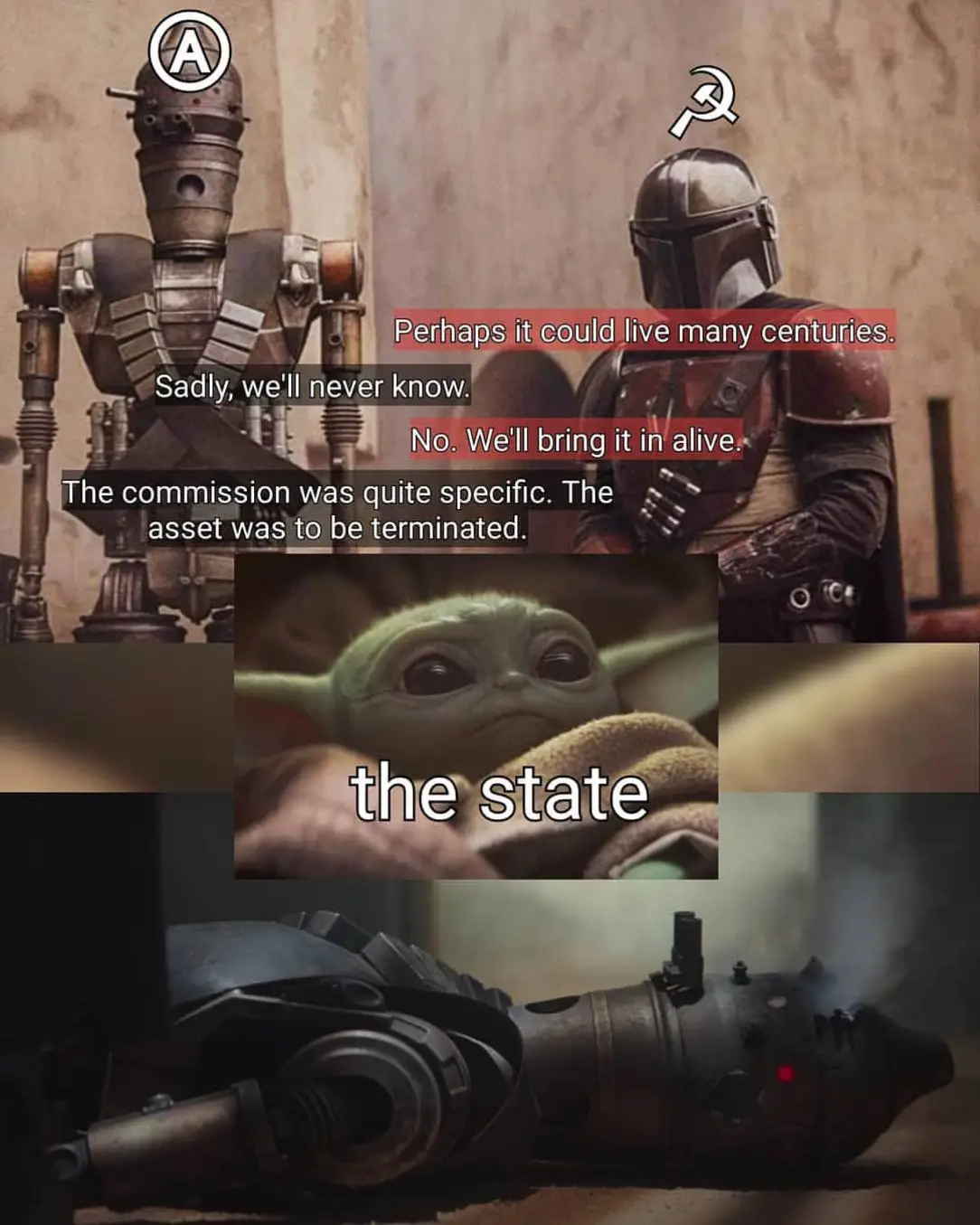
The meme is a screenshot from the TV show "The Mandalorian" where the character of "The Child" (also known as Baby Yoda) is being interrogated by a character from the Empire. The text overlay reads: "The Empire has been trying to get the Child's location for years. The Empire knows that the Child is a key to the Empire's power and that the Child is the key to the Empire’s survival." The meme is a commentary on the Empire's desire to control the Child and use it for their own gain.
detailed-analysis (gemma3-27b-vision)
Okay, let's break down this image, utilizing the theoretical frameworks you've requested. It's a complex meme/image, so we'll go into some depth.
Please Note: The interpretations below are based on the imagery, text, and potential meanings within the context of the theories. There's inherent subjectivity in applying these frameworks.
1. Visual Description
The image is a multi-panel collage constructed from scenes of the Star Wars series The Mandalorian. It features:
- Top Left: A C-3PO-like droid, seemingly in disrepair.
- Top Right: A stormtrooper with a hammer-and-sickle symbol (associated with Soviet communism) visible on their shoulder.
- Center: A fragmented image of "Baby Yoda" (Grogu), the vulnerable child character. Text overlaid reads "Sadly, we’ll never know" and "No. We’ll bring it alive."
- Bottom: A close-up of a stormtrooper, a gun slung over the shoulder, in focus.
- Center Overlay: The word "the state" is superimposed in large font.
The overall aesthetic is dark and gritty, with a digital, meme-like quality. The combination of Star Wars imagery with communist iconography creates a jarring, intentionally provocative juxtaposition.
2. Foucauldian Genealogical Discourse Analysis
This image immediately lends itself to a Foucauldian reading.
- Power/Knowledge: The "state" as labeled, embodies power structures. The image presents a discourse on control, preservation, and potential eradication (implied by the phrase "terminated"). The state's interest in "the asset" (Baby Yoda) is not inherent to the object itself, but is constituted by the power dynamics involved. The discourse is about how power defines and utilizes resources, and claims agency over life and death.
- Genealogy: The combination of Star Wars (a fictional future empire) with Soviet iconography is an interesting genealogy. It brings together two distinct historical/fictional regimes that both demonstrate strong centralized control and an emphasis on securing resources. It's not about direct equivalence, but about exploring how the concepts of state control have manifested in different ways across time and space.
- Discipline and Biopower: The “commission” to terminate Baby Yoda is an act of biopower—control over life itself. Even the attempt to "bring it alive" is a form of control—to mold it, to utilize it, to ensure its survival under the state's terms. The image highlights how seemingly neutral acts can be deeply intertwined with power dynamics.
3. Marxist Conflict Theory
From a Marxist perspective, this image can be read as a commentary on the exploitation and control of resources, even (or perhaps especially) in fantastical settings.
- Class Struggle: The contrast between the vulnerability of Baby Yoda and the heavily armed stormtroopers suggests a fundamental power imbalance. Baby Yoda is the "asset" – a resource to be controlled, while the troopers represent the forces of the state that wield the power.
- Means of Production: Baby Yoda, within the Star Wars universe, possesses unique abilities. These abilities can be seen as the “means of production.” The state seeks to control those means of production for its own purposes (implied, but not stated).
- Alienation: The dehumanizing treatment of Baby Yoda (seeing it simply as an "asset") exemplifies alienation – the separation of individuals from the products of their labor (in this case, their potential) and from their own humanity.
- Ideology: The image challenges the ideological justifications for state power. The seemingly neutral claim of "bringing it alive" masks the underlying motivations of control and exploitation.
4. Postmodernism
This image screams postmodernism.
- Pastiche & Intertextuality: The blending of Star Wars and Soviet symbolism is a prime example of pastiche – the imitation of multiple styles. It’s a deliberate interweaving of different cultural and narrative threads.
- Deconstruction: The image deconstructs the idea of a coherent “state.” It doesn’t offer a simple definition, but rather presents a fragmented, ambiguous representation. It questions the authority and legitimacy of the state.
- Simulacra & Simulation: Baby Yoda itself can be seen as a simulacrum – a copy without an original. The focus on it as an "asset" shifts the meaning from its inherent value to its status as a representation. The state's actions are not about the thing itself, but about the image and control of the thing.
- Meta-Narrative Critique: The image can be seen as a commentary on grand narratives of power and control. It questions the idea that any single ideology or regime (whether capitalist, communist, or imperial) can claim universal legitimacy.
5. Critical Theory
This image lends itself to the Frankfurt School's Critical Theory.
- Instrumental Reason: The focus on Baby Yoda as an "asset" showcases instrumental reason—reason used solely as a means to an end, devoid of ethical considerations. The state’s interest is purely pragmatic – maximizing utility and control.
- Culture Industry: The image itself, as a meme, is a product of the culture industry. It's a commodified form of expression that can be used to reinforce or challenge dominant ideologies.
- Domination: The image exemplifies the pervasive nature of domination. Even within a fictional universe, power structures exist and exert control over individuals and resources. The seemingly benevolent act of "bringing it alive" is ultimately another form of control.
Queer Feminist Intersectional Analysis
While not as immediately apparent as the other frameworks, a Queer Feminist Intersectional lens can also be applied.
- Vulnerability & Control: Baby Yoda, as a vulnerable being, can be read as representing marginalized groups. The state's attempt to control it mirrors how power structures often attempt to control the bodies and lives of those deemed "other."
- Reproduction & Life Creation: Baby Yoda is a child, representing the potential for future generations. The state's interest in controlling the “asset” can be interpreted as a metaphor for control over reproduction and the creation of new life.
- Challenging Normative Power: The image, through its juxtaposition of Star Wars and communist imagery, subtly challenges the conventional narratives of power. It suggests that even seemingly benevolent forces can be oppressive.
Let me know if you'd like me to expand on any of these points or apply other theoretical frameworks.
simple-description (llama3.2-vision)
This meme is a humorous comparison between a conversation between a Soviet-era robot and a Soviet-era soldier, and a conversation between a Soviet-era robot and a Soviet-era soldier's child. The text "the state" appears in the image, which is likely a reference to the Soviet state's ability to control and manipulate its citizens. The meme pokes fun at the idea that even the state's most powerful and intimidating figures can be controlled and even killed by a child.
tesseract-ocr
Fi ~ iN = ian \ 7) a= ef a= rae Ey Tt = Ss : Peers col many centufies. 1 os = pe . 5 . Sadly, we'll never know. fe a % S i Tig qa Foy iVeaNoceiNe Meee oea f- — ) The commission was quite specific. The Fo p ; ' _ asset wasjto be terminated. oid CT eo) i ee eo, NT ead -— a a J ” re Bd - a a